

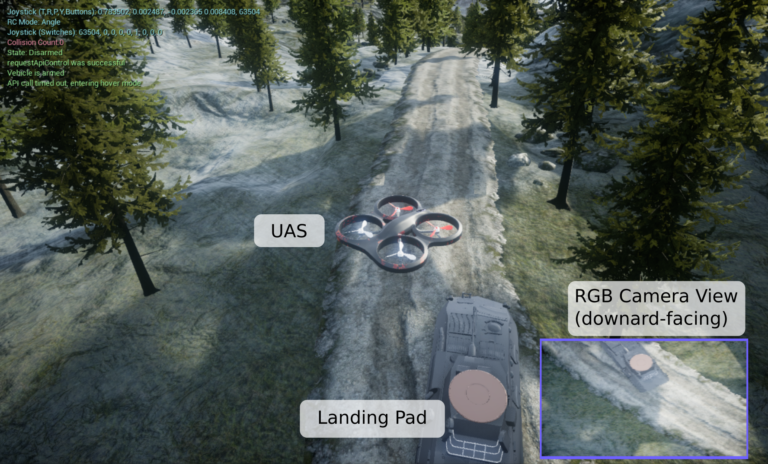
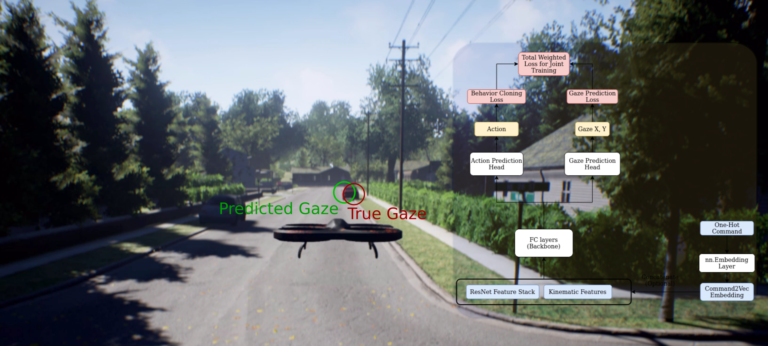

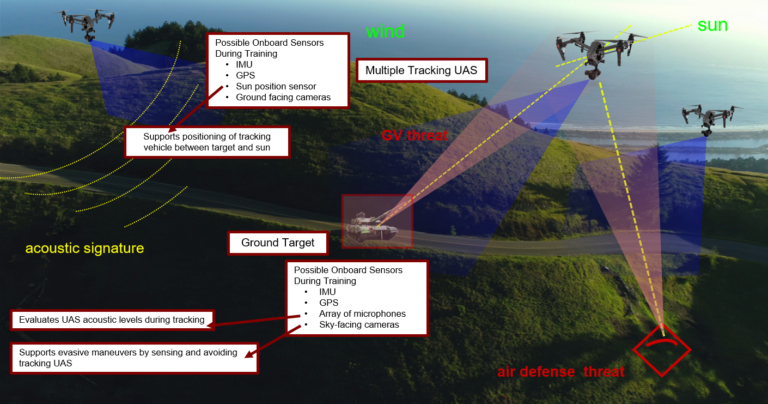
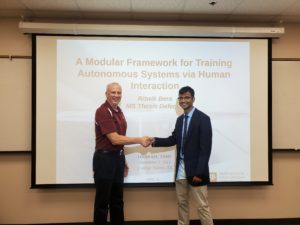
 VSCL student Ritwik Bera, who will graduate with his Master of Science degree in May 2022, has defended his thesis “A Modular Framework for Training Autonomous Systems via Human Interaction”. Bera joined VSCL in 2019 after having spent a summer working with the lab in 2017. Bera previously participated in summer a internships at Zoox in Summer 2021. After graduation, Bera will work with Zoox in Foster CIty, CA as a Software Engineer in the Planning and Control department working on trajectory generation algorithms.
VSCL Graduate Students Present Papers at the 2022 AIAA SciTech Forum
VSCL graduate students Garrett Jares, Chris Leshikar, and Hannah Lehman will present papers in January at the 2022 AIAA SciTech Forum in San Diego, California.
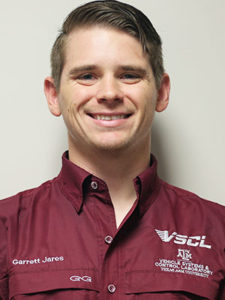 Garrett Jares ’17 will be presenting the paper “Flight Demonstration and Validation of Control Acquisition Autopilot Attack”. The paper investigated a method of cyber attack by which an attacker might take over control of a vehicle. This paper built upon prior work by demonstrating and validating the attack on a DJI F450 quadrotor running the ArduCopter autopilot. The experiments focused on two scenarios. One in which the victim performed regulation while the attacker performed non-zero setpoint control and another in which the victim performed non-zero setpoint control while the attacker performed regulation of the system. The experimental results show how the attack poses a threat to real-world UAS and evaluates its performance under different control scenarios.
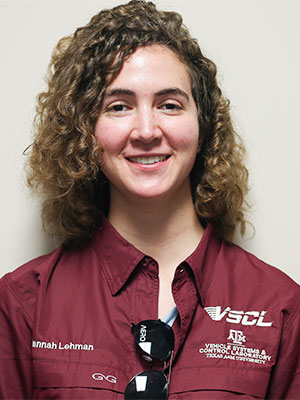
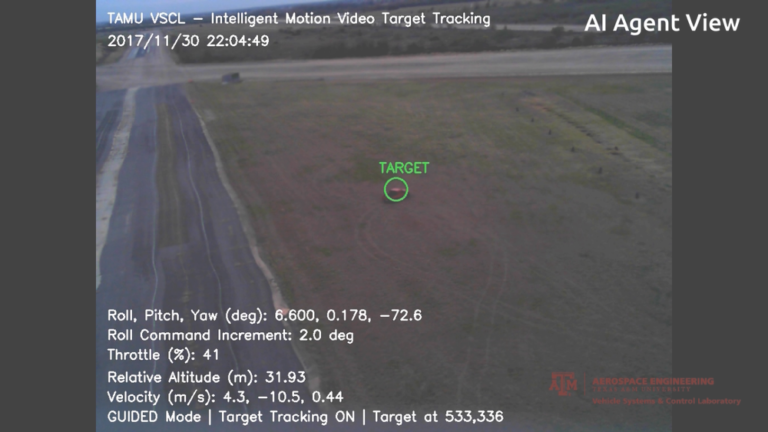
Hannah Lehman ’20 will be presenting the paper “Addressing Undesirable Emergent Behavior in Deep Reinforcement Learning UAS Ground Target Tracking”, which seeks to investigate and further understand the impact of emergent behavior in reinforcement learning controlled UAS. The paper builds on previous work by further investigating a fixed wing tracking a ground target through reinforcement learning and extends the learning environment and possible agent behavior. The emergent behavior is discovered, categorized, and mitigated through a number of algorithmic, reward, and environment modifications. These approaches are evaluated in simulation based on their ability to improve tracking and extend total tracking time.
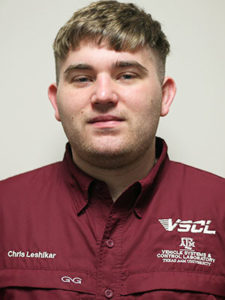 Chris Leshikar ’20 will be presenting the paper “System Identification Flight Testing of Inverted V-Tail small Unmanned Air System”, which addresses challenges in conducting flight testing an inverted V-Tail fixed-winged vehicle and the results obtained from the flight tests. The goal of the flight tests was to obtain longitudinal, lateral/directional and combined longitudinal lateral/directional linear state-space model for the RMRC Anaconda using the Observer\Kalman Identification (OKID) algorithm. Both manual and automated excitation signals were injected into the Anaconda. Parametric sweeps of the excitation signals were performed using the Developmental Flight Test Instrumentation Two (DFTI2) system. The identified longitudinal linear state-space model modelled the longitudinal dynamics well and the identified lateral/directional reasonably well while the identified combined longitudinal lateral/directional model showed decent correlation with the decoupled models.
VSCL Student Cassie-Kay McQuinn Graduates with Bachelor of Science
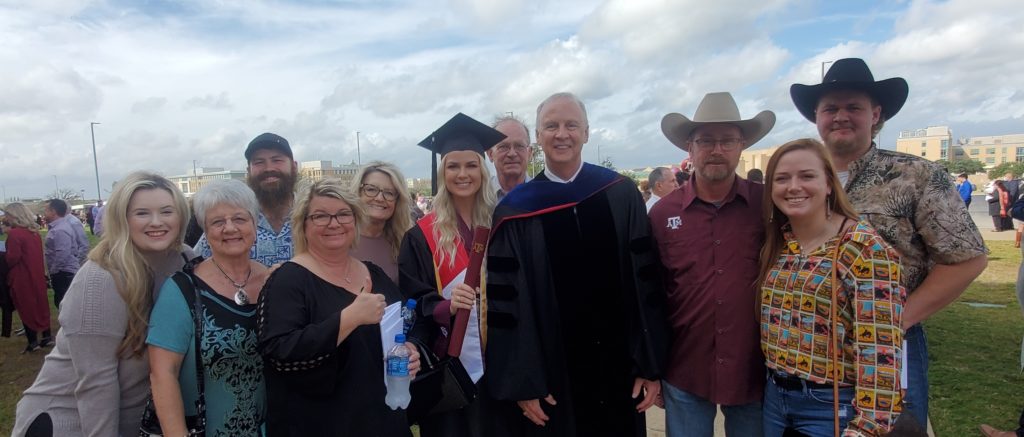
VSCL Undergraduate Cassie-Kay McQuinn graduated on December 17, 2021 with her Bachelor of Science degree in Aerospace Engineering with Summa Cum Laude and Engineering Honors. Cassie-Kay will be joining VSCL as a M.S. student starting in Spring 2022. She has been an active member of VSCL since Fall 2021, working in system identification. In addition to completing Engineering Honors, she is a Presidential Endowed Scholar, the 2021 Aerospace Engineering Advisory Board Scholarship recipient, and has earned a certificate of Holistic Leadership in Engineering through completion of the Zachry Leadership Program. She is the current Vice President of the Texas A&M chapter of the Sigma Gamma Tau Aerospace Engineering Honor Society. As an undergraduate she interned with L3Harris Technologies working in the Structural Analysis and Structural Design departments. Cassie-Kay’s main interests include flight test engineering, aircraft dynamics and system identification.
VSCL welcomes incoming PhD student Maison Clouatre for Fall 2022
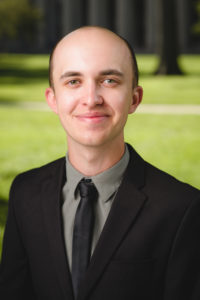 Maison Clouatre is an incoming Ph.D. student in the aerospace engineering department. He will graduate in May 2022 with a double major in electrical engineering and mathematics from Mercer University. As an undergraduate, Clouatre held visiting research positions in the Electronic Systems (ELSYS) Laboratory at the Georgia Tech Research Institute (GTRI), the Vehicle Systems & Control Laboratory (VSCL) at Texas A&M University, and the Laboratory for Information & Decision Systems (LIDS) at the Massachusetts Institute of Technology (MIT). His research interests lay at the intersection of control theory, optimization, and learning, and he focuses on applying his theory to the fields of quantum information science and aerospace engineering. Clouatre is both a Goldwater Scholar and Stamps Scholar. At VSCL, Clouatre will research quantum control and learning for quantum dynamics.
VSCL Undergraduates Awarded Scholarships at Fall Aerospace Engineering Award Ceremony
VSCL undergraduates Alex Gross ’23, Cassie-Kay McQuinn ’21, and Leah Davis ’22 were awarded Aerospace Engineering Scholarships at the Fall Aerospace Engineering Award ceremony this semester.
VSCL undergraduate students Alex Gross ’23 and Leah Davis ’22 were awarded the Benjamin R and Deanna J Smith Scholarship. The scholarship is awarded to 5 outstanding undergraduate students selected by the donors for their academic merit. Alex is a Junior in Aerospace Engineering with minors in Computer Science and Mathematics. He is expected to graduate in May 2023 and has been a member of VSCL since Spring 2020. Leah Davis will graduate in May 2022.
VSCL undergraduate Cassie-Kay McQuinn ’21 was awarded the Aerospace Engineering Advisory Board Scholarship. The scholarship is awarded to an outstanding student in the Department of Aerospace Engineering at Texas A&M. Selection criteria includes: leadership/professional involvement, academic success and service to the department. Cassie is a Senior and will graduate in December from Texas A&M University with a B.S. in Aerospace Engineering with Engineering Honors. She has been a member of VSCL since Spring 2021 and will be continuing her work with VSCL as a Master of Science student in Spring 2022.
VSCL Welcomes New MS Student Cassie-Kay McQuinn for Spring 2022
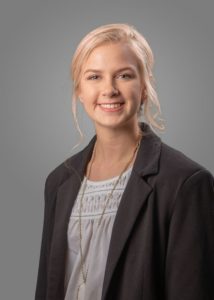 Cassie-Kay McQuinn ’21 is an M.S. student in the aerospace engineering department. Cassie-Kay has been an active member of VSCL since Fall 2021, working in system identification. She will graduate in December from Texas A&M University with a B.S. in Aerospace Engineering with Engineering Honors. In addition to completing Engineering Honors, she is a Presidential Endowed Scholar, the 2021 Aerospace Engineering Advisory Board Scholarship recipient, and has earned a certificate of Holistic Leadership in Engineering through completion of the Zachry Leadership Program. She is the current Vice President of the Texas A&M chapter of the Sigma Gamma Tau Aerospace Engineering Honor Society. As an undergraduate she interned with L3Harris Technologies working in the Structural Analysis and Structural Design departments. Cassie-Kay’s main interests include flight test engineering, aircraft dynamics and system identification.
Two VSCL Current and Former VSCL Members Co-Inventors on Newly Awarded Patent
VSCL alumni Felix Turcios and current VSCL Ph.D. student Hannah Lehman are co-inventors on newly awarded US Patent 11,094,211, “Judgmental oversteering taxi aid system and method ”. The system creates a UI and integration system to guide the pilot for an autonomous taxi assistance program. The program is designed to help pilots taxi around airports, especially in situations where oversteer is required and may be difficult for the pilot to properly judge.
-
- Felix Turcios
-

- Hannah Lehman
Felix Turcios currently works at Collins Aerospace in Cedar Rapids Iowa as a Sr. Systems Engineer. Hannah Lehman is a former Collins Aerospace summer intern with Felix’s team in the Advanced Concepts Group.
Click here to view the patent.
VSCL Undergrad Alex Gross receives AIAA Cary Spitzer Digital Avionics Scholarship
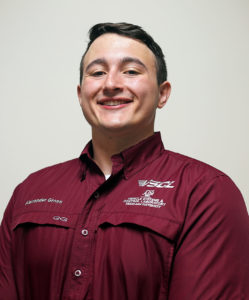 Alex Gross, a Junior Aerospace engineering student, has been awarded the prestigious AIAA Cary Spitzer Digital Avionics Scholarship. Gross has been a member of VSCL since 2020 and has focused his research on UAS autonomous guidance and landing, embedded systems, and user-interface integration. Read more about this award in the Texas A&M Engineering announcement.
Valasek Gives NASA Jet Propulsion Laboratory AI Seminar on Cycle of Learning Research
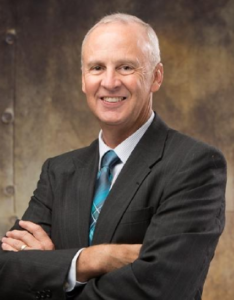
Dr. John Valasek
Dr. John Valasek, Professor in the Department of Aerospace Engineering at Texas A&M University and Director of the Vehicle Systems & Control Laboratory, gave a virtual seminar titled “Combining Human Demonstrations and Interventions for Safe Training of Autonomous Systems in Real-Time” for the AI Seminar Series hosted by the NASA Jet Propulsion Laboratory (JPL). The date of the seminar was 18 August 2021.
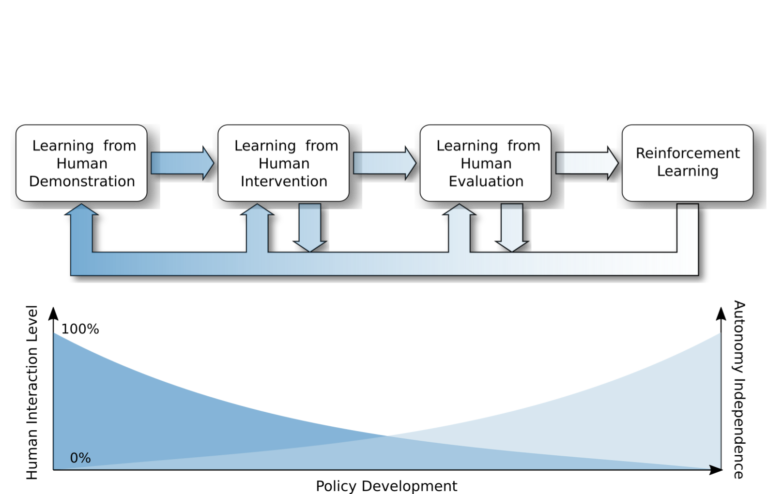
Cycle-of-Learning (CoL) (https://www.youtube.com/watch?v=AQwsk6kZfok) was presented as a framework using an actor-critic architecture with a loss function that combines behavior cloning and 1-step Q-learning losses with an off-policy pre-training step from human demonstrations. This enables transition from behavior cloning to reinforcement learning without performance degradation and improves reinforcement learning in terms of overall performance and training time. This approach is shown to outperform state-of-the-art techniques for combining behavior cloning and reinforcement learning, for both dense and sparse reward scenarios. Results are presented for haptic and eye tracking input modalities, and suggest that directly including the behavior cloning loss on demonstration data helps to ensure stable learning and ground future policy updates.
VSCL Graduate Student Kameron Eves Awarded 2021-2022 CIRTL Teaching-as-Research (TAR) Fellow
Kameron Eves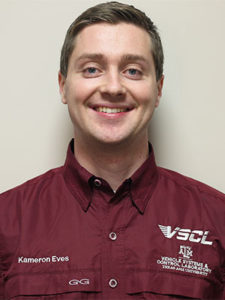 , a Ph.D. student in the Vehicle Systems & Control Laboratory (VSCL), has been selected as a 2021-2022 Center for the Integration of Research, Teaching, and Learning (CIRTL) Teaching-as-Research (TAR) Fellow. CIRTL TAR Fellows design and perform an experimental research project about education. Research such as this can help educators adjust their teaching to best help students succeed. Eves’ project proposal seeks to find ways to merge the concepts of active learning and learning styles. These teaching ideas are commonly used in many classrooms, but are seldom used in a complementary way. More specifically, Eves will examine the way question structure can affect participation for students who are usually passive observers in class. The CIRTL TAR Fellowship is competitive. It includes up to $1,000 of funding, and those who publish their work in an academic journal can be awarded a CIRTL Scholar Certificate.
Eves is a second year Aerospace Engineering Ph.D. student with the VSCL. His primary research topic is adaptive control for hypersonic systems. He graduated in 2019 from Brigham Young University in Mechanical Engineering and joined the VSCL immediately after. Eves’ career goals are to join academia and teach at a university. There, he will be able to put into practice many teaching principles such as those to be discovered in this CIRTL TAR project.