• Skip to primary navigation
  • Skip to main content
  • LinkedIn
  • Videos
  • Research
    • Facilities
    • Vehicles
    • Sponsors
  • Publications
    • Books
    • Journal Papers
    • Conference Papers
  • People
    • Faculty
    • Staff
    • Graduate Students
    • Undergraduate Students
    • Alumni
    • Where VSCL Alumni Work
    • Friends and Colleagues
  • Prospective Students
  • About Us
  • Contact Us
  • Where VSCL Alumni Work

Texas A&M University College of Engineering
  • image001 (2)
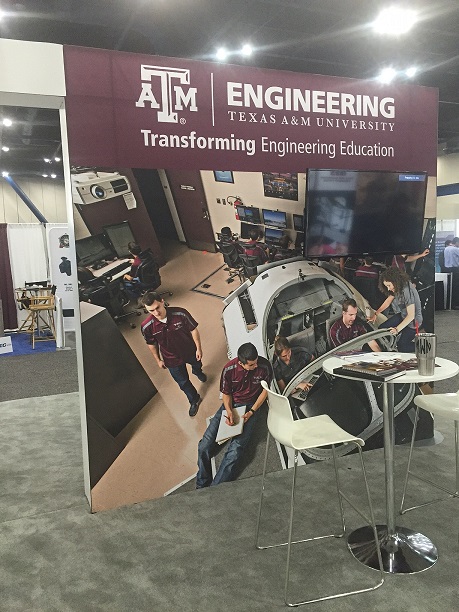
    2017 ASEE Annual Conference & Exposition, Columbus OH
  • gaze_vscl(1)
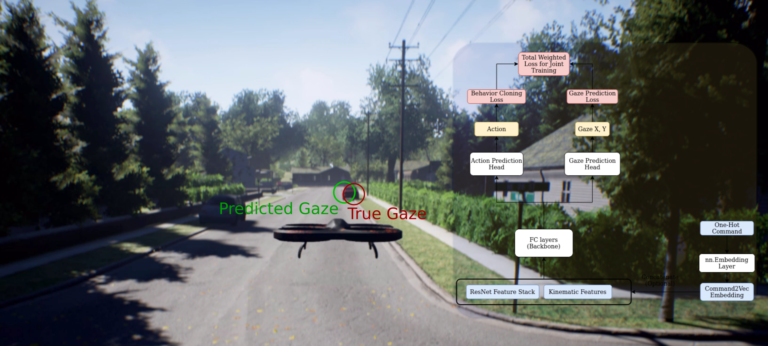
    Gaze-Guided Imitation Learning
  • VSCL Group 2025
  • A26U8172
    UAS Flight Research Facility at RELLIS Test Range
  • A26U7927

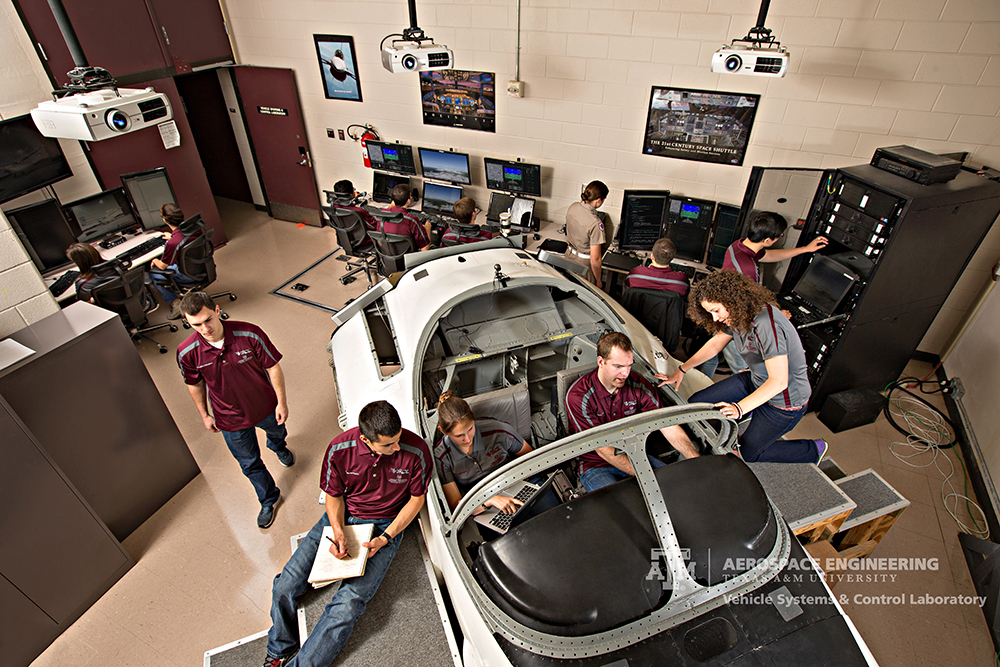
    Engineering Fight Simulator Facility
  • AUS-2
    Pegasus UAS Designed, Built, and Patented by VSCL
  • col_diagram_exp2
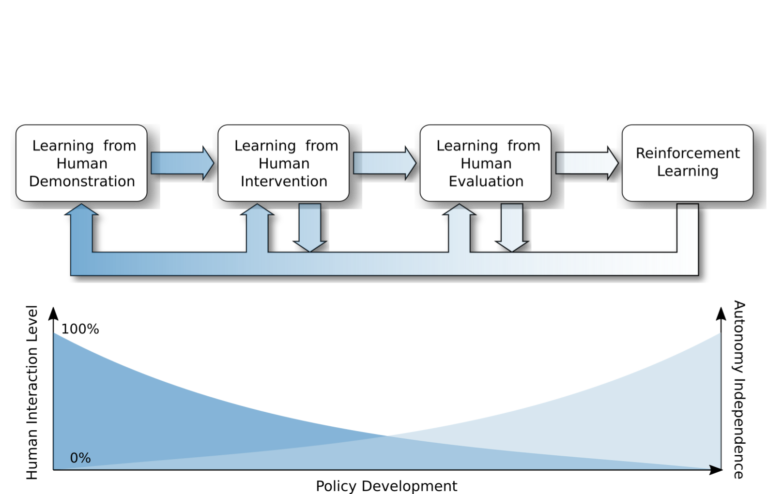
    Cycle of Learning for Human-Agent Interaction
  • WebsiteTarget
  • A26U8345-2
    Pegasus UAS Designed, Built, and Patented by VSCL
  • airsim_col
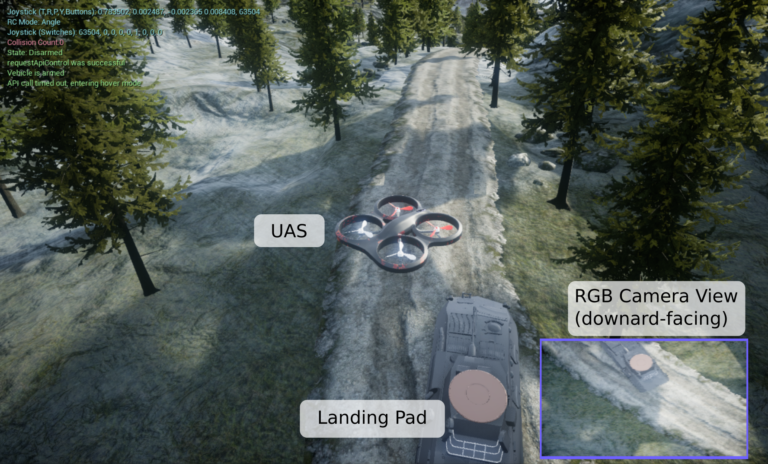
    Cycle-of-Learning for Autonomous Systems to Facilitate Human-Agent Teaming
  • 28-Army-futures-command-1200×750
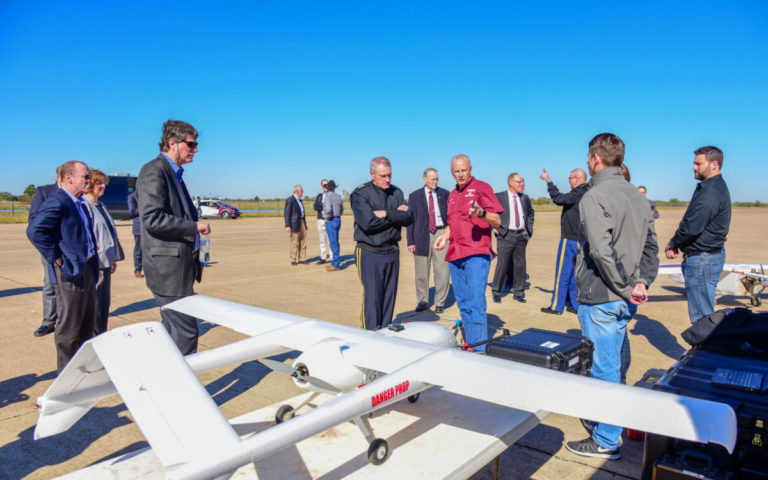
    Dr. John Valasek briefs General John M. Murray, commanding general of United States Army Futures Command (AFC), on autonomous UAS research in VSCL
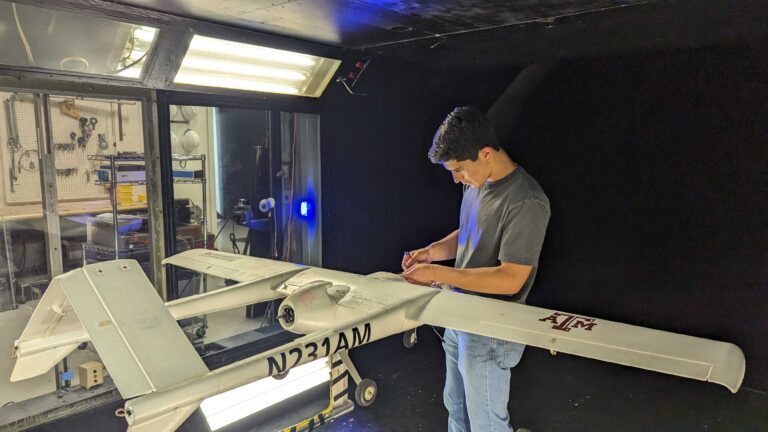
  • Undergraduate research assistant working on UAS platform for wind tunnel testing.
    Wind tunnel testing of UAS platform.
  • RTD Full Scenario
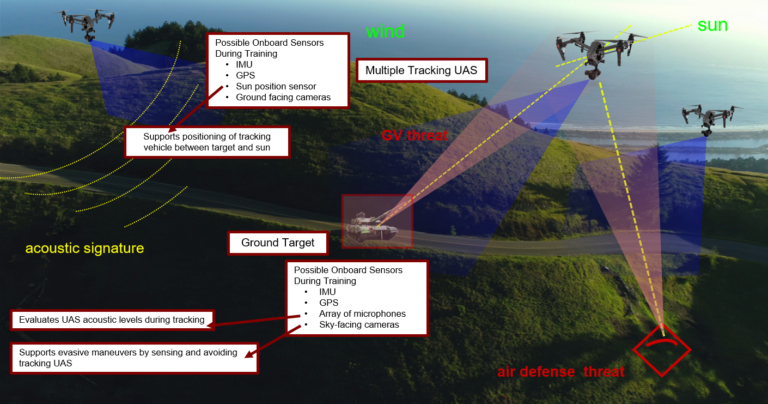
    Robust Threat Detection for Ground Combat Vehicles with Multi-Domain Surveillance in Hostile Environments
  • 20160727_143456
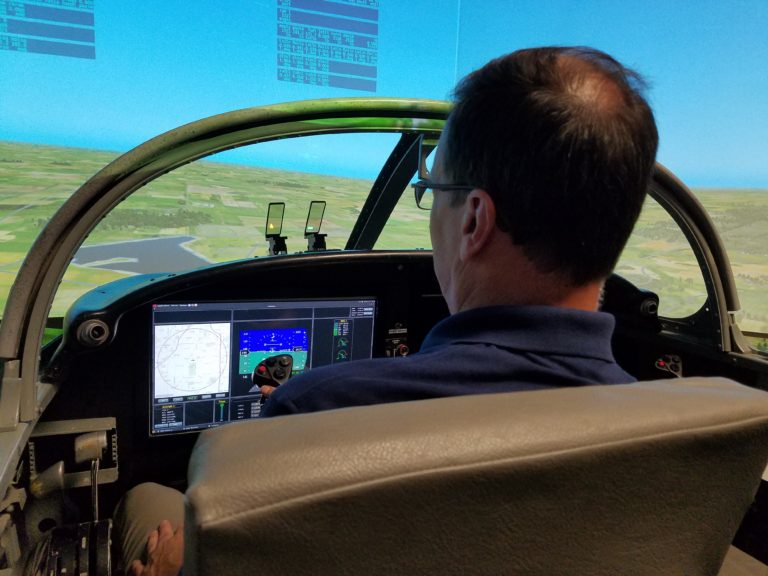
    FAA Test Pilot David Sizoo Flies an Approach Using Derived AOA in the Engineering Flight Simulator

People, Innovation, Excellence

Research Goal

Utilize the Theory-Computation-Experiment paradigm to research Low Cost Attritable Aircraft Technology (LCAAT) with autonomy to establish trust, providing a game changing capability that transforms the way manned and unmanned air, space, and ground systems are designed, controlled, and operated to effectively accomplish missions and tasks. VSCL is thus focused on synergistic strategies for the analysis, control, validation & verification of complex autonomous vehicle and sensor systems operating in challenging environments.

The Vehicle Systems & Control Laboratory is directed by Dr. John Valasek.

Graduate Research Assistant Positions Available

The Vehicle Systems & Control Laboratory (VSCL) has multiple fully funded Ph.D. positions in Aerospace Engineering that are available. Interested students are encouraged to apply for research in the following areas:
– Autonomous and Nonlinear Control of Cyber-Physical Air, Space, and Ground Systems
– Vision Based Sensors and Navigation Systems
– Cybersecurity for Air and Space Vehicles
– Air and Space Vehicle Control and Management
– Advanced Cockpit/UAS Systems and Displays
– Control of Bio-Nano Materials and Structures
– Human-in-the-Loop Artificial Intelligence for Coordinated Autonomous Unmanned Air Systems

More information and details for applying can be found here.

UAS Research and Flight Testing by the Numbers

  • 21 Years of Fixed-Wing UAS Flight Testing under FAA Auspices
  • 26 Externally Funded UAS Research Programs (1999 – Present)
  • 400+ Flights with an operational tempo of 133 thermal IR and multi-spectral data collection flights in the field over 12 months (2015 – 2016)
  • 24 Certified UAS Flight Testers Currently on Staff
  • 3 Certified UAS Pilots Currently on Staff
  • 13 UAS Vehicles in Current Fleet

Research Project Spotlight

Project: System Identification for Unmanned Air Systems

Sponsor: National Science Foundation (NSF) Center for Autonomous Air Mobility & Sensing (CAAMS)

Purpose: System Identification is a process to develop a mathematical representation of the dynamics of a physical system from measured data. Accurate models enable prediction of performance and dynamics of a system.

Challenges: Models for sUAS are generally not available as manufacturers do not have models for commercial sUAS and models for military sUAS are not typically available. Modeling and control systems are often vehicle dependent and not easily portable across sUAS. Many commercial autopilots do not provide data needed for online system identification

Our Approach: Utilizing the Observer Kalman Filter Identification algorithm with the Developmental Flight Test Instrumentation 2 framework, full state space models can be identified in near-real time onboard the vehicle utilizing data from a variety of sensors.


Recent News


VSCL Students Fojtik and Bowden Graduate with Masters of Engineering

Posted on July 18, 2019 by Garrett Jares

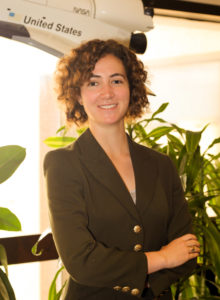
VSCL Graduate Research Assistant Emily Fojtik graduated with her Master of Engineering degree in May 2019 and has been hired by VectorNav Technologies, Dallas, TX. Emily will be working as a Test Engineer with a principal focus of automating and expediting the verification and validation of products at VectorNav.  Emily started working with VSCL in the Spring of 2016, with her major roles including managing the Texas A&M University Engineering Flight Simulator and developing a means for evaluating human factors aspects for Head Mounted Displays (HMD) for Enhanced Vision System technologies.

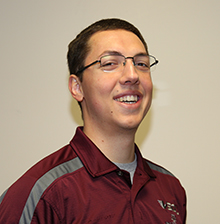
VSCL Graduate Research Assistant Zeke Bowden graduated with his Master of Engineering degree in June 2019 and has been hired by Lockheed Martin Aeronautics Company, Fort Worth, TX.  Zeke started working with VSCL in the Fall of  2014, and as one of the principal pilots with a Remote Pilot Certificate and Certified UAS Operator, has played a key role in every Unmanned Air System (UAS) project as either a UAS pilot or as a flight test engineer.  He had previously done a summer internship as a flight test engineer at Insitu Inc., Hood River, OR.
Filed Under: Alumni, Graduation

VSCL undergraduate Hannah Lehman recognized for scholastic and research excellence at national and college of engineering levels

Posted on July 17, 2019 by Garrett Jares

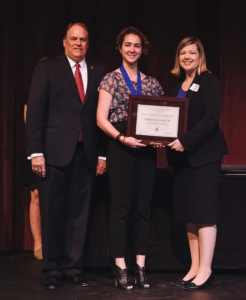
Hannah Lehman ‘20, a senior in the Department of Aerospace Engineering at Texas A&M University and an undergraduate research assistant of the Texas A&M Vehicle Systems & Control Laboratory, has been awarded the AIAA Foundation Cary Spitzer Digital Avionics Scholarship for the 2019/2020 academic year.  She is being recognized for her outstanding academic record and her research contributions in Reinforcement Learning for the intelligent control of Unmanned Air Systems.  The scholarship is awarded annually to a college student in good academic standing who is pursuing a degree in aerospace engineering, or aeronautical engineering.

Hannah was recognized as the 2019 Gathright Phi Kappa Phi Outstanding Junior in the College of Engineering.  Each year, the deans in each college are asked to select the most outstanding student from among all the juniors in their respective colleges based on research and/or creative production, community engagement, accomplishments/awards, and academic record, with the final selection criteria determined by the dean of each respective college.  Named in honor of the first president of the A&M College of Texas, it was established in April 1973 by The Association of Former Students in conjunction with Texas A&M’s Student Government Association.  As of Spring 2019, this award has become a collaboration between The Association of Former Students, LAUNCH: Academic Excellence, and the Texas A&M chapter of Phi Kappa Phi and has been renamed the “Gathright Phi Kappa Phi Outstanding Junior” award.


Filed Under: Awards

VSCL End of Semester Lunch

Posted on May 6, 2019 by Garrett Jares

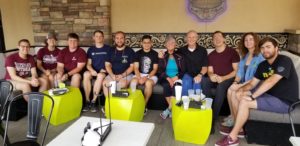
The Vehicle Systems and Control Laboratory celebrated end of semester lunch at Mad Taco.

Filed Under: Uncategorized

VSCL Students Selected for Summer 2019 Internships

Posted on May 5, 2019 by Garrett Jares

VSCL Graduate Research Assistant and Ph.D. Student Vinicius G. Goecks has been selected for a Summer 2019 internship at the US Army Research Lab in Aberdeen, MD. Vinicius will be working as a Research Fellow on the US Army initiative to investigate how efficiently transition and update policies/controllers, trained initially with human demonstrations, using off-policy actor-critic reinforcement learning in the Cycle-of-Learning. Vinicius has been an active member of VSCL since Spring 2016, focusing on human-machine interaction and the control of UAS with Machine Learning, and the Intelligent Motion Video Target Tracking for UAS.

VSCL Undergraduate Research Assistant Student Hannah Lehman has been selected for a Summer 2019 research internship as part of the NSF funded Research Experience for Undergraduates (REU) program. Hannah will be working as a Research Intern, with a principal focus of facilitating multi agent machine learning across heterogeneous agents. Hannah started working with VSCL in the Spring of 2017, with her major roles including managing the flight simulator lab and performing research into reinforcement learning for use onboard aircraft.

VSCL Undergraduate Research Assistant and B.S. Aerospace Engineering student Brandon Lansdell spent the Summer of 2018 and 2019 at Lockheed Martin Missiles and Fire Control in Grand Prairie, TX working as a Systems Engineer on the PAC-3 Missile Defense Program. During his time there, he has worked in simulation and algorithm development, as well as test operations. Brandon has been an active member of VSCL since Spring 2018, focusing on a multi agent architecture system created by VSCL students called CLARK.

VSCL Graduate Research Assistant and M.S. Aerospace Engineering student Blake Krpec was selected to visit US Army Research Lab in Aberdeen, MD during summer 2019. Blake will be visiting for 2 weeks where he will work with engineers at Army Research Lab on developing autonomous vehicle systems. He will be working as a Journeyman Research Fellow on the US Army initiative to investigate a potential target tracking /following system involving one UAS being able to detect another UAS, and navigate relative to said target. Blake revied his bachelor’s of science from A&M in Aerospace Engineering in May 2019, and has been a member of VSCL since Fall of 2016. Blake supported flight test projects, sensor and hardware integration, aircraft performance, and other target tracking efforts.

VSCL Undergraduate Research Assistant and B.S. Computer Engineering Student Mia Brown has been selected for a Summer 2019 internship at Dell Technologies in Round Rock, TX. Mia will be working as an Enterprise Security Analyst Intern, where she will be analyzing the security procedures for internal products at Dell Technologies. Mia started working with VSCL in the Spring of 2017, with her major roles including working in the Texas A&M University Engineering Flight Simulator and helping to develop a means for evaluating human factors aspects for Head Mounted Displays (HMD) for Enhanced Vision System technologies.

VSCL Graduate Research Assistant and Ph.D. Student Garrett Jares has been selected for a Summer 2019 Internship with Sandia National Laboratories in Albuquerque, NM. Garrett will be working as a Year-Round Graduate Student Intern – R&D with the Navigation, Guidance, & Control Organization. Garrett has been a member of VSCL since Fall 2018, focusing his work on UAS embedded systems, flight operations, and cybersecurity for UAS. He is also the lead engineer in the engineering flight simulator lab.

Filed Under: Internships

Valasek Invited Presenter at Autonomy for Hypersonics Field Day

Posted on April 17, 2019 by Garrett Jares

Dr. John Valasek, professor in the Department of Aerospace Engineering at Texas A&M University and director of the Vehicle Systems & Control Laboratory, was an invited Firestarter Presenter on the topic of Payload & Mission Management for Intelligence, Surveillance, and Reconnaissance (ISR) Missions. Sponsored by Sandia National Laboratories, the Autonomy for Hypersonics (A4H) Field Day was held on 18-19 April 2019, Albuquerque, NM. The A4H Mission Campaign seeks to conduct groundbreaking autonomy research in collaboration with academic and industrial partners to address critical national security issues.

Filed Under: Presentations

Cycle-of-Learning for Autonomous Systems from Human Interaction Presented by Vinicius Goecks at AAAI-19 Conference

Posted on March 14, 2019 by Garrett Jares

VSCL Graduate Research Assistant Vinicius Goecks presented a paper on Cycle-of-Learning for Autonomous Systems from Human Interaction at the Conference on Artificial Intelligence AAAI-19 on 31 January. Co-authored by researchers from the US Army Research Laboratory’s Human Research and Engineering Directorate, this continuing project investigates how to utilize different forms of human interaction to safely train autonomous systems in real-time by learning from both human demonstrations and interventions. This method improves task completion performance for the same amount of human interaction when compared to learning from demonstrations alone, while also requiring on average 32% fewer data to achieve that performance. This provides evidence that combining multiple modes of human interaction can increase both the training speed and overall performance of policies for autonomous systems. The paper documenting this work is “Efficiently Combining Human Demonstrations and Interventions for Safe Training of Autonomous Systems in Real-Time,” AAAI-2019-6613.


Filed Under: Machine Learning, Presentations

Valasek Invited Panelist in Forum 360 Webinar on Verification and Validation in the Age of Autonomy at 2019 AIAA SciTech Conference

Posted on March 2, 2019 by Garrett Jares

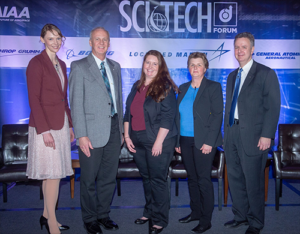
Dr. John Valasek, professor in the Department of Aerospace Engineering at Texas A&M University and director of the Vehicle Systems & Control Laboratory, was in invited panelist on the topic of Verification and Validation in the Age of Autonomy at the 2019 AIAA SciTech Conference, 10 January 2019, San Diego, CA.

Panelists in the session discussed the V&V of autonomous systems and how they pose a challenge for regulators and others tasked with evaluating those systems.  As the second and third waves of autonomy become reality, concerns arise as to the safety and reliability of new technologies that leverage these capabilities. Methods for verification and validation of software that enable autonomous systems must be developed to support new certification processes. For safety critical systems, ethical issues regarding machine decision making and the role of human-on-the-loop paradigms must be addressed. For defense applications, mission assurance will be a significant driving factor in certifying systems for deployment. How can government authorities, companies, and the general public be assured that new, autonomous technologies are reliable?

In the webinar recording below please go to 41:00 to see Dr. Valasek’s introductory presentation, before the Q&A with the audience begins:  https://livestream.com/AIAAvideo/scitech2019/videos/185656997

Details of the session and participants can be found here:

https://scitech.aiaa.org/Intelligent-Systems-Create-Validation-Challenges/


Filed Under: Presentations

VSCL Hosts Army Research Laboratory

Posted on February 9, 2019 by Garrett Jares

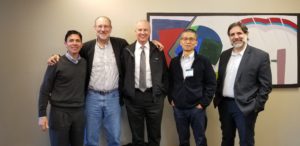
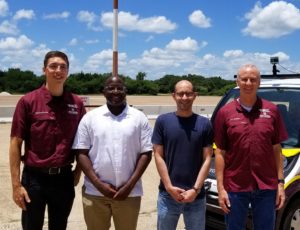
VSCL hosted Dr. Jaret Riddick, Director of the Army Research Laboratory, and Dr. Bryan Glaz, Chief Scientist of the Army Research Laboratory at the Texas A&M University UAS Flight Testing Facility at RELLIS Campus.  Dr. Jaret Riddick and Dr. Bryan Glaz spoke with VSCL lab director Dr. John Valasek and VSCL graduate student Vinicius G. Goecks about the work VSCL completes at the flight testing facility and toured the grounds.

Pictured are Vinicius, Dr. Riddick, Dr. Glaz, and Dr. Valasek

.

Filed Under: Presentations

Vehicle Systems & Control Laboratory Awarded Patent for Design of Unmanned Air System

Posted on January 30, 2019 by Garrett Jares

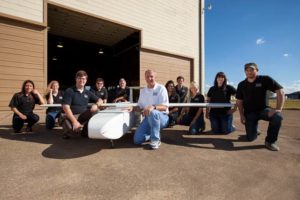
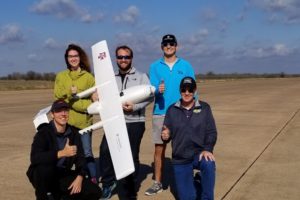
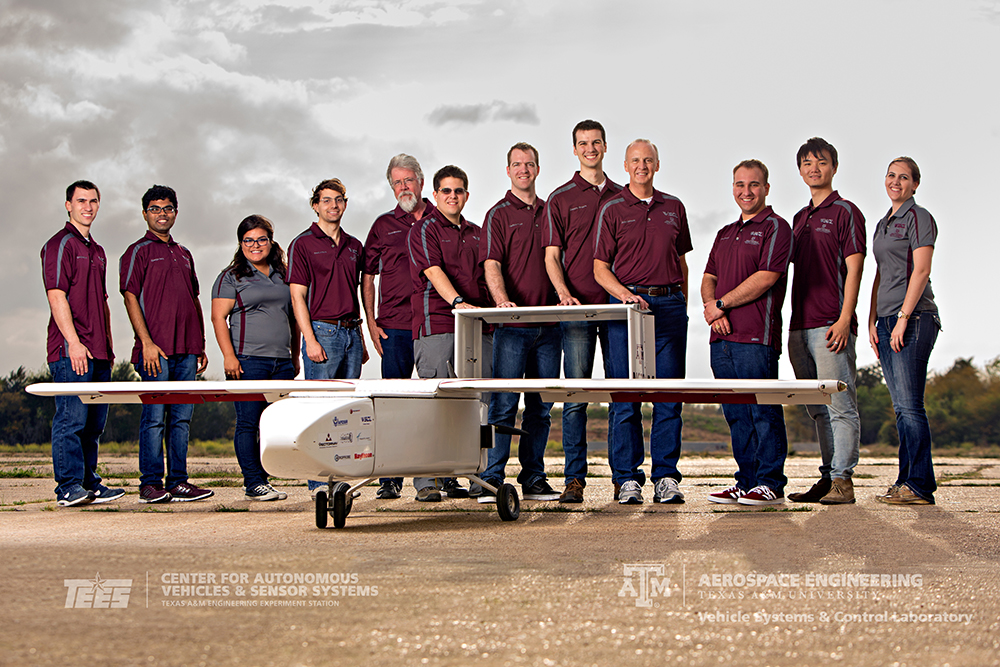
Dr. John Valasek and Co-Inventors Andrew Beckett, James F. May, and Cecil C. Rhodes with research team and Pegasus at RELLIS Campus hangar.

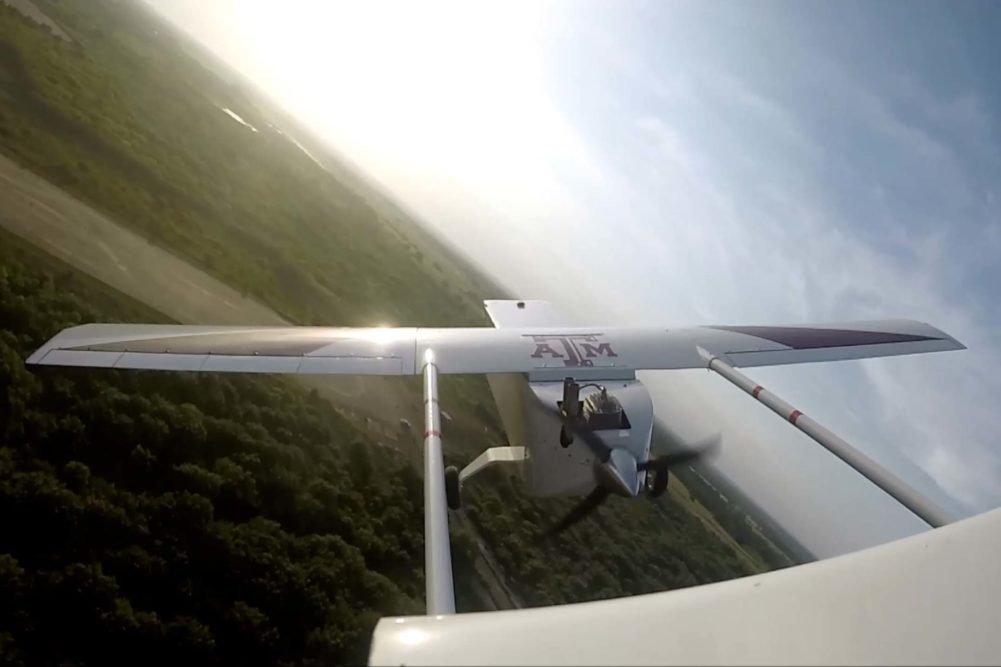
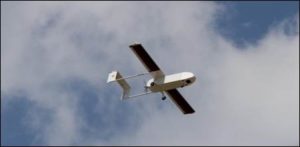
A team of inventors from the Vehicle Systems & Control Laboratory, in the Department of Aerospace Engineering A&M University, have been awarded U.S. Patent 9,957,035 for Un-Manned Aerial Vehicle Having Adjustable Wing Module, Tail, and Landing Gear. The Pegasus Unmanned Air System (UAS) was conceived, specified, designed, built, and flown by the team of Dr. John Valasek, Professor, Graduate Research Assistants Andrew Beckett and James F. May, and A&P Technician and Flight Mechanics Specialist Cecil C. Rhodes Jr. Pegasus was conceived as the Control Systems Integration Testbed (CONSINT) for researching and evaluating fault tolerant adaptive control laws, autoland control laws, and a variety airborne sensors for imaging and tracking missions.

Video of the Pegasus flight operations can be viewed here: https://youtu.be/NWg24afA5GU

The Pegasus patent can be viewed here: https://patents.google.com/patent/US9957035B2/en


Pegasus has 80+ flights at the Texas A&M University RELLIS campus, out of its design life of 300 takeoff and landing cycles. The airframe has a wing span of 12 feet and is designed to 7g limit maneuvering load factor and has a maximum takeoff weight of 108 pounds. Pegasus can carry 30 pounds of payload in the nose and fuselage payload bay, which has a volume of 12U half-width rack chassis. Pegasus features variable static stability with a positionable wing location on the fuselage and multiple redundant control surfaces: 8 ailerons, 2 elevators, 2 rudders, and throttle. Pegasus has a stall speed at maximum takeoff weight of 26 knots and a maximum speed of 90 knots. The endurance is 1+ hour depending upon fuel system configuration.


Filed Under: Awards, Pegasus

VSCL’s Reinforcement Learning Control Law for Ground Target Tracking Featured in January’s Aerospace America

Posted on January 28, 2019 by Garrett Jares

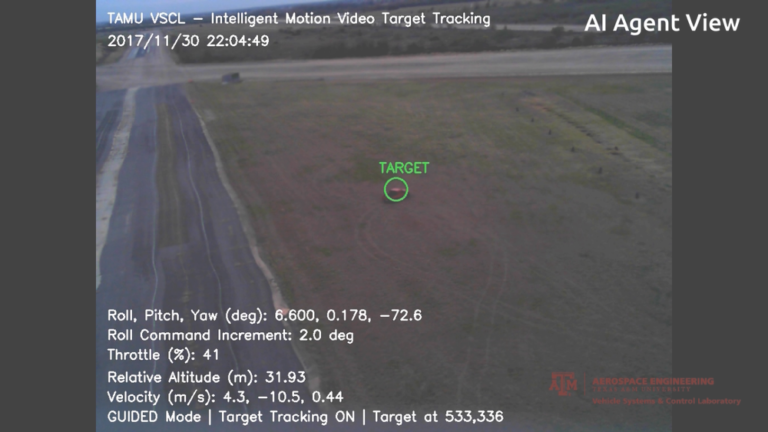
The January 2019 edition of Aerospace America’s annual Year in Review section for Information Systems featured the flight-demonstration of a machine learning algorithm developed by a team of VSCL students and faculty.  The article discussed the progression of the project from its first demonstration in December 2017 to more recent demonstrations.  The algorithm is based on Q-Learning and provides a control policy for the vehicle’s orientation in order to keep the target fixed in the image frame autonomously. The algorithm was tested against stationary and randomly moving targets in both a structured and unstructured environment.

The Aerospace America article can be found here.

Dr. John Valasek, Vinicius Goecks, Hannah Lehman, Zeke Bowden, and Blake Krpec.

Filed Under: Publications, Target Tracking

« Previous Page
Next Page »

© 2016–2026 Log in

Texas A&M Engineering Experiment Station Logo
  • State of Texas
  • Open Records
  • Risk, Fraud & Misconduct Hotline
  • Statewide Search
  • Site Links & Policies
  • Accommodations
  • Environmental Health, Safety & Security
  • Employment