

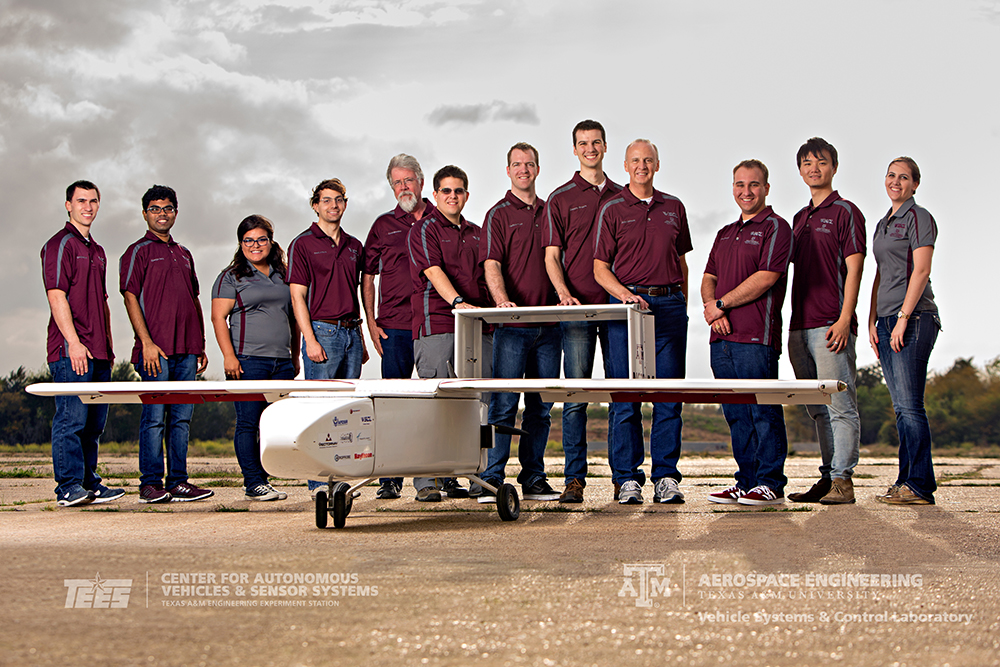
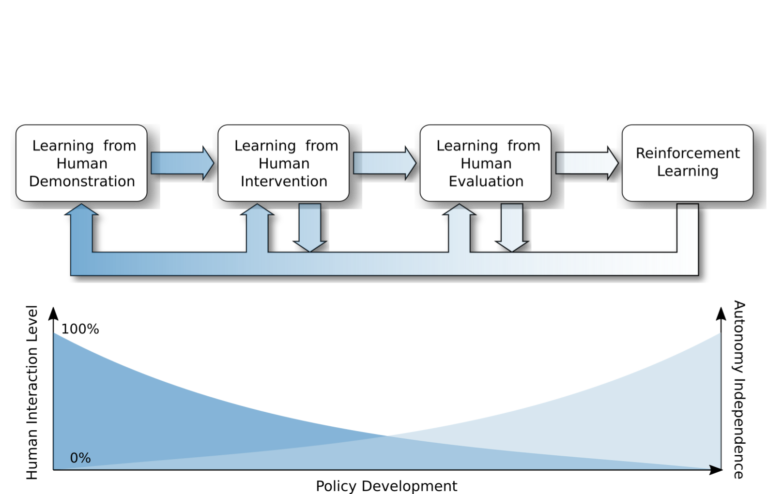

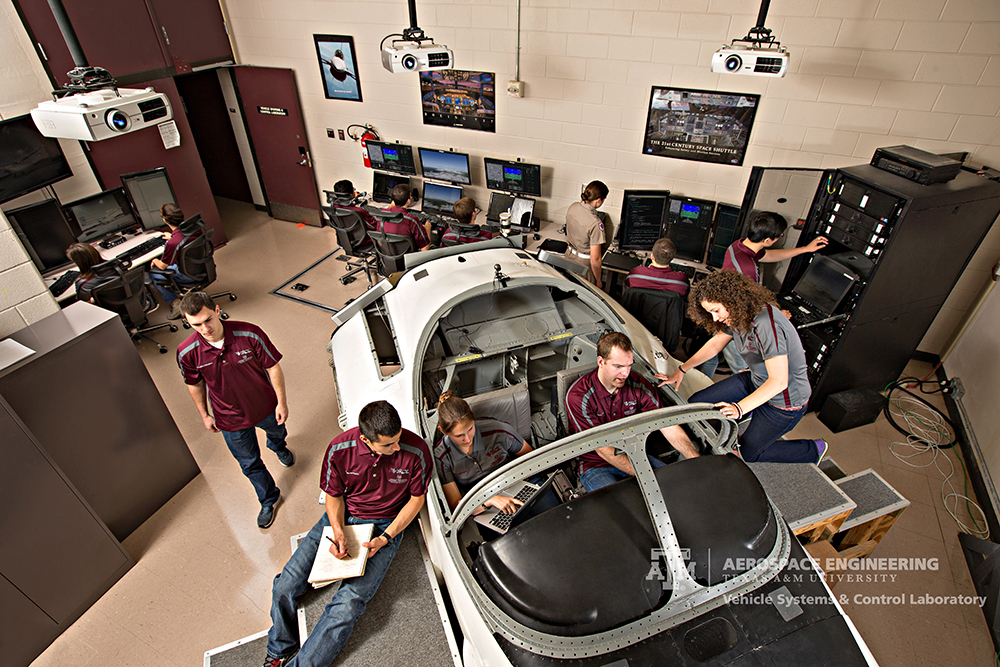
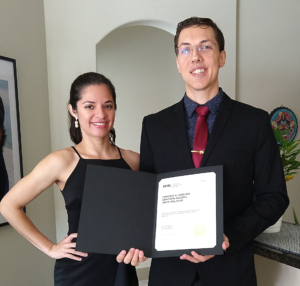
The 50th graduate degree has been earned by a VSCL graduate student. Jin Suzuki earned the first degree, an M.S. in 1997, and Dr. Vinicius Goecks earned the fiftieth degree, a Ph.D. in May 2020. Several VSCL graduates students have earned both the M.S. and the Ph.D. degrees during this span, and Dr. Valasek has served as advisor to all 50 degrees. The list of students and dates can be viewed here.
Four New Ph.D. Graduate Students Join VSCL in Fall 2020
VSCL is proud to welcome four new Ph.D. graduate research assistants:
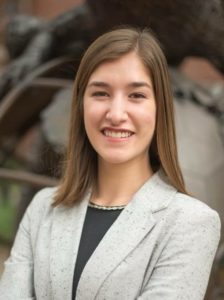
Shelby Hackett is a Ph.D. student in the aerospace engineering department. She graduated in May 2020 from the University of Florida with B.S. degrees in mechanical and aerospace engineering. During her undergraduate studies, she completed an honors thesis on range optimal control for an aircraft, looking at methods for solutions that lie on a singular arc. While in school, she completed internships at Sandia National Laboratories and GE Oil & Gas as a Research & Development intern and a Manufacturing Engineering intern, respectively. Shelby is currently interning at Sandia National Laboratories in Albuquerque, NM as a Research & Development intern. She will be a member of the Guidance, Navigation, and Control II group, working on improving GPS systems for defense vehicles. This is her second summer interning with Sandia. In the fall, Shelby will research Tightly Integrated Navigation and Guidance for Multiple Autonomous Agents, which is sponsored by Sandia National Laboratory.
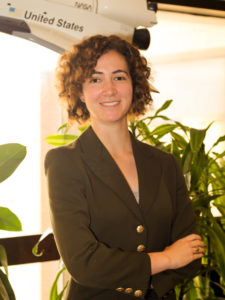 Hannah Lehman is a Ph.D. student in the aerospace engineering department. Hannah has been an active member of VSCL since Fall 2017, focusing on human-machine interaction and the control of UAS with Machine Learning. As an undergraduate, she participated in internships with Rockwell Collins, Collins Aerospace, and the REU program. She graduated with the B.S. degree in Aerospace Engineering from Texas A&M University as a University Scholar, University Honors, and Engineering Honors in May 2020. As a Graduate Research Assistant Hannah researches Tightly Integrated Navigation and Guidance for Multiple Autonomous Agents, which is sponsored by Sandia National Laboratory. She is also participating in a remote 2020 summer internship at Sandia National Laboratory with a focus on machine learning.

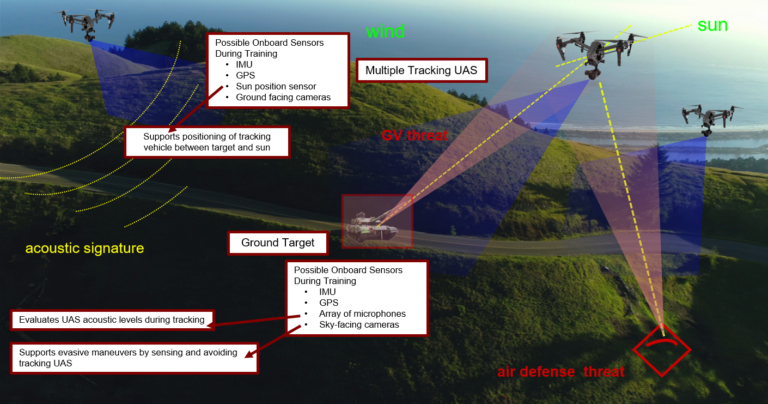
Nidhin Ninan is a Ph.D. student in the aerospace engineering department. He graduated from the University of Kansas with a B.S. degree in aerospace engineering. During his undergraduate studies, Nidhin worked on Simultaneous Localization and Mapping (SLAM) based navigation using depth sense camera and edge detection using reinforcement learning for a Mars rover prototype being built at KU for the Mars Society’s University Rover Challenge. AT VSCL, Nidhin will be working on the Agile Technology Development (ATD) – Air-Ground Coordinated Teaming, which is sponsored by the Army Futures Command.

Ravi Kumar Thakur is a Ph.D. student in the aerospace engineering department. His interest is in the field of aerospace robotics and autonomy. He graduated with an MS(Research) degree in Electronics and Communication from the Indian Institute of Information Technology Sri City, Chittoor in 2019. For his thesis, he worked on developing machine learning-based models for estimating scene flow from stereo images. He earned his BS in Engineering Physics from National Institute of Technology Calicut in 2014. In the past, he was a machine learning engineer at Ford Motor Company, where he worked on driver assistant technology with a focus on visual odometry and object tracking. Before that, he worked at the Indian Institute of science working on the development of an endoscopy simulator. At VSCL, Ravi will be working on the project Enhancing the Cycle-of-Learning for Autonomous Systems to Facilitate Human-Agent Teaming which is sponsored by Army Research Laboratory.
VSCL graduate student Garrett Jares joins AIAA Aerospace Cybersecurity Working Group
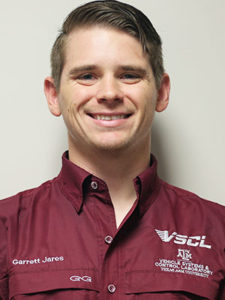 VSCL Graduate Research Assistant and Ph.D. student Garrett Jares has joined the AIAA Aerospace Cybersecurity Working Group (ACWG). The ACWG is involved with aerospace cybersecurity within the overall vision and mission of AIAA. It is composed of cybersecurity interested members from across the AIAA and provides opportunities to educate those involved with conceptualization, design, development, testing, deployment, operations, maintenance, and management of aerospace systems. ACWG seeks to engage in active information exchange among those involved in aerospace related cybersecurity, documenting the results, and making those results available to the broader aerospace systems community. The goal of the working group is to enable organizations to improve the confidentiality, integrity and availability of aerospace systems and data.
Garrett is a recipient of the 2020 NSF Graduate Research Fellowship, which is supporting his doctoral dissertation on investigating cyber-attacks designed that are designed to take control of an aircraft by targeting the vehicle’s sensor data. This research will help identify and better understand the vulnerabilities in current systems and develop safeguards against such attacks. Garrett is a recipient of the Crawford & Hattie Jackson Foundation Scholarship, the Edward C. Clay ’47 Memorial Scholarship, and the 2018 Lechner Graduate Fellowship.
Valasek Inducted Into Cal Poly Engineering Hall of Fame
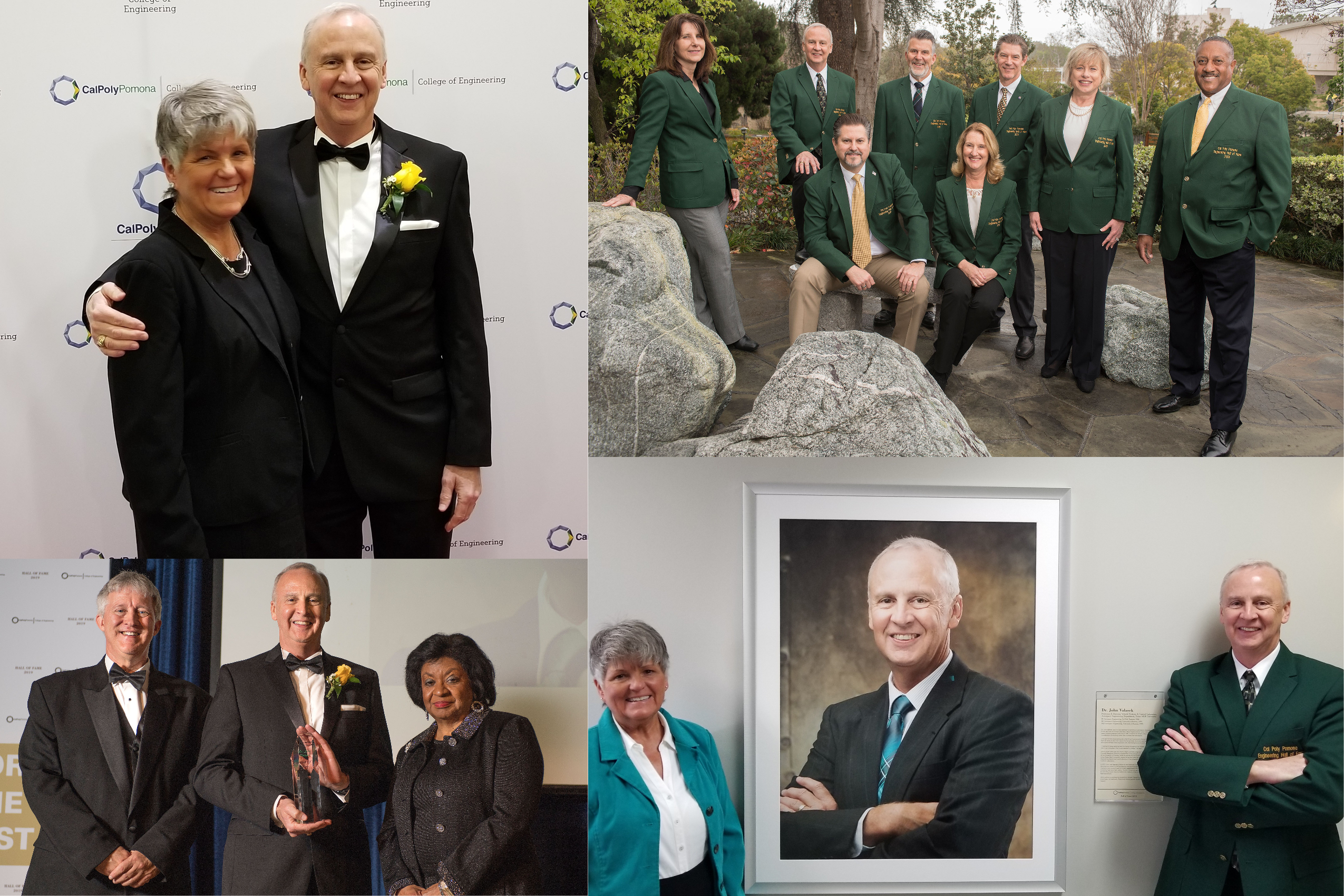 Dr. John Valasek, professor in the Department of Aerospace Engineering at Texas A&M University and director of the Vehicle Systems & Control Laboratory, has been inducted into the Engineering Hall of Fame, College of Engineering, California State Polytechnic University, Pomona.
Valasek was one of nine engineering alumni so honored. The college’s Hall of Fame recognizes, honors, and preserves the outstanding accomplishments and contributions of alumni engineers and engineering technologists who have distinguished themselves in the community through leadership and professional achievement. From helping usher in the era of digital television to guiding the development of California’s most recognizable structures, each inductee has made meaningful contributions deserving of honor and preservation.
Valasek graduated with the B.S. degree in aerospace engineering from Cal Poly, Pomona in 1986. While a student at Cal Poly he served as Chairman of the AIAA Student Branch, and was the Student Chairman of the 1985 AIAA Region VI Student Paper Conference. He worked part-time during his senior year in the Flight Controls Research Group at Northrop Corporation, Aircraft Division, before joining that group at Northrop upon graduation.
Valasek Appointed to Dean’s Leadership Board
Dr. John Valasek, professor in the Department of Aerospace Engineering at Texas A&M University and director of the Vehicle Systems & Control Laboratory, has been appointed to the Dean’s Leadership Board (DLB) of the College of Engineering, California State Polytechnic University, Pomona. The DLB is an advisory board of high-level executives that bring their expertise and knowledge in their respective engineering fields. This group of alumni and industry experts secure resources for the college and to help define its strategies and goals.
Valasek graduated with the B.S. degree in aerospace engineering from Cal Poly, Pomona in 1986. While a student at Cal Poly he served as Chairman of the AIAA Student Branch, and was the Student Chairman of the 1985 AIAA Region VI Student Paper Conference. He worked part-time during his senior year in the Flight Controls Research Group at Northrop Corporation, Aircraft Division, before joining that group at Northrop upon graduation.
VSCL Alumnus Dr. Dipanjan Saha Joins Northeastern University as a Postdoc
Dr. Dipanjan Saha, a December 2018 Ph.D. graduate of VSCL, has started a new position as a Postdoctoral Fellow with the Department of Electrical and Computer Engineering at Northeastern University, effective 01 July 2020. Dipanjan has been selected to be part of Northeastern’s newly launched Experiential Artificial Intelligence (EAI) postdoc program. This program is meant to prepare the postdoctoral fellows towards a future career in Machine Learning (ML) and Artificial Intelligence (AI) through courses and research. Dipanjan is mentored by Prof. Taskin Padir, and his research will develop novel AI techniques targeted at specific applications including robotics and healthcare. His Ph.D. dissertation investigated novel theories of control design for nonlinear, nonstandard multiple-time-scale systems with uncertainties and output feedback. Prior to his current position, he has pursued postdoctoral research at Texas A&M University on tensegrity systems and uncertainty quantification. He has also been the instructor of record for AERO 321 (Dynamics of Aerospace Vehicles) for three semesters, and a member of the AIAA Guidance, Navigation and Control Technical Committee.
VSCL Alumni Vinicius G. Goecks Receives Best Student Paper Award
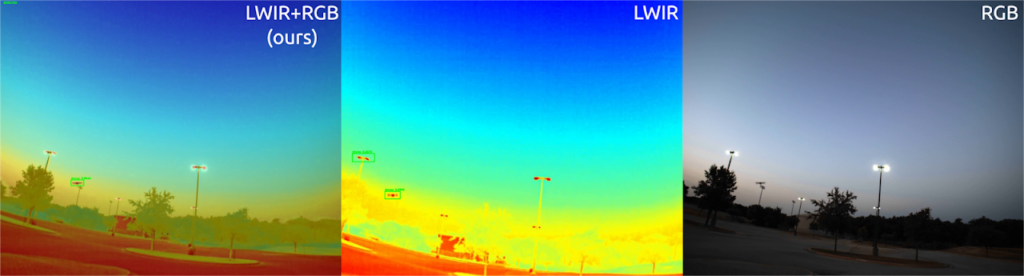
VSCL paper “Combining Visible and Infrared Spectrum Imagery using Machine Learning for Small Unmanned Aerial System Detection”, by Vinicius G. Goecks, Grayson Woods, and John Valasek, has been selected as the winner of the 2020 SPIE Automatic Target Recognition Best Student Paper Award. This paper presented a novel approach to combine data from RGB and long-wave infrared (LWIR) cameras to detect drones through previously difficult environments such as flying above and below the treeline/horizon, in the presence of birds, and glare from the sun.
“The main insight of our approach is that it enables detection and tracking of vehicles at any time of the day, around-the-clock, and in real-time.” says Dr. Goecks. “It also can be built on top of any existing camera system with minimal computation overhead.”
A summary video of the system can be found here, along with videos with all predictions for the single-vehicle case and multiple-vehicle case.
The paper was presented at the 2020 SPIE Defense + Commercial Sensing Conference Digital Forum held 27 April – 8 May 2020. The paper is available at the SPIE Digital Library and the preprint version is available at arXiv.
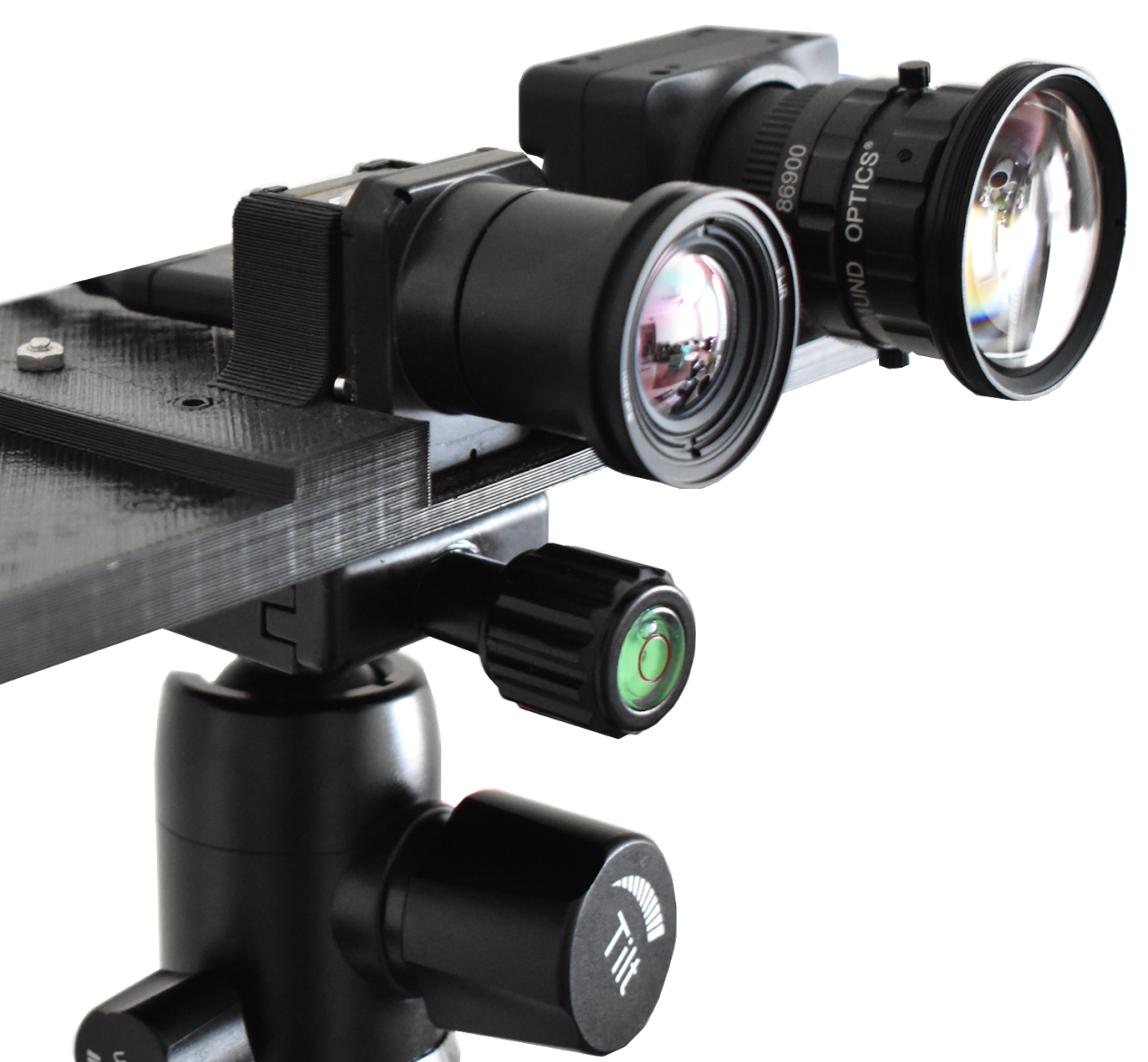
Long-wave Infrared and Visible Spectrum sensors
VSCL Student Vinicius G. Goecks Graduates with Doctor of Philosophy
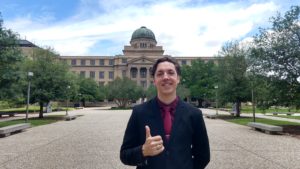
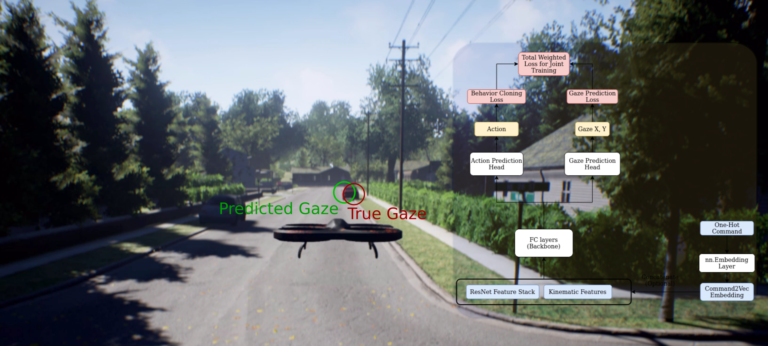
VSCL alumni Vinicius G. Goecks, who graduated with his Doctor of Philosophy degree in May 2020, has started his postdoctoral position at the US Army Research Laboratory, Aberdeen Proving Ground, MD. At the US Army Research Laboratory, Vinicius will be developing novel algorithms on human-in-the-loop reinforcement learning assisted by eye gaze and natural language commands applied to tasks where unmanned robotic agents are teamed with humans. He had joined VSCL in 2016 and had previously participated in Summer internships at the US Army Research Laboratory in 2017, 2018, and 2019.
VSCL graduate student Garrett Jares Awarded NSF Graduate Research Fellowship

Garrett Jares, a Ph.D. student in the Department of Aerospace Engineering at Texas A&M University and Graduate Research Assistant in the Vehicle Systems & Control Laboratory, has been awarded a 2020 NSF Graduate Research Fellowship. The NSF Graduate Research Fellowship Program (GRFP) recognizes and supports outstanding graduate students in NSF-supported science, technology, engineering, and mathematics disciplines who are pursuing research-based Master’s and doctoral degrees at accredited United States institutions. NSF Fellows are anticipated to become knowledge experts who can contribute significantly to research, teaching, and innovations in science and engineering.
Garrett earned the BS degree in Computer Science from Texas A&M University with a minor in Cybersecurity and a minor in Mathematics, graduating Magna Cum Laude in 2017. He has been working in the Vehicle Systems & Control Laboratory (VSCL) with his advisor, Dr. John Valasek, since his undergraduate senior capstone project in 2017. During his undergraduate education, Garrett studied extensively in cybersecurity including research in cryptography topics. Garrett’s work with VSCL has been developing embedded systems for Unmanned Air Systems (UAS), and overseeing the operation of the Engineering Flight Simulator Laboratory. Garrett is combining his undergraduate knowledge with his experience in VSCL to investigate Cybersecurity for air and space vehicles.
Garrett’s doctoral dissertation will investigate cyber-attacks designed that are designed to take control of an aircraft by targeting the vehicle’s sensor data. This research will help identify and better understand the vulnerabilities in current systems and develop safeguards against such attacks. Garrett is a recipient of the Crawford & Hattie Jackson Foundation Scholarship, the Edward C. Clay ’47 Memorial Scholarship, and the 2018 Lechner Graduate Fellowship.
Bera to Present PODNet Paper at AAAI-MAKE 2020 on March 23
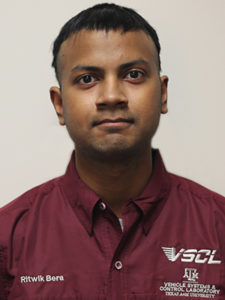
VSCL Graduate Research Assistant Ritwik Bera will present a paper titled “PODNet: A Neural Network for Discovery of Plannable Options” at the AAAI-MAKE: Combining Machine Learning and Knowledge Engineering in Practice, AAAI Spring Symposium on March 23, 2020. Co-authored by researchers from the US Army Research Laboratory’s Human Research and Engineering Directorate, this continuing project investigates how to segment an unstructured set of demonstrated trajectories for option discovery. This enables learning from demonstration to perform multiple tasks and plan high-level trajectories based on the discovered option labels. This method is composed of several constituent networks that not only segment demonstrated trajectories into options, but concurrently trains an option dynamics model that can be used for downstream planning tasks and training on simulated rollouts to minimize interaction with the environment while the policy is maturing. The paper documenting this work is “PODNet: A Neural Network for Discovery of Plannable Options,” currently available at https://arxiv.org/abs/1911.