
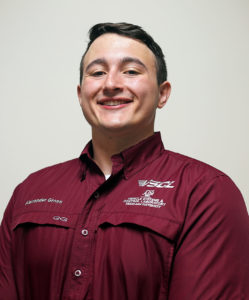
Kameron Eves (B.S. Mechanical Engineering, BYU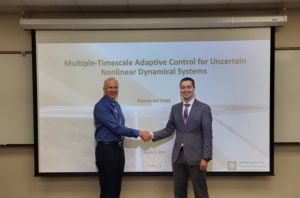 ) successfully defended his Ph.D. dissertation titled “Multiple-Timescale Adaptive Control for Uncertain Nonlinear Dynamical Systems”. Kameron’s dissertation investigated combining nonlinear multiple time-scale controllers that VSCL has been researching for the last 15 years, with adaptive controllers which VSCL has been researching for more than 20 years. Multiple-timescale control has been shown to have difficulty with uncertain systems and adaptive control has been shown to have difficulty with multiple-timescale systems. His dissertation describes a novel control methodology called [K]Control of Adaptive Multiple-timescale Systems (KAMS). KAMS seeks to address systems that simultaneously exhibit uncertain and multiple-timescale behaviors. Unlike traditional multiple-timescale control literature, KAMS uses adaptive control to stabilize the subsystems. The reference models and adapting parameters used in adaptive control significantly complicate the stability analysis. KAMS is a flexible theory and framework and the stability proofs apply to a wide array of adaptive algorithms and multiple-timescale fusion techniques. Additionally, formal and numerical validation of how KAMS can relax the minimum phase assumption for a multitude of common adaptive control methods. KAMS is demonstrated and evaluated on examples consisting of stabilization and attitude control of a quadrotor Unmanned Air System; fuel-efficient orbital transfer maneuvers; and preventing inlet unstart on hypersonic aircraft.
A proposal on KAMS was submitted to DoD sponsors, and the Office of Naval Research (ONR) awarded a three-year research project to continue this work, and flight test it. Conference and journal papers are being written on this work.
Kameron’s is the 57th graduate degree earned by a VSCL graduate student. Kameron graduated from the Mechanical Engineering Department at BYU in 2019, with minors in mathematics and business. At BYU, Kameron worked in the Multiple Agent Intelligent Coordination and Control (MAGICC) laboratory. He will be starting work as an Assistant Professor at Utah Tech University in June.
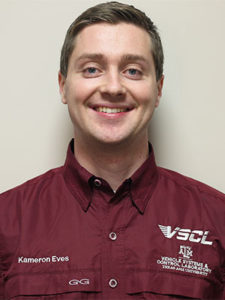 Kameron Eves will be presenting the paper “Adaptive Control for Non-minimum Phase Systems Via Time Scale Separation,”. Adaptive control for non-minimum phase systems remains a challenging problem. Eves proposes a method of adaptive control for systems that may be both nonlinear and non-minimum phase. This is accomplished by exploiting time scale separation between the internal and external dynamics.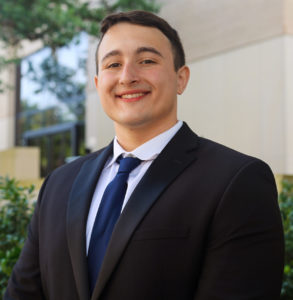
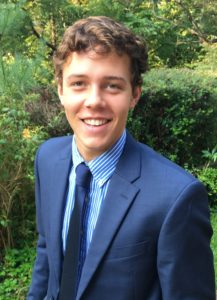 David Van Wijk will be presenting the paper “Deep Reinforcement Learning Controller for Autonomous Tracking of Evasive Ground Target”. Van Wijk presents a method of tracking an evasive ground target using deep RL on a rotorcraft wherein the target attempts to hide behind occlusions. A variety of environment conditions are trained and evaluated, resulting in an agent able to successfully track a randomly moving target with the presence of occlusions.
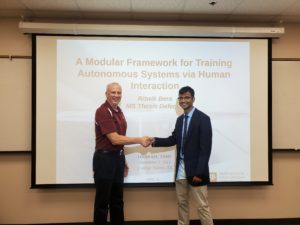 VSCL student
 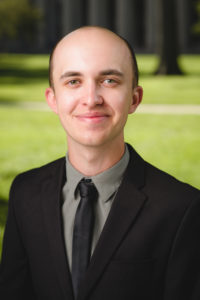 Maison Clouatre is an incoming Ph.D. student in the aerospace engineering department. He will graduate in May 2022 with a double major in electrical engineering and mathematics from Mercer University. As an undergraduate, Clouatre held visiting research positions in the Electronic Systems (ELSYS) Laboratory at the Georgia Tech Research Institute (GTRI), the Vehicle Systems & Control Laboratory (VSCL) at Texas A&M University, and the Laboratory for Information & Decision Systems (LIDS) at the Massachusetts Institute of Technology (MIT). His research interests lay at the intersection of control theory, optimization, and learning, and he focuses on applying his theory to the fields of quantum information science and aerospace engineering. Clouatre is both a Goldwater Scholar and Stamps Scholar. At VSCL, Clouatre will research quantum control and learning for quantum dynamics.
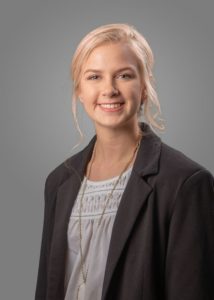 Cassie-Kay McQuinn ’21 is an M.S. student in the aerospace engineering department. Cassie-Kay has been an active member of VSCL since Fall 2021, working in system identification. She will graduate in December from Texas A&M University with a B.S. in Aerospace Engineering with Engineering Honors. In addition to completing Engineering Honors, she is a Presidential Endowed Scholar, the 2021 Aerospace Engineering Advisory Board Scholarship recipient, and has earned a certificate of Holistic Leadership in Engineering through completion of the Zachry Leadership Program. She is the current Vice President of the Texas A&M chapter of the Sigma Gamma Tau Aerospace Engineering Honor Society. As an undergraduate she interned with L3Harris Technologies working in the Structural Analysis and Structural Design departments. Cassie-Kay’s main interests include flight test engineering, aircraft dynamics and system identification.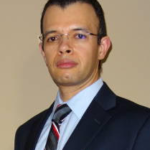

 Alex Gross, a Junior Aerospace engineering student, has been awarded the prestigious AIAA Cary Spitzer Digital Avionics Scholarship.