VSCL is proud to welcome two new graduate research assistants:
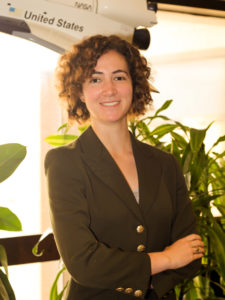
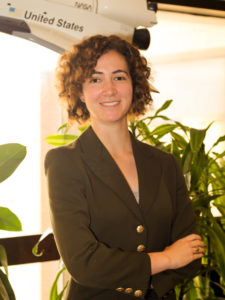
 Erin Swansen joins VSCL as a Ph.D. transfer student in the Aerospace Engineering department. Erin has over five years of experience in industry at Boeing as a guidance, navigation, and control engineer in the Advanced Autonomous Systems group. Her work involved guidance and control system development for a variety of aerial platforms including UAVs, high performance aircraft, and guided weapons. During graduate school, she has interned at NASA and Sandia National Laboratories doing flight control research and development. Her professional and research background includes significant work using robust and adaptive control to address challenges in flight, particularly for hypersonic vehicles. She has also conducted research sponsored by Sandia National Laboratories to develop a new methodology to improve performance of machine learning algorithms for sparse data sets. Her current research interests focus on implementable and verifiable algorithms that allow the safe use of machine learning in guidance and control architectures. Erin earned a B.S. in Systems Science and Engineering and an M.S. in Electrical Engineering from Washington University in St. Louis. With VSCL, Erin will be contributing towards the Center for Autonomous Air Mobility and Sensing (CAAMS) which is sponsored by the National Science Foundation (NSF).
 Payton Clem is a Master of Science Student in the Aerospace Engineering department. She is graduating from Texas A&M with her Bachelor of Science in Aerospace Engineering with Minors in Mathematics and Astrophysics in Fall 2023. During her undergrad, she was involved in campus activities like working at the Memorial Student Center to provide support to her fellow Aggies, and was a member of P.S.U.N., an on campus organization that provides free programs and events to children with special needs. Finding an interest in research, she worked in Dr. Daniel Selva’s lab, SEAK, on a NASA SBIR project with Aureus Innovation to develop a new systems engineering language. This involved creating a satellite design from scratch using systems engineering diagrams with the SIMPL developing language. Within the SEAK lab she also assisted in developing a rule based planner that would be used in a space mission simulation for space mission design. She was also the project lead of her capstone design group, which provided a satellite constellation design, as well as mission planning software to aid in the solution of an on-orbit servicing problem for L3Harris. As she continued her research, Payton developed an interest into the applications of artificial intelligence within the aerospace engineering field. Payton became a member of VSCL in her senior year, applying her interest in AI by working on the Robust Threat Detection project, research she will continue during her Masters. Her work with VSCL will be primarily focused on Autonomous, Nonlinear Control of Air, Space and Ground Systems.
 VSCL alumnus Dr. Ryan Weisman ’12 has been inducted as a 2023 Fellow of
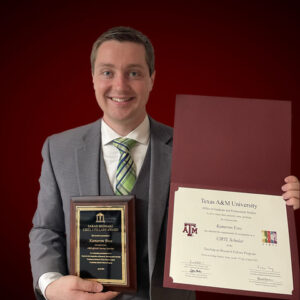 Ph.D. student Kameron Eves received two awards from the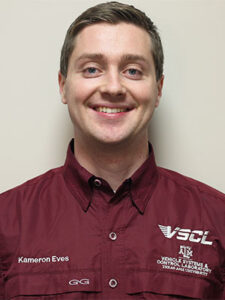
 Dr. John Valasek and the Vehicle Systems & Control Laboratory has been awarded a multi-year (2023-2026) research grant by the Office of Naval Research (ONR) to investigate multiple time scale (MTS) adaptive control systems for naval applications such as unmanned air systems (UAS), high performance aircraft, and satellites. MTS systems are systems with some states that evolve quickly and some states that evolve slowly. These systems can have coupled fast and slow modes which occur simultaneously. MTS systems are particularly interesting from a controls perspective because the time scale separation in the plant can cause degraded performance or even instability under traditional control methods. Accounting for the time scales can remedy this problem. For example, a MTS control technique demonstrated significantly reduced rise times over traditional Nonlinear Dynamic Inversion (NDI). Similarly, traditional adaptive control has been demonstrated to have reduced performance on MTS systems. On the other hand, traditional control techniques that are specifically designed for MTS systems cannot account for systems with model uncertainties. Thus, a method of MTS control for uncertain systems is needed.