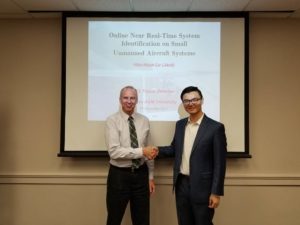
VSCL researchers Raul Santos, Seth Johnson, Carla Zaramella, Zach Curtis will present papers in January at the 2026 AIAA SciTech Forum in Orlando, Florida.
 On 12 January, Raul Santos will present the paper ”Deep Reinforcement Learning Waypoint Generation for Attitude Station-Keeping with Sun Avoidance”. This work studies deep reinforcement learning–based waypoint generation for autonomous on-orbit attitude control and examines how observation and action space design influence neural network performance.
Santos, Raul, Binz, Sadie, McQuinn,Cassie-Kay, Valasek, John, Hamilton, Nathaniel, Hobbs, Kerianne L., and Dulap, Kyle, ”Deep Reinforcement Learning Waypoint Generation for Attitude Station-Keeping with Sun Avoidance,” 2026 AIAA Science and Technology Forum and Exposition, Orlando, FL, 12 January 2026
On 12 January, Seth Johnson will present the paper “Modular Open System Architecture for Low-cost Integrated Avionics (MOSA LINA)”. This work investigates a modular, open-system avionics architecture for experimental vehicles that reduces integration complexity and supports platform-agnostic mission reconfiguration through plug-and-play sensor integration. Two case studies are investigated: one focused on synchronized high-fidelity data collection and the other on autonomous fixed-wing target tracking.
Johnson, Seth, Santos, Raul, Martinez-Banda, Isabella, Luna, Noah, and Valasek, John, “Modular Open System Architecture for Low-cost Integrated Avionics (MOSA LINA),” 2026 AIAA Science and Technology Forum and Exposition, Orlando, FL, 12 January 2026.
 On 15 January, Carla Zaramella will present the paper “Identification of Non-Dimensional Aerodynamic Derivatives using Markov Parameter Based Least Squares Identification Algorithm”. This work expands apon previous developments of the MARBLES algorithm to directly identify non-dimensional stability and control derivatives using computed Markov Parameters with a least squares estimator and a priori information.
Leshikar, Christopher, Zaramella, Carla, Madewell, Evelyn, and Valasek, John, “Identification of Non-Dimensional Aerodynamic Derivatives using Markov Parameter Based Least Squares Identification Algorithm,” 2026 AIAA Science and Technology Forum and Exposition, Orlando, FL, 15 January 2026
 On 16 January, Zachary Curtis will present the paper “Real-Time Controller Architecture for sUAS Flight Test”. This work investigates a C++/ROS architecture for real -time controller implementation. The said architecture, Kanan, allows safe and fast integration of custom controllers across a broad range of vehicles and controller types.
Luna, Noah, Valasek, John, and Curtis, Zachary, “Real-Time Controller Architecture for sUAS Flight Test,” 2026 AIAA Science and Technology Forum and Exposition, Orlando, FL, 16 January 2026.
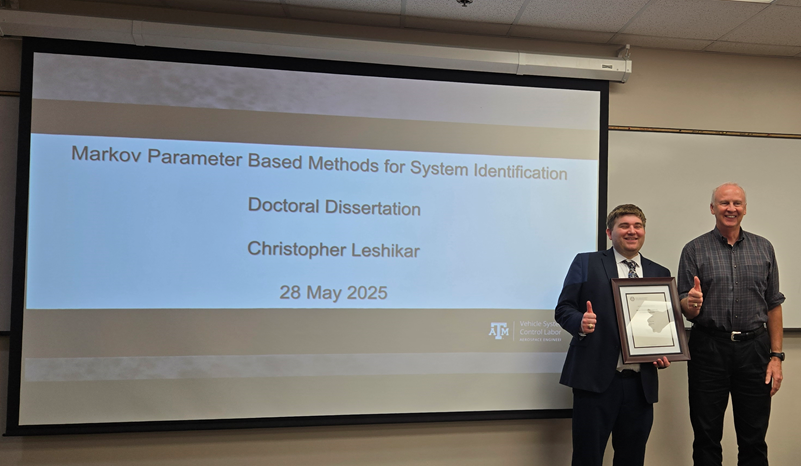
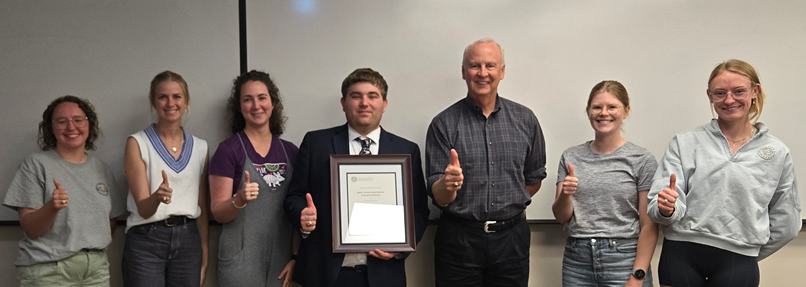
 This paper presents a summary of system identification flight testing and results for a variety of large and small fixed-wing and multirotor Unmanned Air Systems at Texas A&M University from 1999-2023. The six different types of vehicles range from a large powered-parafoil, to a fixed-wing vehicle with synthetic jet actuated roll control effectors, to a radially asymmetric multirotor, to large and small fixed-wing vehicles, and a Steppe eagle. The Observer/Kalman Filter Identification algorithm is used to generate linear time invariant state-space models, and results for both near real-time online model generation, and post-flight offline model generation are presented. The use and efficacy of a variety of test input types and their sensitivity to exogenous inputs such as turbulence, in addition to identified model evaluation and selection criteria are discussed. Several generations of low size, weight, power, and cost flight test instrumentation including the Developmental Flight Test Instrumentation data acquisition package are also presented. Challenges that arose from the flight testing campaigns along with solutions are highlighted in the paper.