• Skip to primary navigation
  • Skip to main content
  • LinkedIn
  • Videos
  • Research
    • Facilities
    • Vehicles
    • Sponsors
  • Publications
    • Books
    • Journal Papers
    • Conference Papers
  • People
    • Faculty
    • Staff
    • Graduate Students
    • Undergraduate Students
    • Alumni
    • Where VSCL Alumni Work
    • Friends and Colleagues
  • Prospective Students
  • About Us
  • Contact Us
  • Where VSCL Alumni Work

Texas A&M University College of Engineering

Research

Our research is focused on bridging the scientific gaps between traditional computer science topics and aerospace engineering topics, while achieving a high degree of closure between theory and experiment.  We focus on machine learning and multi-agent systems, intelligent autonomous control, nonlinear control theory, vision based navigation systems, fault tolerant adaptive control, and cockpit systems and displays.  What sets our work apart is a unique systems approach and an ability to seamlessly integrate different disciplines such as dynamics & control, artificial intelligence, and bio-inspiration.  Our body of work integrates these disciplines, creating a lasting impact on technical communities from smart materials to General Aviation flight safety to Unmanned Air Systems (UAS) to guidance, navigation & control theory.  Our research has been funded by AFOSR, ARO, ONR, AFRL, ARL, AFC, NSF, NASA, FAA, and industry.

Autonomous and Nonlinear Control of Cyber-Physical Air, Space and Ground Systems

Vision Based Sensors and Navigation Systems

Cybersecurity for Air and Space Vehicles

Air Vehicle Control and Management

Space Vehicle Control and Management

Advanced Cockpit/UAS Systems and Displays

Control of Bio-Nano Materials and Structures

Autonomous Air Refueling Concepts For Area Dominator Vehicle

Boeing Phantom Works Through Sargent Fletcher, Inc. and StarVision Technologies
1 November 2003 – 30 October 2007
Total Award $358,000

A high fidelity AAR simulation will mitigate the risk associated with these demonstrations, particularly the air-to-ground and air-to-air flight tests. While simulations of individual components, such as the VisNav sensor, have already been implemented, no comprehensive simulation has been created that realistically captures the behavior of the combined AAR system (sensors, controller, tanker, and receiver). Such a simulation will allow for the identification and resolution of system deficiencies before flight testing, where unforeseen problems are more costly in terms of schedule and budget.

The simulation will be used to 1) validate the adequacy of the VisNav navigation solution, 2) validate the proposed controller in terms of performance and robustness, and 3) generate a set of operating conditions where the system is expected to perform. The simulation will be able to test scenarios involving various tanker and receiver vehicle relative range and velocities, various lighting conditions, and disturbance effects.

Working with me on this program are Graduate Research Assistants:

  • Roshawn E. Bowers
  • Changwha Cho
  • Jeff Morris
  • Tom Wagner

Institute for Intelligent Bio-Nano Materials and Structures for Aerospace Vehicles

NASA Langley Research Center
1 September 2002 – 31 August 2007
Co-P.I.s John L. Junkins, Dimitris Lagoudas, Othon K. Rediniotis, John D. Whitcomb, and James Boyd
Total award $15,760,418

NASA has chosen Texas A&M University to lead the Texas Institute of Intelligent Bio-Nano Materials and Structures for Aerospace Vehicles (TiiMS), bringing together some of the top researchers in Texas and the world — including a Nobel laureate and several members of the National Academies — in biotechnology, nanotechnology, biomaterials and aerospace engineering to develop the next generation of bio-nano materials and structures for aerospace vehicles. The technical scope for the institute focuses on basic research issues underlying the major theme of TiiMS — the marriage of biotechnology with nanotechnology to enable the development of intelligent reconfigurable aerospace structures.
The main focus of TiiMS is to develop and advance the nano and biotechnologies that enable our vision of adaptive, intelligent, shape-controllable micro and macro structures, for advanced aircraft and space systems. The key is integrating intelligence and multifunctionality into the varied components of aerospace systems and vehicles. Our research seeks to investigate and develop advanced control systems to enable intelligence, agility and adaptability of aerospace vehicles made from these smart materials.

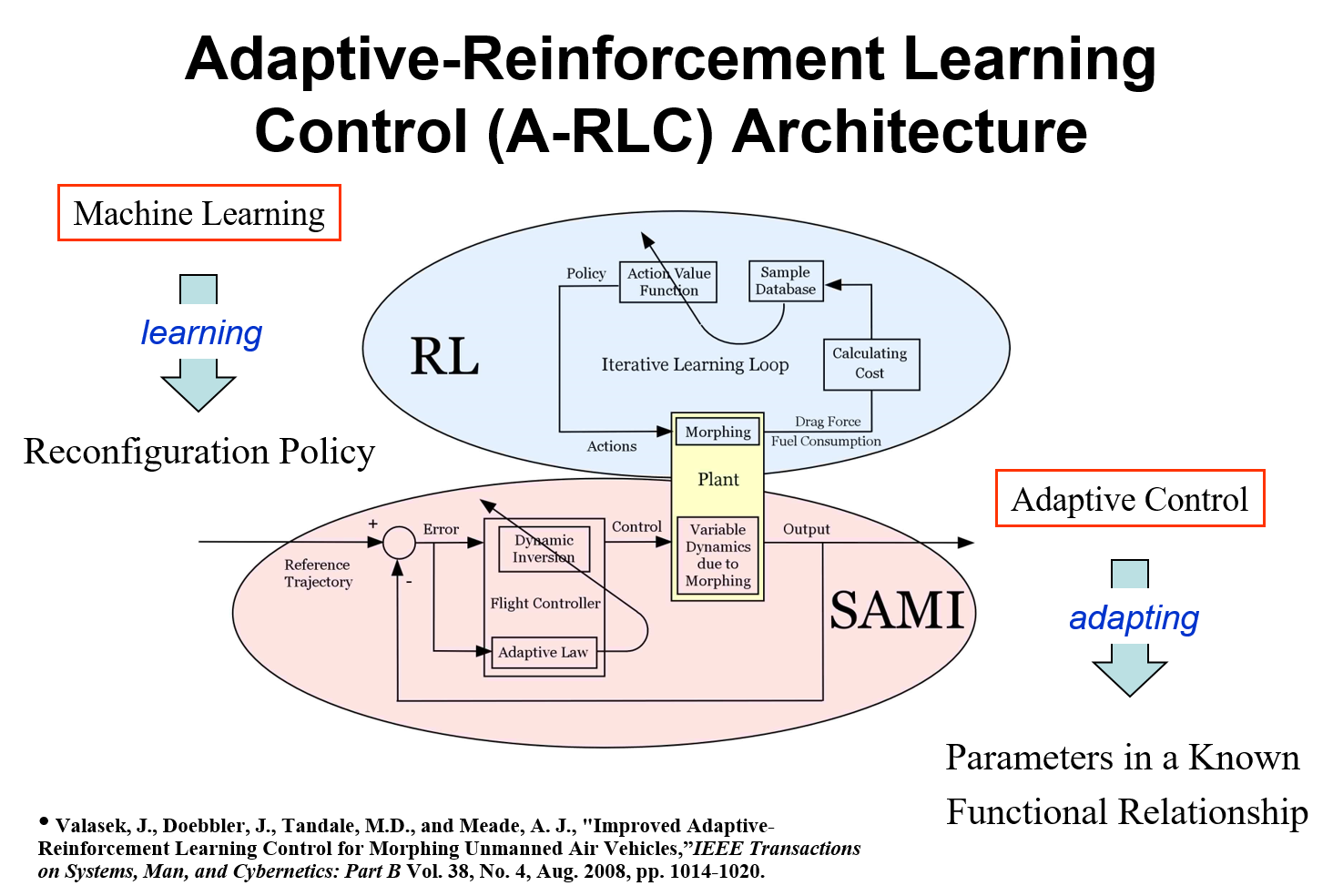
Research Objective 1: Characterization of Shape Memory Alloys using an Artificial Intelligence approach. The capability to control shape modifications of Shape Memory Alloy materials benefits from accurate models of the voltage/current-force/deformation relationships. These models are typically developed from a constitutive relation for the Shape Memory Alloy behavior which is then integrating into a structural model. The characterization approach used here does not need a constitutive model, but uses Reinforcement Learning to directly learn an input-output mapping characterization from physical experimentation, in real-time. This has the potential to significantly simplify and speed up the characterization process. Adaptive-Reinforcement Learning Control (A-RLC), a computational method that we created and developed, is being used to bridge the gap from numerical simulation to physical experimentation. We have designed and built a bench-test rig to validate the approach, and besides characterization, an optimal control policy is determined that learns how to control the shape of a Shape Memory Alloy to a specified length.
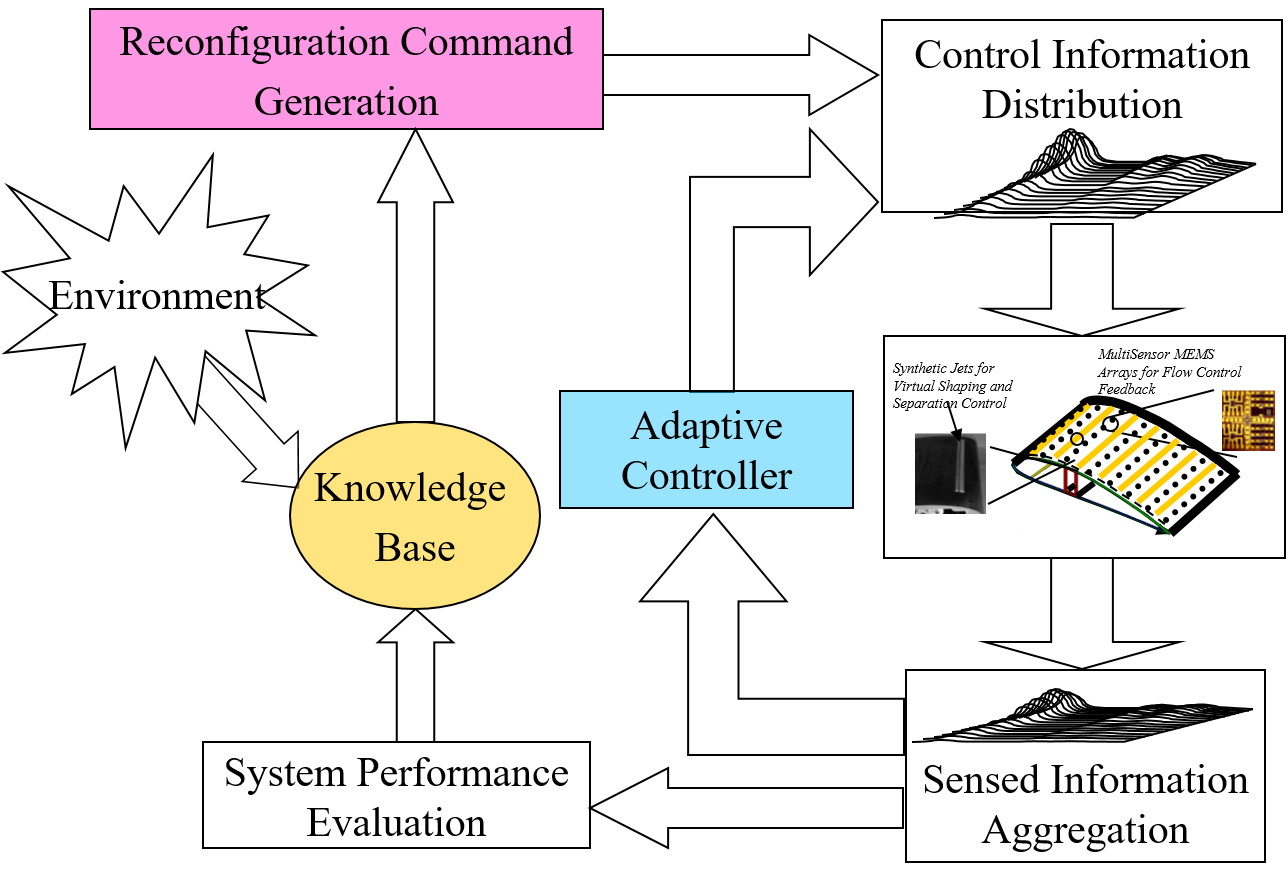
The results of this Objective are expected to aid in characterizing the effectiveness of this type of advanced control mechanism in intelligent systems, and further research in the modeling and control of morphing air and space vehicles.

Objective 1 goals:

  • Determine the length of time that is required for the A-RLC unit to learn the nonlinear model of the actual material that will be employed in a morphing wing.
  • Determine the A-RLC unit’s ability to optimize state-value functions and minimize a cost function of trajectories after having already learned the SMA model while not having had experience of the particular set of states required.
  • Compare the A-RLC unit’s deduction of SMA behavior with current mathematical models of SMA behavior.
  • Generate data that will allow future modification of the A-RLC unit to more quickly optimize the behavior of SMA actuators.

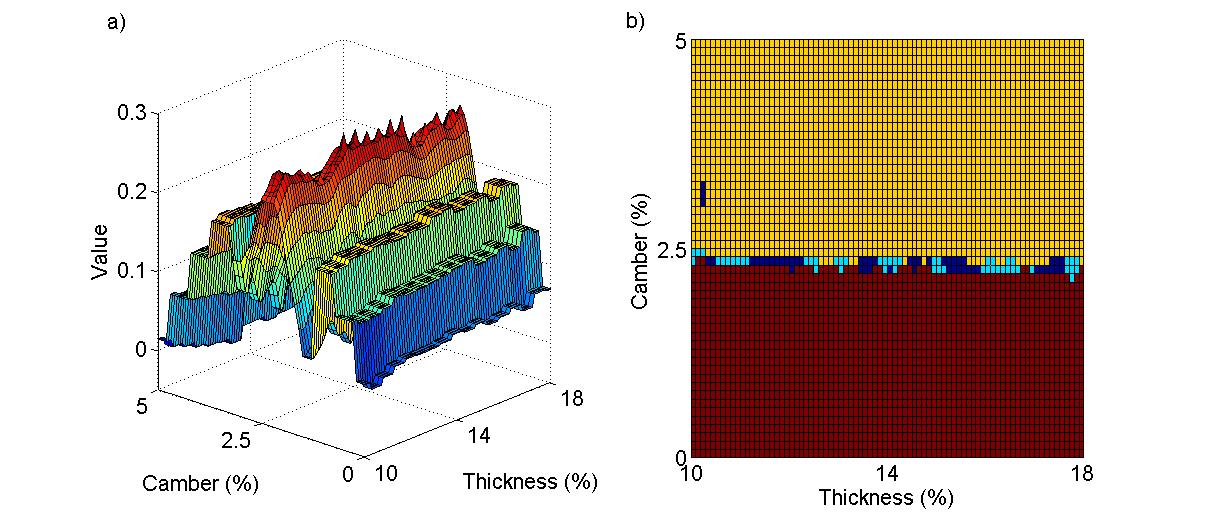
Research Objective 2: Intelligent shape changing control of morphing air vehicles that use distributed actuation and sensing on a massive scale. The Defense Advanced Research Projects Agency (DARPA) uses the definition of an air vehicle that is able to change its state substantially (to the order of 50% more wing area or wing span and chord) to adapt to changing mission environments, thereby providing superior system capability that is not possible without reconfiguration. We are developing an Adaptive-Reinforcement Learning Control (A-RLC) methodology to the problem of Morphing for Mission Adaptation. A-RLC is a marriage of traditional feedback control and Artifcial Intelligence intended to address two of the three essential functionalities for a morphing vehicle: how to reconfigure, and learning to reconfigure. The third is knowing when to reconfigure. A-RLC uses Structured Adaptive Model Inversion (SAMI) as the controller for tracking trajectories and handling time-varying properties, parametric uncertainties, un-modeled dynamics, and disturbances. Reinforcement Learning with a Q-Learning algorithm is used to learn how to produce the optimal shape at every flight condition over the life of the aircraft. Important aspects of nonlinear, massively distributed actuation and sensing systems are control effector saturation and stability. We are developing a rigorous theoretical framework that addresses these aspects. The A-RLC methodology will be demonstrated with a numerical simultation example of 3-D delta wing unmanned air vehicle that can morph in all three spatial dimensions, over a set of optimal shapes corresponding to specified flight conditions, while tracking a specified trajectory in the presence of disturbances.
Objective 2 goals:

  • Modeling and control of hierarchical adaptive systems.
  • Distributed sensing, actuation and intelligence.
  • Applications at different length scales.

Research Objective 3: Space Based Radar (SBR) antenna reconfiguration by morphing. The state of the art in spacecraft communication requires that multiple antennas be mounted on a single spacecraft so as to permit communication with multiple ground stations, many of which have unique receivers and transmitter characteristics. Our approach is to use a single antenna capable of altering its geometry to achieve world-wide compatibility between receivers and transmitters. We seek to develop and demonstrate the feasibility of a reconfigurable antenna shape controller that can achieve and control the optimal antenna shape, on demand. Shape-Memory Alloys (SMA) have been employed to enhance structural properties and increase the ability of structures to adapt and conform as desired, and antenna elements rigged with SMA actuators will be used here as the actuation element. Adaptive-Reinforcement Learning Control A-RLC) will be used to efficiently alter the antenna shape to achieve optimal concavity. This controller is capable of independently learning the optimal concavity in a lifelong sense, thus allowing a space-based radar and communication systems to decrease the quantity of antennas currently mounted on spacecraft.

Objective 3 goals:

  • Synthesize an original Reinforcement Learning algorithm.
  • Construct a simple finite element model of a parabolic antenna element.
  • Quantify input/output behavior of a space antenna utilizing SMA actuators.
  • Demonstrate reconfiguration capability using simulation.

Working with me on this program are Graduate Research Assistants:

  • Monish Tandale
  • Jie Rong
  • Paul Gesting
  • James Doebbler
  • Theresa Spaeth

and Undergraduate Research Assistants:

  • Chris Haag
  • Holly Feldman


Intelligent Vision Sensing For Motion Based Guidance

State of Texas Advanced Research Program, Austin, TX
1 January 2002 – 31 December 2003
Co-P.I. John L. Junkins
Total award $240,000

NASA Langley Research Center

VisNav Glove Flight System
Air vehicles have always required numerous hours of pilot training to obtain a sufficient level of competence. Most people can understand the pitching, rolling, and yawing motions of an airplane by simply watching them fly. However translating these motions into control stick, throttle, and rudder petal movements is much less intuitive. This research focuses on the development of a new glove-based input device, utilizing the revolutionary Vision Based Navigation system, developed at Texas A&M, called VisNav. This data glove type interface is designed to enable the average person to command and fly an aircraft, using only hand motions. This is a very intuitive and natural way to pilot an airplane, and requires very little specialized training. It is a particularly useful capability for rapid prototyping and evaluation of flight control concepts at real-time flight simulator facilities. This concept can also be extended outside of the simulator to allow for remote control of semi-autonomous unmanned aerial vehicles.

Over the last five years, the Aerospace Engineering Department at Texas A&M University has been researching and developing an intelligent Vision Based Navigation system called VisNav. The VisNav system comprises a new kind of optical sensor combined with structured active light sources (beacons) to achieve a selective or “intelligent” vision. Light is structured in the frequency domain, analogous to radar, so that discrimination and target identification is near-trivial even in a noisy ambient environment. We have applied this technology to the problems of autonomous docking and rendezvous of spacecraft (NASA Johnson Space Center), autonomous landing of UAV’s on ships (Office of Naval Research), and autonomous aerial refueling of UAV’s (Army Research Office). Essentially, anywhere that extremely accurate relative position and flight rate information is needed with miniaturized equipment.

Specific tasks and research objectives:

  • Identify the technology factors and requirements for extending the basic VisNav technology.
  • Use these technology factors and requirements to enable development of a VisNav wireless data glove for the remote control of vehicles using hand motions and gestures.
  • Demonstrate real-time operation of the data glove for controlling a high fidelity, real-time, flight simulator.

Working with me on this program are Graduate Research Assistants:

  • Brian Wood
  • Roshawn Bowers
  • Yuanyuan Ding

Cooperative and Formation Control of Autonomous Vehicles

Army Research Office through a National Defense Science and Engineering Graduate Fellowship (NDSEG)
1 September 2001 – 31 August 2004

Cooperative and formation control of autonomous land, air, and underwater vehicles is an emerging technology area with a seemingly endless array of military and civil applications. In the case of air vehicles, autonomous formation control will provide enhanced tactical effectiveness and a large reduction in aerodynamic drag due to a change in the direction of the lift vector due to the upwash of the lead aircraft. This effect is similar to the familiar “drafting” in automotive racing. Aircraft formation flight control research in the Flight Simulation Laboratory at Texas A&M University is aimed at designing, testing, and evaluating robust, stable control algorithms to be used in both manned and unmanned aircraft formation control applications.

Our approach is to use a structural dynamics analogy for an unconstrained formation of generic vehicles in one or two dimensions. For individual vehicles, this framework consists of formulating the equations of motion with virtual dampers and springs, and then using feedback linearization to eliminate nonlinearities and drive errors asymptotically to zero. A virtual formation is used to control the trajectory of all vehicles within the formation, by specifying the desired trajectory of its center of mass.

Specific tasks and research objectives:

  • Formulate the governing equations so that the least amount of data flow as possible is required between vehicles.
  • Determine the requirements on accuracy for practical application to flight vehicles.
  • Integrate the formation controller with the Fault Tolerant Structured Adaptive Model Inversion (SAMI) control methodology.
  • Test and evaluate the control algorithms via non real-time and real time simulation.
  • Investigate schemes for cooperative control of vehicles in formation.

Future phases of this project will encompass nonlinear control design methods, and integrate the Vision Based Navigation (VisNav) relative positioning system to provide accurate relative position measurements in real-time. Formation flight testing of the algorithms will be conducted at the Flight Test Facility of the Texas A&M Flight Mechanics Laboratory, using the Maxdrone research UAV.


Working with me on this program is Graduate Research Assistant:

  • Edward R. Caicedo

Autonomous Aerial Refueling of Unmanned Air Vehicles

Army Research Office through a National Defense Science and Engineering Graduate Fellowship
1 September 2001 – 31 August 2004

Unmanned Aerial Vehicles (UAV’s) have many important applications ranging from military to research and everyday civilian uses. The goal of this research is to extend the operational envelope of UAV’s by designing an autonomous in-flight refueling system. One of the most difficult technological hurtles to overcome in autonomous in-flight refueling is the need for a highly accurate sensor to measure the locations of the tanker and the aircraft. Currently GPS is limited by an approximately one-foot accuracy.

This project overcomes the sensor accuracy problem by utilizing a revolutionary Vision-based Navigation system called VisNav. Since 1998, Texas A&M researchers have been developing a revolutionary vision system that accurately determines the line of sight vector between two objects, to an accuracy of millimeters. It is capable of providing the needed six degree-of-freedom information for real-time navigation, and can enable accurate autonomous aerial refueling without extensive alterations in the current refueling systems. It can be applied to both the current probe-and-drogue as well as the boom method for refueling. VisNav comprises a new kind of optical sensor combined with structured active light sources (beacons) to achieve a selective or “intelligent” vision. VisNav structures light in the frequency domain, analogous to radar, so that discrimination and target identification is near-trivial even in a noisy ambient environment. Several Light Emitting Diodes (LED) called beacons, are attached to the refueling target frame ##A##, and an optical sensor, or Position Sensing Diode (PSD), on the aircraft frame ##B##.

The LEDs emit structured light modulated with a known waveform; filtering of the received energy allows all ambient energy to be ignored. Thus VisNAv can be used in 100 percent cloud cover, total darkness, and adverse weather conditions. The position of the light centroid on the PSD is directly related to the centroid of the beacons with respect to the location of the PSD on the aircraft. A Gaussian Least Squares Differential Correction (GLSDC) routine is used to calculate the six-degree of freedom data at an update rate as high as 100 Hz.

Working with me on this program is Graduate Research Assistant:

  • Jennifer J. Kimmett

Development of an Integrated Multidisciplinary Curriculum for Intelligent Systems

National Science Foundation
1 March 2001 – 29 February 2004
Co-P.I.s Dimitris C. Lagoudas, Thomas W. Strganac, Othon K. Rediniotis, and John D. Whitcomb
Total award $354,999

This program is a curriculum development in the Aerospace Engineering department which provides undergraduate students an optional degree specialization in intelligent systems, encompassing both specialized core courses and elective courses throughout the freshman through senior years. Each participant receives specialized instruction in intelligent autonomous vehicles; biomimetics; smart materials technology; fluid-structure-control interactions; multidisciplinary design optimization; computational mechanics; controls; aerodynamics; and structures. The capstone of this program is a two-semester senior design sequence in which students design, simulate, test, build, and fly intelligently controlled uninhabited aerial vehicles (UAVs). Students who complete this Intelligent Systems option receive a certificate recognizing their accomplishment.

Working with me on this program are Graduate Research Assistants:

  • Brian Wood
  • Monish Tandale
  • Roshawn Bowers

Flight Tests of an Unmanned Powered Parachute: A Validation Tool for GN&C Algorithms

Advanced Mission Design Branch, NASA Johnson Space Center
1 September 2000 – 31 December 2001
Co-P.I.s Donald T. Ward, Thomas C. Pollock, and David W. Lund
Total award $219,534

Paratows  buckeyes
The NASA X-38 is the prototype of a Crew Return Vehicle (CRV) which will be used as an emergency escape system or lifeboat from the International Space Station. The X-38 and CRV are some of the first re-entry vehicles to use a parafoil for maneuvering during the terminal phase of its operational trajectory. The CRV will operate with a high degree of autonomy, and its guidance algorithms must be able to avoid obstacles in the landing area, and permit touch down with a rate of descent that will not harm the vehicle occupants, who could be injured or otherwise incapacitated.

To exercise the guidance algorithms and serve as a testbed for the X-38, NASA purchased two Buckeye “powered parachutes”. One vehicle was configured and instrumented to fly autonomously. To assist with the modeling of this vehicle and validation of the guidance algorithms and instrumentation package, tow tests of the X-38 parafoil system (above left) and flight tests of the Buckeye vehicle (above right) will be conducted at the Flight Test Facilityof the Texas A&M Flight Mechanics Laboratory.

Specific tasks and research objectives:

  • Assess the ability of various guidance algorithms to be flown on V201 to maintain heading control.
  • Measure the targeting capability of algorithms for V201 use.
  • Validate wind alignment and estimation performance attained by the guidance algorithms.
  • Quantify navigational errors (including actual deviations from the desired trajectory, biases, noise, etc.) acheieved during the simulated terminal phase maneuvering.
  • Compare data from Buckeye flights to simulator predictions of performance and extrapolate the findings to the X-38 vehicle in its terminal maneuvering.
  • Provide a hvehicle for emulating pallet drops (modeling the larger parachute planned for V201) that could use the terminal guidance algorithms.
  • Develop and valdiate the use of the autonomous Buckeye vehicle as a hazard avoidance testbed.

Working with me on this program are Graduate Research Assistants:

  • Gi-Bong Hur
  • Dallas Hopper
  • Edward R. Caicedo

Synthesis and Evaluation of Robust Dynamic Inversion Flight Controllers for X-38 Class Re-Entry Vehicles

GN&C Design and Analysis Branch, NASA Johnson Space Center
1 May 2000 – 1 May 2001
Total award $97,320

X-38 In Flight Test
As opposed to traditional synthesis techniques, in which the nonlinear plant is separated into several linearized models at discrete operating points, and a closed-loop controller is synthesized for each one, Dynamic Inversion seeks to synthesize a global control law from a single nonlinear model. Two open research issues are the “user friendliness” of designing Dynamic Inversion controllers, and controller robustness and fragility.

A previous Dynamic Inversion study on the X-38 conducted at Texas A&M (see below) partially addressed the first of these open issues by generating a comprehensive design guidelines document complete with tutorials, procedures, tools, and examples.

With regard to the second issue, Dynamic Inversion by itself cannot assure stability and performance robustness to disturbances and perturbations in the plant and controller. Therefore, an additional robust control technique must be married to the Dynamic Inversion controller to ensure robustness. There are several robust control techniques and robustness measures currently available to the control designer. Examples in the current literature show a tendency to use whatever robust control and analysis techniques the designer is most familiar with, as opposed to those which are best for a particular application. H-infinity and Mu-synthesis are two of the more popular techniques.

Specific tasks and research objectives:

  • Demonstrate practical application of the guidelines, procedures, tools, and software previously developed, and validate the design guidelines document. This will be done with a Dynamic Inversion controller design case study for a re-entry vehicle.
  • Identify and evaluate the advantages that European Dynamic Inversion methods have to offer in terms of ease of use, and suitability for implementation, compared to the particular Dynamic Inversion approach commonly used in North America. These advantages will be directly incorporated into the comprehensive design methodology.
  • Develop new, non-conservative robustness measures, and examine the fragility of Dynamic Inversion control laws.

Working with me on this program are Graduate Research Assistants:

  • Jennifer A. Georgie
  • Dai Ito

Cockpit Data Fusion with Fixed-Base Simulation Validation for Free-Flight Guidance

State of Texas Advanced Technology Program, Austin, TX
1 January 2000 – 31 December 2001
Co-P.I. John H. Painter
Total award $208,061

Texas A&M Flight Simulation Laboratory
This research aims to solve a fundamental technical problem associated with civil aviation moving operationally into Free Flight, the new air traffic management paradigm intended to make the nation’s air traffic control system safer and more efficient. Presently, air traffic is managed through ground tracking, ground computing, and verbal negotiations between ground controller and pilot. Conceptually, Free Flight allows a pilot significant latitude to optimize a flight trajectory, as it is being flown. An important ramification, especially for General Aviation, is that responsibility for aircraft separation will rest increasingly with the pilot. The entire Free Flight scheme relies on greatly increased digital data flow between pilot, ground controller, and between all aircraft in the immediate airspace. Onboard computing then uses this collected data to optimize individual aircraft guidance.

GAPATS Display
Technically, the research problems are those of cockpit data fusion onboard the aircraft, and of computational and visual aids for pilot and ground controller. Our approach is to extend our previous work in independent flight software agents, to the development of a single high dimensional “Arbitrator” agent. The Arbitrator will resolve conflicts between the guidance vectors produced by several independent agents. Data fusion software elements will be developed and implemented into flight software, and a real-time, fixed-base flight simulator will be used for validation.

Weather Radar Image. CLL is for Easterwood Airport, College Station, TX
The present research is based on five years of prior research in this area funded by NASA Langley Research Center, the State of Texas, and Rockwell/Collins. Some of the pilot decision aiding capabilities created and developed were an Independent Approach Monitor and an Independent Weather Agent. Many of the prior results will also be incorporated, including a new pilot decision aid based on Fuzzy Logic (patent applied for), and an integrated cockpit computation and display system, employing expert systems, for aiding the pilot in instrument flying, known as the General Aviation Pilot Advisor and Training System (GAPATS).

Specific tasks and research objectives:

  • Resolve trajectory guidance conflict resolution by implementing a suitable guidance software architecture and requisite algorithms, with validation by fixed-base flight simulation, under Free Flight conditions. This is the key technology item for enabling individual aircraft to compute and fly trajectories while simultaneously maintaining separation from other data-linked aircraft, from weather, and from terrain. Achievement of this objective is greatly aided by the existing fixed-base flight simulator, having the augmentable cockpit software system produced under the previous NASA Langley GAPATS project.
  • Simulator validation of the conflict resolution guidance software, specifically with regard to handling traffic restrictions for scenarios with multiple aircraft. This entails generating the multiple traffic trajectories that are to be digitally communicated to the aircraft, according to the Automatic Dependent Surveillance Broadcast (ADS-B) format and scenarios.
  • Simulator validation of the weather restrictions guidance software, for the conditions of squall line weather. Simulated radar intensity data for a moving line of thunderstorms will be generated, and this intensity data will be integrated into the existing moving map display, and into the existing simulator weather graphic, as seen from the cockpit.

Working with me on this program are Graduate Research Assistants:

  • C. Cale Stephens
  • Surya U. Shandy
  • Jie Rong
  • Sangeeta Bokadia
  • Dallas Hopper

and Undergraduate Research Assistants:

  • Kristi Ferber
  • Heather Ransom
  • Theresa Spaeth
  • Nicole Norstrud

Display Automation and Assessment Concepts for an Advanced Tactical Airlift Cockpit

Marconi Aerospace Defense Systems Inc., Austin, TX
15 October 1999 – 15 April 2000
Co-P.I.’s John H. Painter and Donald T. Ward
Total award $98,326

Royal Air Force C-130J Flight Deck
The United States Air Force is planning to modify approximately 525 aircraft to establish a common, supportable, cost effective baseline configuration for AMC, ACC, ANG, AFRC, PACAF, USAFE and AFSOC C-130 aircraft. The selected contractor will design, develop, integrate, test, fabricate and install a new avionics suite for approxi-mately thirteen variants of C-130 Combat Delivery and Special Mission models. The installation schedule requires a throughput of between 65 and 85 aircraft per year through 2010.

This research will study advanced display integration concepts for reducing crew workload, and improving situational awareness for the tactical airlift mission. It is an element in the risk reduction effort in conjunction with the Marconi-Honeywell effort for the C-130 Avionics Modernization Program (C-130 AMP).

Specific tasks include:

  • Analyzing the impact of current human factors requirements and developing metrics to allow evaluation of the effect of avionics improvements on individual and collective crew performance
  • Proposing tasks for cockpit automation that are likely to promote the two-man crew concept.
  • Evaluating potential contributions to rapid prototyping by the Texas A&M Flight Simulation Laboratory and its real-time, fixed-base flight simulator.

Working with me on this program is Graduate Research Assistant:

  • C. Cale Stephens
  • Jennifer A. Georgie

and Undergraduate Research Assistants:

  • Kristi Ferber
  • Dallas Hopper
« Previous Page
Next Page »

© 2016–2026 Log in

Texas A&M Engineering Experiment Station Logo
  • State of Texas
  • Open Records
  • Risk, Fraud & Misconduct Hotline
  • Statewide Search
  • Site Links & Policies
  • Accommodations
  • Environmental Health, Safety & Security
  • Employment