
• Skip to primary navigation
  • Skip to main content
  • LinkedIn
  • Videos
  • Research
    • Facilities
    • Vehicles
    • Sponsors
  • Publications
    • Books
    • Journal Papers
    • Conference Papers
  • People
    • Faculty
    • Staff
    • Graduate Students
    • Undergraduate Students
    • Alumni
    • Where VSCL Alumni Work
    • Friends and Colleagues
  • Prospective Students
  • About Us
  • Contact Us
  • Where VSCL Alumni Work

Texas A&M University College of Engineering

Research

Our research is focused on bridging the scientific gaps between traditional computer science topics and aerospace engineering topics, while achieving a high degree of closure between theory and experiment.  We focus on machine learning and multi-agent systems, intelligent autonomous control, nonlinear control theory, vision based navigation systems, fault tolerant adaptive control, and cockpit systems and displays.  What sets our work apart is a unique systems approach and an ability to seamlessly integrate different disciplines such as dynamics & control, artificial intelligence, and bio-inspiration.  Our body of work integrates these disciplines, creating a lasting impact on technical communities from smart materials to General Aviation flight safety to Unmanned Air Systems (UAS) to guidance, navigation & control theory.  Our research has been funded by AFOSR, ARO, ONR, AFRL, ARL, AFC, NSF, NASA, FAA, and industry.

Autonomous and Nonlinear Control of Cyber-Physical Air, Space and Ground Systems

Vision Based Sensors and Navigation Systems

Cybersecurity for Air and Space Vehicles

Air Vehicle Control and Management

Space Vehicle Control and Management

Advanced Cockpit/UAS Systems and Displays

Control of Bio-Nano Materials and Structures

OASIS: A System for Pinpoint Landing and Hazard Avoidance On Lunar and Martian Surfaces for both Manned and Unmanned Landers

Collaborative Effort with NASA Langley Research Center
15 May 2005 – present
Collaborator: David L. Raney

Supported by:
Texas Institute of Intelligent Bio-Nano Materials and Structures for Aerospace Vehicles (TiiMS) and NASA Langley LAARS Program

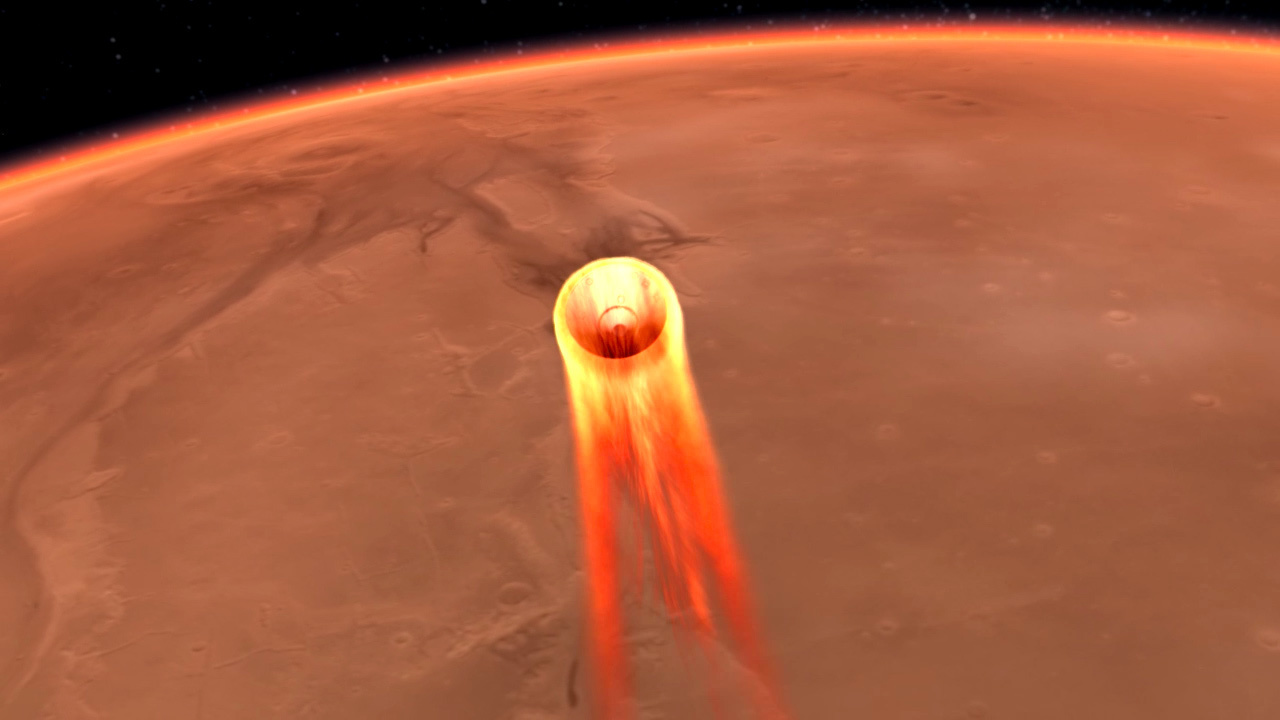
The NASA Exploration Initiative Spiral 2 exploration mission architecture involves heavy reliance on both manned and unmanned landers to pre-position and then leverage assets on the lunar surface.

This research is seeks to develop an Optionally Autonomous Surface Intelligence System (OASIS) to provide a pinpoint landing and hazard avoidance capability for both manned and unmanned landers that could operate on either the lunar or martian surface, to support Spiral 2 and follow-on Exploration Mission activities. The OASIS Project would develop a dynamic cost map-based guidance and control system along with a variable-autonomy interface for optional pilot control of descent and landing. These systems would be integrated with a real-time terrain mapping/hazard detection sensor to generate surface feature data for the formulation of the guidance cost map.

Crossrange and downrange maneuvering during the terminal landing phase is generally expensive in terms of propellant budget. To minimize the need for corrections during the final landing phase, the OASIS project will develop active control for early phases of reentry where minor guidance corrections and energy management maneuvers are highly leveraged. Additionally, the potential to actively control the descent path while the vehicle is on the chute will be investigated for Mars landers. Although steerable parafoil chute systems have been demonstrated on earth, such systems will pose novel dynamics and control challenges when scaled appropriately for the martian atmosphere. Finally, the OASIS Project will include a capability for real-time precision resolution of lunar/martian surface features to enable high precision terrain-based navigation to the final landing site during the terminal flight phase.

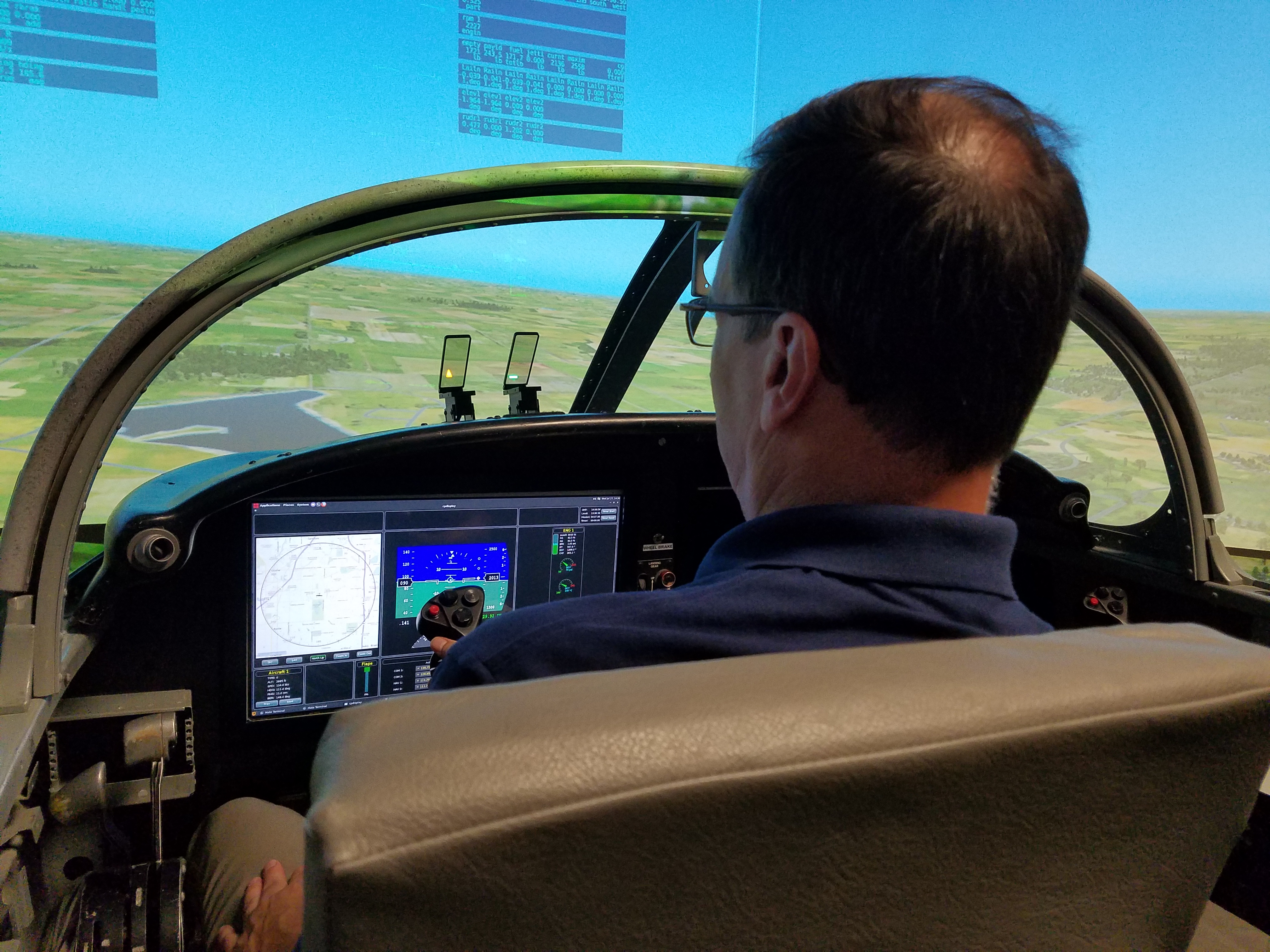
Variable autonomy will be a major research focus since manned landers will require the ability for human monitoring and optional intervention via an operator interface that is both intuitive and flexible. The OASIS Project will develop and implement a human-machine interface system that relates terrain hazard information and precision guidance through tactile, auditory, and visual cues, enabling the human to continuously elect a level of interaction that ranges from pure oversight to full manual control.

The high value of assets on board the lander will necessitate active detection and avoidance of surface hazards including large rocks, crevasses, and excessively rough or inclined terrain. The OASIS Project will develop a hazard-avoidance cost mapping algorithm that provides information to the lander’s terrain-based guidance and navigation system. This function will utilize data from the high precision surface feature resolution sensor suite.

Unprecedented landing precision will be required to complete the Spiral 2 activity. Historically, the touchdown precision of current entry, descent and landing systems ranges from approximately 3 km at best to tens of km in some cases. By contrast, the required precision for missions that leverage pre-positioned assets will be on the order of tens of meters. The OASIS Project will develop a system to provide active control through all phases of entry, descent, and landing to enable the required degree of landing precision.

Specific tasks and research objectives:

  • Acquire, modify, and host representative simulation model of manned lander.
  • Acquire and implement relevant atmosphere and terrain models for lunar and martian landing scenarios.
  • Develop and implement algorithms for fault tolerant control during early entry phases to enable high precision touchdown site acquisition.
  • Investigate potential for control on chute to reduce propellant requirements for high precision Mars landing.
  • Develop and implement active hazard detection sensor models and lander guidance cost mapping algorithms
  • Develop hazard avoidance and precision landing cueing interface for piloted lander simulation.
  • Integrate cost mapping guidance with piloted lander cueing interface.

Working with me on this program is Graduate Research Assistant:

  • Theresa Spaeth

UAV Hingeless Flight Controls via Active Flow Control, Phase I

Aeroprobe Corporation
1 May 2005 – 31 January 2006
Total award $33,000

Flow control seeks to modify the flow so that it behaves in a different (favorable) fashion compared to no control. It may be used to control or promote boundary layer transition, limit flow separation, replace conventional Aerodynamic Control Effectors (ACE) providing significant stealth benefits, augment lift, modify acoustic emissions or reduce drag. The potential benefits of flow control are many and varied: reduced structural weight, greater resistance to battle damage and improved survivability (fewer components and linkages), improved performance (drag relates to the number of breaks in the aircraft’s external surface), greater flight envelopes (separation suppression), reduced operational cost (fewer components) and greater stealth capability.

Flow control may be implemented passively or actively. Active flow control is seen as a means to performance enhancement and a way to replace conventional ACE. Active methods for flow control include blowing, suction, moving surface elements, oscillatory blowing/suction, wall oscillation, vibrating ribbons, and zero-mass-flux, finite momentum actuators or Synthetic Jet Actuators (SJAs).

This research seeks to answer specific questions about active flow control:

  1. What characteristics are necessary for a flow control effecter to be functional in this application?
  2. What vehicle configuration would benefit the most from such an effecter?
  3. How can the effects of the flow control be modeled?
  4. What type of flight control laws and feedback mechanisms would be necessary to control the aircraft via flow control actuators?
  5. How would using non-conventional flow effecters improve aerodynamic performance?

In this research, we develop and implement active flow control in an unmanned aerial vehicle (UAV) configuration to show how the design and application of active fluidic control may be used to improve the performance of a proposed UAV. The fluidic control is implemented using a combination of SJA and trailing edge continuous blowing (or SJA’s). The flow control may be used to extend the angle-of-attack envelope by suppressing flow separation and to achieve hingeless control by modifying the wing’s circulation through trailing edge flow manipulation (using a modular jet flap or circulation control). At high incidence, upper surface flow control using SJA’s is used to re-attach the flow while trailing edge blowing is used to achieve control authority. Our SJA design is well validated and has been shown to be reliable and effective in many investigations. Proposed methods for achieving aerodynamic modeling, sensors for feedback to aid in control, as well as control law are investigated.

Specific tasks and research objectives:

  • Determine a suitable actuator and implementation for flow control.
  • Unmanned aerial vehicle conceptual configuration layout.
  • Feedback methodology and implementation.
  • Modeling of effects of proposed ACE.
  • Control law design.
  • Performance improvement estimates.
  • Demonstration of key technology: ACE effectiveness.

Working with me on this program is Graduate Research Assistant:

  • Monish D. Tandale

Control of Forward Reaction Control System (RCS) Jets for Atmospheric Flight Risk-Reduction of Shuttle Orbiter During Entry

Collaborative Effort with
Peter F. Covell, NASA Langley Research Center
Alan Strahan, NASA Johnson Space Center

1 January 2005 – 31 December 2006
Supported by:
NASA Johnson Undergraduate Cooperative Student Program
NASA Johnson Graduate Internship Program
Texas A&M University Flight Simulation Laboratory

During shuttle orbiter entry, failure or degradation of flight control effectiveness or vehicle aerodynamics may result in loss of vehicle control. The loss of the shuttle orbiter Columbia was an example of this, and other failure scenarios include:

  1. Debris impact renders aft Orbital Maneuvering System (OMS) / Reaction Control System (RCS) inoperable, or degrades aero surface control effectiveness.
  2. Wing damage induces an aerodynamic asymmetry greater than the baseline flight control system can handle.
  3. Vehicle damage requires flight at off-nominal attitudes to protect damaged regions from extreme thermal load.

In theory, the forward RCS jets can be used to provide additional torque to maintain yaw control in situations where the aft RCS jets alone are insufficient. The forward RCS jets are not currently used for atmospheric flight control on the shuttle orbiter because the baseline controller was designed to sufficiently handle the present flight/risk envelope without using them. This was largely due to an old aerodynamics “myth” that said the forward RCS jet interactions can be adverse, and thus unsuitable for vehicle control purposes. Although it is true that adverse effects can occur at low angle-of-attack, they are far less likely to occur at higher angle-of-attack, and in August 2004 an aerodynamics Proposal Review Team re-visited the concept and concluded that there were no major aero-mechanic issues that would prohibit use of forward RCS for entry control.

The objective of this research is to design a controller that uses the forward RCS jets to provide additional torque for a damaged vehicle, or a vehicle with damaged control surfaces, or damaged aft jets, to augment the nominal controls during entry. Although the shuttle orbiter retains a fuel reserve of forward RCS jet propellant during entry, the ratio of forward and aft jet activity must be balanced to stay within availability constraints and center of gravity limitations. Use of the aileron and rudder trim limits can help this. A control allocation scheme couple with a fault tolerant Structured Adaptive Model Inverse (SAMI) adaptive controller will be used to detect damage induced torque effects and failed jets.

Specific tasks and research objectives:

  • Assess value of using forward RCS during entry failure scenarios.
  • Develop updated aero model by extending current aero database above Mach 4.5 to characterize RCS jet interactions.
  • Design wrap-on control law to include forward RCS.
  • Conduct non real-time simulator evaluation.
  • Conduct preliminary risk assessment.
  • Conduct real-time simulator evaluation using Shuttle Engineering Simulator (SES).
  • Implement control allocation scheme.
  • Synthesize and develop Structured Adaptive Model Inverse (SAMI) adaptive controller.

Potential long-term study elements include investigation of the multi-axis RCS contributions afforded by the forward pitch RCS jets, and the aft pitch and roll jets.

Working with me on this program is Undergraduate Research Assistant:

  • Carolina Restrepo

Support for Autonomous Aerial Refueling System (AARS) Demonstration

Star Vision Technologies
1 April 2005 – 31 October 2005
Co-P.I.David W. Lund
Total award $30,000

This program is an experimental feasibility assessment of an innovative and robust Autonomous Aerial Refueling System (AARS). The system has been tailored to specific powered munitions and will provide significant battlefield enhancements by allowing persistent and sustained air operations. The AARS proposed is the result of several years of studies and feasibility assessments and includes a novel vision-based relative navigation sensor, an Intelligent Supervisory Control system and customized refueling hardware. Leveraging prior feasibility assessments, the proposed Phase I effort will include an innovative flight experiment including the critical components of the AARS, a Boeing Phantom Works donated vehicle, and ground support contributions from the Texas A&M University’s Flight Mechanics Lab. The proposed Phase I flight experiment will help benchmark a high fidelity simulation model of the AARS with a powered munition. The flight experiment will address key feasibility issues and mitigate risks of conducting a Phase II aircraft-to-aircraft demonstration of the AARS in a relevant environment.

Successful unmanned refueling operations require a control system to govern the receiver approach, fuel system prep, stand-off, proximity engagement and hook-up. There are also aborts, emergency separations and fuel system shutdown commands that will have to occur under the direction of the overall AARS supervisory controller. Texas A&M University has developed a unique intelligent supervisory control system for automated rendezvous and docking that is being licensed to StarVision Technologies and Sargent Fletcher Inc. The intelligent supervisory control system leverages decades of manned refueling experience from Sargent Fletcher in a rules-based finite state logic machine. An appropriate communication system is used to transfer navigation information from tanker to receiver. The intelligent supervisor resides as code within the tanker and receiver flight controllers.

For refueling powered munitions with strict volume and mass constraints a new type of fuel delivery, vehicle mating, and receiver probe mechanisms were required. Sargent Fletcher has developed a set of customized and unique refueling hardware assemblies that include the triangle boom, the flycatcher, and the microprobe.

Our team has devised an innovative technique to validate the feasibility of the AARS in a relevant flight environment by leveraging significant hardware and facility contributions from the team members. The experiment will include a receiver vehicle flying in proximity to a moving target mounted from a truck. The experiment will be conducted at the Texas A&M University Flight Mechanics Lab (FML). The receiver air vehicle will pursue and dock with a target mounted on a moving truck. A mast is mounted to the truck to locate the VisNav beacons above the wake of the moving truck. A cage is provided to allow for radio control (RC) piloting of the receiver vehicle for aborts and emergencies. This also allows the RC pilots to be within visual range of the receiver throughout the proximity operation.

This low-cost and innovative flight experiment approach coupled with high fidelity simulations will allow the AARS to advance to a higher technology readiness level and proceed along the roadmap to an aircraft to aircraft docking demonstration. The data obtained from this experiment will allow the AARS team to modify the high fidelity Maltab/Simulink models with actual flight data and use the simulations to then test the AARS in a greater set of possible mission scenarios.

Specific tasks and research objectives:

  • Develop overall system architecture and coordinate the requirements and interfaces of the AARS. The main product is a coordinated set of tasks that efficiently produce the desired combination of simulation and flight experimentation.
  • Tailor the Intelligent Supervisory Control architecture to the specific application of the AARS. The output of this task is the software code that is compatible with the demonstration vehicle and a potential tanker vehicle (for Phase I this is a moving truck).
  • Develop a high fidelity simulation of the planned flight experiment that can be calibrated with actual flight data. This task will result in MATLAB/SIMULINK based simulation of the receiver vehicle and a model of the moving truck. This task includes development of models, controllers and anticipated flight trajectories, and evaluation of the simulated versus actual data.
  • Prepare the ground vehicle and support equipment for the flight experiment.
  • Integration of the AARS components into the receiver flight vehicle and conduct the flight experiments.

Working with me on this program are Graduate Research Assistants:

  • Jeff Morris
  • Tom Wagner
  • James Doebbler

Prediction of Icing Effects on the Stability and Control of Light Airplanes

Aeronautical and Educational Services Company
15 March 2005 – 30 June 2005
Total award $18,884

The accumulation of ice on aircraft in flight is one of the leading causes of general aviation accidents, and to date only relatively sophisticated methods based on detailed empirical data and flight data exist for its analysis. A useful tool for a basic analysis of icing effects on airplane performance, stability, and control is an accurate yet simplified dynamical simulation model, based upon relatively simple data for airplane configuration, propulsion system, mass properties, and icing data.

This research develops such a tool, and applies it to the investigation of stability and control characteristics, and climb and descent performance of a representative light aircraft in icing conditions. Empirical data and DATCOM methods will be used to develop a linear time-invariant, six degree-of-freedom state-space model of a Cessna 208. Validation of the model will be accomplished by comparison to commercially available flight test data for a Cessna 208. To investigate the effect of ice accretion on stability and control characteristics, climb maneuvers, and descent maneuvers, existing icing data for a light aircraft of similar configuration was incorporated into the model. It is assumed here that the icing accretion is fully developed, and configurations of wing icing alone; horizontal tail icing alone; and combined wing and horizontal tail icing will be analyzed using the component build-up method. A vortex lattice computer code will also be used to validate the results.

Specific tasks and research objectives:

  • Generate state-space linear airframe models of a representative light airplane in the clean configuration. Perform climb comparisons to commercially obtained flight data for the same aircraft to validate the models.
  • Incorporate icing effects on the state-space linear clean airframe models. Verify icing effects with climb comparisons to published data for longitudinal dynamics.
  • Refine icing models with a Computational Fluid Dynamics (CFD) code, and incorporate asymmetries stemming from icing buildup on wing and horizontal tail.
  • Using the simulation codes developed, evaluate a minimum of 20 test case scenarios.

Working with me on this program is Graduate Research Assistant:

  • Amanda Lampton

Research Experiences for Undergraduates: Nanotechnology and Materials Systems

National Science Foundation
1 March 2005 – 28 February 2008
Co-P.I.s Dan Davis, Dimitris C. Lagoudas, John L. Junkins, Othon K. Rediniotis, John D. Whitcomb, and James Boyd
Total award $250,000

This Research Experience for Undergraduates (REU) program on Nanotechnology and Materials Systems supports 12 engineering and science students each year for three years in a 10-week summer research experience at the Texas A&M University. It offers projects with foci on nanoscience and nanotechnology, materials science, and engineering systems. Projects are selected to span the physical scales from nano through macroscopic systems. The primary goal is to present a model program for increasing the number of U.S. science and engineering students entering graduate studies and pursuing research and academic careers. This goal is pursued through four (4) coordinated components: 1) A challenging research experience in exciting science and engineering fields of nanotechnology and materials; 2) A close and personal mentoring relationships with by senior faculty and researchers, administrators, graduate student role models and peer groups of other undergraduate students; 3) Exposure to the research communities at regional universities, industries and government agencies involved in nanotechnology and materials research to further foster interest in research careers and graduate studies; and 4) Information on graduate school including seminars on GRE preparation, application procedures, and funding a graduate education. Additionally, the program sponsors weekly educational field trips to industrial and governmental agencies such as NASA Johnson Space Center (Houston, TX), Lockheed-Martin Corporation (Fort Worth, TX) and Zyvex Corporation (Richardson, TX). These field trips provide some real-world context to the broad multidisciplinary nanotechnology and materials research the REU students experience in the laboratory. Also, the REU-Site students participate in an annual regional research conference on the multidisciplinary areas of functionalized nanomaterials, multifunctional materials systems, biomaterials and devices, multiscale modeling, novel design concepts, and intelligent systems.

2005 Topic: Space-Based Antenna Morphing using Adaptive-Reinforcement Learning Control

The state of the art in spacecraft communication requires that multiple antennas be mounted on a single spacecraft so as to permit communication with multiple ground stations, many of which have unique receivers and transmitter characteristics. One approach currently being investigated is to use a reconfigurable constellation of satellite antennas, in which each antenna is a single satelite. Another approach is to use a single antenna capable of altering its geometry to achieve world-wide compatibility between receivers and transmitters. The implication of a single space antenna capable of altering its geometry is a significant capability for spacecraft.

This research seeks to develop and demonstrate the feasibility of a reconfigurable antenna shape controller that can achieve and control the optimal antenna shape, on demand. Shape-Memory Alloys (SMA) have been employed to enhance structural properties and increase the ability of structures to adapt and conform as desired, and antenna elements rigged with SMA actuators will be used here as the actuation element. A morphing control aproach called Adaptive-Reinforcement Learning Control will be used to efficiently alter the antenna shape to achieve optimal concavity. This controller is capable of independently learning the optimal concavity in a lifelong sense, thus allowing a space-based radar and communication systems to decrease the quantity of antennas currently mounted on spacecraft.

Specific tasks and research objectives:

  • Generate original Reinforcement Learning algorithm.
  • Construct a simple finite element model of a parabolic antenna element.
  • Quantify input/output behavior of a space antenna utilizing SMA actuators.
  • Demonstrate reconfiguration capability using simulation.

Working with me on this program is Undergraduate Research Assistant:

  • Holly Feldman

Flight and Sensor Simulation for Autonomous Aerial Refueling Technology Development: Phase II

Star Vision Technologies
1 January 2005 – 15 September 2005
Total award $25,000

The Autonomous Aerial Refueling (AAR) Flight Demonstration, a joint effort between Sargent Fletcher Incorporated, StarVision Technologies, and Texas A&M University is, to the best of our knowledge, the first time two remotely piloted vehicles will attempt to hook-up in a simulated refueling configuration. It is a critical step toward demonstrating that in-flight refueling is a feasible way to extend the range and endurance of Class III vehicles.

Specific tasks and research objectives:

  • Demonstrate both ground-to-ground and air-to-ground autonomous docking maneuvers.
  • Preparare for an air-to-air (Phase III) demonstration.
  • Define the allowable approach/alignment envelope required for successful engagement of the microprobe and flycatcher basket.
  • Conduct simulations to evaluate the various receiver to tanker approach options, including VisNav sensor field of view limitations and receiver controllability limitations when evaluating approach trajectories.
  • Assess autopilot modes and modifications through definition of autonomous aerial refueling operation modes.
  • Simulate and analyze the effects of atmospheric and refueler-induced turbulence on the refueling operation.
  • Support assessment of the rendezvous capability and accuracy of refueler and receiver, and make recommendations to implement a successful refueling rendezvous.

Working with me on this program are Graduate Research Assistants:

  • Changwha Cho
  • Roshawn Bowers
  • Tom Wagner

High Fidelity Flight Simulation of Autonomous Air Refueling Using a Vision Based Sensor

Star Vision Technologies
1 July 2004 – 31 December 2004
Total award $38,000

A high fidelity Autonomous Air Refueling (AAR) simulation will mitigate the risk associated with these demonstrations, particularly the air-to-ground and air-to-air flight tests. While simulations of individual components, such as the VisNav sensor, have already been implemented, no comprehensive simulation has been created that realistically captures the behavior of the combined AAR system (sensors, controller, tanker, and receiver). Such a simulation will allow for the identification and resolution of system deficiencies before flight testing, where unforeseen problems are more costly in terms of schedule and budget.

The simulation will be able to test scenarios involving various tanker and receiver vehicle relative range and velocities, various lighting conditions, and disturbance effects. It will be used to:

  1. Validate the adequacy of the VisNav navigation solution
  2. Validate the proposed controller in terms of performance and robustness
  3. Generate a set of operating conditions where the system is expected to perform.

Specific tasks and research objectives:

  • Creat simulation master plan, which will define the overall architecture and internal structure of the simulation, as well as the function and interfaces of each component. It will specify the programming language (Matlab, Simulink, C, etc.) and programming style, define global variables, and outline the required documentation for the each piece of the simulation.
  • Develop high fidelity model of the VisNav system, which will be used to validate the adequacy of the VisNav navigation solution for AAR. This model will include realistic sensor noise, field of view considerations, and provisions for various lighting conditions. The model will be validated using experimental data and/or existing VisNav simulations.
  • The linear state-space model of the Maxdrone obtained in Phase 0 will be modified to include the effects of the triangle boom assembly. The flying qualities of the tanker and boom assembly will be analyzed. If necessary, an autopilot that will allow the tanker to maintain steady, level trim during the docking maneuver will be designed. The tanker model and autopilot will then be incorporated into the simulation as specified by the master plan.
  • Design a feedback controller to maintain stability during flight. The receiver model and autopilot will then be incorporated into the simulation as specified by the master plan.
  • Evaluate options for integrating the VisNav sensor into the Air Dominator vehicle and conduct simulation and analysis for each configuration option.
  • Test and Evaluate Simulation.
  • Document results.

Working with me on this program are Graduate Research Assistants:

  • Changwha Cho
  • Roshawn Bowers
  • Jeff Morris
  • Tom Wagner

Autonomous Aerial Refueling Demonstration, Phase I

Air Force Research Laboratory Munitions Directorate Through Sargent Fletcher, Inc.
1 September 2003 – 30 June 2004
Co-P.I.s John L. Junkins, Donald T. Ward, and David W. Lund
Total Award $100,000

This project will flight test the first closed-loop hook-up of two Unmanned Air Vehicles (UAVs) in a simulated air-to-air refueling configuration. It is the critical step toward a practical and routine Autonomous Air Refuleing (AAR) capability to extend the range and endurance of Class III air vehicles (between 5 and 200 pounds). This project will also further develop the VisNav vision based relative navigation system, and synthesize control laws to enable accurate AAR. Since only slight modifications to legacy refueling systems are required, this technique has the potential to minimize costs required to upgrade manned refueling assets to autonomous refueling. Four phases are planned. The objectives of Phase I include demonstrations of both ground-to-ground and air-to-ground autonomous docking maneuvers, and development leading to the air-to-air flight demonstration of Phase II.

A high-fidelity simulation will be created, consisting of the VisNav sensor, the tanker air vehicle, and the receiver air vehicle. This high fidelity model of the VisNav system will be used to validate the adequacy of the VisNav navigation solution for AAR. The VisNav model will include realistic sensor noise, field of view considerations, and provisions for various lighting conditions. The model will be validated using experimental data and/or existing VisNav simulations. The tanker UAV is the Maxdrone, supplied by Lockheed Martin Aeronautics. State-space models of the Maxdrone will be modified to include the effects of the triangle boom assembly, a specialized refueling drogue for refueling small air vehicles. If necessary, an autopilot that will allow the tanker to maintain steady, level 1-g trim during the docking maneuver will be developed. The Boeing Air Dominator is the reciever UAV, and state-space models based on data supplied by Boeing will be incorporated in the simulation. A flight controller which incorporates measurements from the VisNav relative navigation sensor will be synthesized for the end-game docking maneuver, and implemented on the Air Dominator.

Presently there are two control structures that have been designed and simulated for AAR. The first is Nonzero Setpoint (NZSP), which enables the receiver vehicle to dock with a stationary refueling target. This controller will be used in the Phase I ground-to-ground test, where a robotic mobile platform carrying VisNav equipment will dock with a port on the laboratory wall. The second control structure is the Proportional Integral Filter Command Generator Tracker with Control Rate Weighting (PIF-CGT-CRW) developed by Kimmett and Valasek for the Autonomous Aerial Refueling of Unmanned Air Vehicles program presented below. This control structure allows the receiver vehicle to track a pre-defined trajectory of the refueling boom.

A set of scenarios will be created to test the operation of the AAR system in different operating conditions involving various tanker and receiver vehicle relative range and velocities, various lighting conditions, and disturbance effects. These scenarios will first be evaluated by simulation, and ultimately flown.

Working with me on this program are Graduate Research Assistants:

  • Roshawn E. Bowers
  • Changwha Cho

and Undergraduate Research Assistants:

  • Zach Reeder
  • Kyle Schroeder

Autonomous Intelligent Agents and Displays for Automation and Real-Time Simulation of Non-Controlled Airports

NASA Langley Research Center through Research Triangle Institute
1 March 2004 – 31 December 2004
Total award $152,754

The existing air transport system in US cannot meet the public demand for safety, higher-speed mobility, and increased accessibility. It mostly results from the dominant hub-and-spoke model that results in a concentration of a large percentage of the air traffic at a few hub airports. Meanwhile, there are about 5400 existing public-use-landing facilities around the country in the current National Airspace System (NAS), but scheduled air carriers serve only about 660 of these facilities. Revolutionary technologies are in great need to enhance the transportation capabilities of the nation’s small aircraft transportation network, and thus relieve the congestion of the hub airports.

The ongoing research of terminal airspace management around non-radar, non-tower general aviation airport is both from the point of views of ground system and airborne system. First, an automated ground arrival/departure system is proposed for this kind of small non-controlled airports. Functional description of the airport terminal area infrastructure and automated terminal operations and procedures are defined first, then several types of intelligent agents with negotiation functions are developed in the automation system. Second, an aircraft approaching and landing assistant (AALA), an advanced airborne cockpit system, is proposed aiming at automating part of the pilot decision-making process and thus to decrease the pilot workload and improve flight safety. This research is an extension of previous ten years’ research in intelligent cockpit computing in FSL. Finally, a distributed air/ground ATM system is proposed to realize the objectives of accommodating higher volume traffic, increasing flight safety and efficiency at small non-controlled airports. In this system, pilots, with the aid of advanced cockpit systems and automated ground controllers, assume the primary responsibility in assuring the airspace safety.

This research aims to design an automated arrival/departure system for non-controlled airports and thus meet the needs described above. Functional description of the airport terminal area infrastructure and automated terminal operations and procedures are defined first, then several types of intelligent agents with negotiation functions are developed in the automation system. Moreover, an approaching and landing assistant, which is an advanced cockpit system, is incorporated aiming at automating part of the pilot decision-making process and thus to decrease the pilot workload and improve flight safety. Finally, simulation methodology is determined with a full description of hardware and software used by the simulation.

A high fidelity simulation system is of great importance in design, development and evaluation phases of a new system. Air-traffic Information Management System (AIMS), a program currently under construction, aims at providing fast time simulation for evaluating the capacity, efficiency, and safety of the proposed distributed air/ground ATM system. Moreover, when connected to the EFS, it is able to provide real time simulation for human factor evaluation of cockpit system design.

Specific tasks and research objectives:

  • Investigate functionality and performance of an automated arrival/departure system, addressing the high traffic volume problem in non-controlled airports.
  • Define the multi-layer air traffic space around the terminal area of non-controlled airports, and develop the communication and negotiation procedures necessary for managing the traffic flow.
  • Provide improved terminal area arrival flow planning algorithms, including arrival sequencing and arrival flow re-planning, given a perturbation such as runway change or severe weather.
  • Develop a traffic scenario generator, which provides great flexibility of choosing initial weather conditions, topological data, traffic situation, flight plan for each aircraft, flight procedures, and ATC rules.
  • Develop an intelligent cockpit system, a pilot decision aid tool that assists pilots in decision-making during the high workload flight phase in a complex environment.

Working with me on this program are Graduate Research Assistants:

  • Jie Rong
  • Yuanyuan Ding
  • James Doebbler
  • Paul Gesting
  • Tom Wagner
  • Steve Wollkind

and Undergraduate Research Assistant:

  • Klye Helbing
« Previous Page
Next Page »

© 2016–2026 Log in

Texas A&M Engineering Experiment Station Logo
  • State of Texas
  • Open Records
  • Risk, Fraud & Misconduct Hotline
  • Statewide Search
  • Site Links & Policies
  • Accommodations
  • Environmental Health, Safety & Security
  • Employment