• Skip to primary navigation
  • Skip to main content
  • LinkedIn
  • Videos
  • Research
    • Facilities
    • Vehicles
    • Sponsors
  • Publications
    • Books
    • Journal Papers
    • Conference Papers
  • People
    • Faculty
    • Staff
    • Graduate Students
    • Undergraduate Students
    • Alumni
    • Where VSCL Alumni Work
    • Friends and Colleagues
  • Prospective Students
  • About Us
  • Contact Us
  • Where VSCL Alumni Work

Texas A&M University College of Engineering

Research

Our research is focused on bridging the scientific gaps between traditional computer science topics and aerospace engineering topics, while achieving a high degree of closure between theory and experiment.  We focus on machine learning and multi-agent systems, intelligent autonomous control, nonlinear control theory, vision based navigation systems, fault tolerant adaptive control, and cockpit systems and displays.  What sets our work apart is a unique systems approach and an ability to seamlessly integrate different disciplines such as dynamics & control, artificial intelligence, and bio-inspiration.  Our body of work integrates these disciplines, creating a lasting impact on technical communities from smart materials to General Aviation flight safety to Unmanned Air Systems (UAS) to guidance, navigation & control theory.  Our research has been funded by AFOSR, ARO, ONR, AFRL, ARL, AFC, NSF, NASA, FAA, and industry.

Autonomous and Nonlinear Control of Cyber-Physical Air, Space and Ground Systems

Vision Based Sensors and Navigation Systems

Cybersecurity for Air and Space Vehicles

Air Vehicle Control and Management

Space Vehicle Control and Management

Advanced Cockpit/UAS Systems and Displays

Control of Bio-Nano Materials and Structures

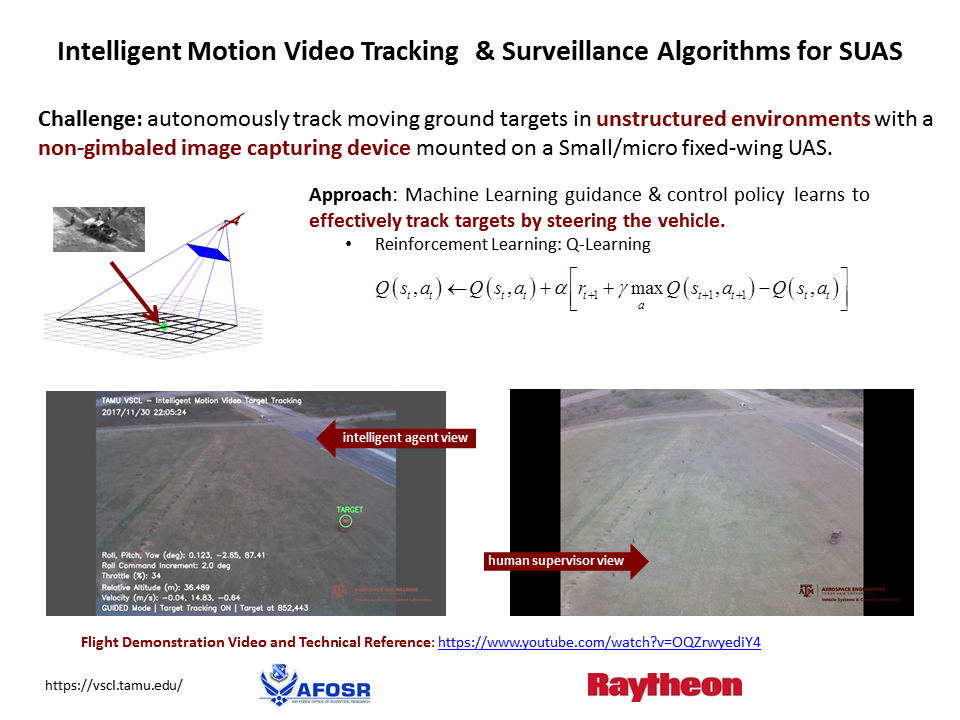
Intelligent Motion Video Algorithms for Unmanned Air Systems, Phase I

Raytheon Company, Intelligence and Information Systems
1 August 2010 – 31 January 2011
Total award $45,000

Advances in unmanned flight have led to the development of Unmanned Air Systems (UASs) that are capable of carrying state-of-the-art video capturing systems for the intended purpose of surveillance and tracking. UASs have the capability to fly through a target area with a mounted camera and allow humans to operate both the UAS and the camera to attempt to survey any objects that are deemed targets. These systems have worked well when controlled by humans, but having them operate autonomously is more challenging.

One way to introduce the concept of autonomy to this problem is to determine a control policy that is capable of controlling the UAS autonomously along a certain trajectory while having the camera controlled by a human. Another way is to do the opposite, and have the UAS flown manually while the camera gimbals to capture and track identified targets. Both of these methods have been explored before and have merit, but having both the UAS and the camera operated autonomously could provide greater flight and tracking efficiency. Having a system that is capable of controlling a UAS and camera system to keep a selected target visible in the camera screen would free the human supervisor to focus on selecting viable targets and analyzing the images received.

The biggest challenge stems from the need to determine an optimal control policy for keeping the target in the middle of the image. Conventional control techniques require determining an appropriate cost function and then finding the weights that make the control optimal. Although finding the optimal control is often straightforward, determining the cost function that best describes the problem is not straightforward. For this research, Reinforcement Learning (RL) is utilized for the determination of the optimal control policy that will both gimbal the camera and steer the UAS to provide target tracking.

The specific RL algorithm used is Q-Learning with Adaptive Action Grid (AAG), developed by Lampton and Valasek as a means to provide greater accuracy in reaching the goal state (i.e., the target), while also decreasing the size (dimensions) of the state-space to be considered. This dramatically decreases the total number of states in the system, so that the learning time becomes more feasible and the storage requirements more tractable. The objective of the approach is to bring any target located in an image captured by a camera into the center of the image, using the AAG learned control policy described above. The learning agent will determine offline (initially) how to control the UAS and camera to get a target from any point in the image to the center and hold it there. A feature of this approach is that the learning agent will continue to learn and refine and update the previously offline learned control policy, during actual operation.

Working with me on this program are Graduate Research Assistants:

  • Kenton Kirkpatrick, Ph.D. student
  • Jim May, M.S. student

Optimal Six Degree-of-Freedom Maneuver Command Generator and Simulator Tools for Aircraft

L-3 Communications, Integrated Systems
15 February – 31 December 2009
Total award $89,000

The proposed work seeks to conduct applied research to support current and future L-3 IS goals in the area of trajectory design and generation. The focus of this work will be on investigating and implementing practical techniques for designing control inputs for complex aircraft trajectories, with an emphasis on evaluating dynamic loads and system identification. The objectives of the proposed effort are three fold. The first objective is to develop a MATLAB/SIMULINK flight simulation framework applicable to conventional transport airplane types. The second objective is to develop a simulated pilot that can be used for performing maneuvering flight and handling qualities analyses. The third objective is to develop methods for system identification using flight test data. Establishing a structured framework for aircraft data that will provide for modeling of a variety of transport aircraft types will facilitate new simulation developments. This effort will define an organized approach for defining, inputting and assembling the data needed for flight simulation.

Working with me on this program is Graduate Research Assistant:

  • Jim May, M.S. student

Optimal Trajectories and Analysis Using Implicit Functions

NASA Johnson Space Center
1 January 2009 – 31 May 2009
Co-P.I. Dr. John L. Junkins
Total award $51,913

The project supports current and future NASA goals in the area trajectory design and generation. It is based upon a novel extension and investigation of new analytical and computational methods for solutions of Lagrange’s Implicit Function Theorem for trajectory design and optimization. Compared to current methods, this new approach not only offers the promise of improved computation time, but more importantly insight into higher-order sensitivities. The focus of this work will be on investigating ways to make this method practical for designing complex lunar descent and ascent trajectories, with an emphasis on lunar descent and braking. These applications are of direct interest to our nation’s current and future vision for space exploration and national defense.

The Implicit function theorem originally due to Lagrange is an important result in analysis. Related methods for differentiation of implicit functions are even more important. The convergence of most versions of the Newton’s method to solve nonlinear equations and the theoretical foundations of virtually all algorithms for solving nonlinear differential equations (local existence and uniqueness of solutions) are closely related to these classical results. Other than serving as an important theoretical tool, the implicit function theorem and related concepts can be generalized to arrive at high order sensitivity equations for algebraic and differential equations about a given pre-computed solution. This perspective enables the conception of methods that construct families of neighboring solutions and blend them together in a fashion that simultaneously improves the accuracy of the local approximations and guarantees global piecewise continuity to a prescribed degree of partial differentiation.

In the light of these theoretical and computational advances, it is felt that it is important to develop general methods for trajectory optimization, investigate the high order sensitivities, and in particular, develop methods that enable computation of extremal field maps for neighboring optimal trajectories. Relatively simple benchmark problems we have run show that computing families of neighboring optimal solutions that previously took several hours to generate can now be generated in a small fraction of one hour. This is especially important as NASA returns to the moon with the “anytime, anywhere” mindset. That is, NASA is designing vehicles to leave Earth for the moon at anytime and land at any desired location on the lunar surface. The same holds for mission aborts back to Earth. A quick, efficient, and effective analytical and computational tool is a top priority for NASA mission planners and trajectory designers. Improved optimal solutions will increase efficiency and reduce flight time and fuel costs, which, in turn, facilitate a more flexible mission with increased payload capacity. Ultimately, we seek to address time varying constraints along the trajectory.

Working with me on this program is Graduate Research Assistant:

  • Matthew Harris, M.S. student

Fault and Abort Tolerant Intelligent Ascent Control for Launch Vehicles

Phase I: Vehicle modeling, simulation development, and preliminary control law synthesis

NASA Johnson Space Center
1 August 2008 – 31 July 2009
Total award $129,569

The next generation of vehicles that will take humans to the moon or Mars must be much more reliable and safer than both the manned (Space Shuttle Orbiter) and unmanned (e.g., Cassini, Mars Rover) vehicles that are currently being used. Fault tolerant control systems that autonomously adapt and safely and predictably recover from various equipment and system failures will be absolutely necessary. The Orion Crew Exploration Vehicle (CEV) program requires automated capability for numerous Guidance Navigation, and Control (GN&C;) functions during the ascent phase of flight, particularly the automated execution of ascent abort scenarios. It is also a significant and challenging control problem because of elastic body modes, environmental uncertainties, possible control faults, and the need to be highly adaptable to possible mission aborts.

This program seeks to conduct applied research to support current and future NASA goals in the area of launch vehicles (near term) and landers (intermediate term) by investigating and developing new approaches for the fault and abort tolerant ascent control of launch vehicles. The focus will be on novel and non-traditional control methods which have the potential to significantly improve current levels of safety in manned launch vehicles. Specifically, during the theory and algorithm development stage of this research, we will investigate ways to combine intelligent control techniques with adaptive control systems. This will enable the handling of time-varying parameters and environmental disturbances, while also providing a decision support function and the capability to learn and handle abort scenarios.

Adaptive-Reinforcement Learning Control (A-RLC), an intelligent autonomous control methodology developed by the Vehicle Systems & Control Laboratory at A&M University and previously used for the control of aircraft and planetary entry vehicles, will be extended and tailored for the ascent phase of launch vehicles. A-RLC can make use of a variety of Machine Learning techniques, and determining the most efficient, implementable, and verifiable one will be a major task of the proposed work.

One goal of the research will be to investigate and quantify the benefits / tradeoffs of using alternative and non-traditional approaches to fault tolerance and handling aborts, by determining the most efficient, implementable, and verifiable set from the following candidate list:

  • Intelligent Learning and Control
  • Intelligent Learning and Control
  • Machine Learning
  • Reinforcement Learning
  • Neural Networks
  • Fuzzy Logic
  • Advanced Learning / Function Approximation Techniques

The approach taken for the proposed research will be to develop hierarchical, combined nonlinear Fault Tolerant Structured Adaptive Model Inversion Control (SAMI) with Adaptive – Reinforcement Learning Control (A-RLC), tailored specifically to launch vehicles. In this scheme, Fault Tolerant SAMI provides the fault tolerance capability. It is ideally suited to this application because of its flexibility for a variety of system types, and because a fault detection scheme is not required. The launch abort handling capability will be provided by A-RLC, which will learn how to safely and effectively handle non-nominal situations.

Working with me on this program are Graduate Research Assistants:

  • Monika Marwaha, Ph.D. student
  • Amanda Lampton, Ph.D student
  • Anshu Narang, Ph.D student

Machine Learning Control of Morphing Micro Air Vehicles

Air Force Office of Scientific Research
1 January 2008 – 30 November 2010
Co-P.I. Dr. Suman Chakravorty
Total award $450,000

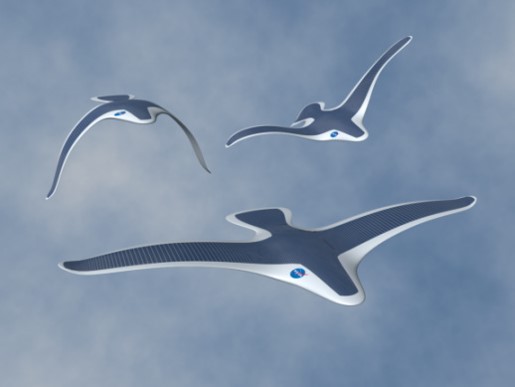
This project investigates a creative and bioinspired theory of learning control which is capable of addressing the essential functionalities of a morphing Micro Air Vehicle (MAV), and which is also extensible to capabilities such as flapping and perching. The objective is to address the optimal shape control of an entire air vehicle configuration as a function of flight condition, not just simple changes such as wing sweep angle or incidence angle. The project spans theory to computation to experiment, and incorporates machine learning concepts integrated with model reference adaptive control. It uses nonlinear synthesis and simulation models of appropriate fidelity validated and verified with a hardware testbed, and culminates in a flight test demonstration.

The Defense Advanced Research Projects Agency (DARPA) defines a morphing air vehicle as a platform that is able to change its state substantially (on the order of 50%) to adapt to changing mission environments, thereby providing a superior system capability that is not possible without reconfiguration. In the context of intelligent systems, three essential functionalities of a practical morphing air vehicle are:

  1. When to reconfigure
  2. How to reconfigure
  3. Learning to reconfigure

When to reconfigure is a major issue, as the ability for a given air vehicle to successfully perform multiple missions can directly be attributed to shape, at least if aerodynamic performance is the primary consideration. Each task or mission has an ideal or optimal vehicle shape, e.g. configuration. However, this optimality criteria may not be known over the entire flight envelope in actual practice, and the mission may be modified or completely changed during operation. How to reconfigure is a problem of sensing, actuation, and control. It is important and challenging since large shape changes produce time-varying vehicle properties, and especially, time-varying moments and products of inertia. The controller must therefore be sufficiently robust to handle these potentially wide variations. Learning to reconfigure is perhaps the most challenging of the three functionalities, and the one which has received the least attention. Even if optimal shapes are known, the actuation scheme(s) to produce them may be only poorly understood, or not understood at all; life long learning for reconfiguration strategies provide a robust evolutionary response to changing needs and missions. This permits the vehicle to be more survivable, and multi-role.

Our approach combines Machine Learning and Adaptive Dynamic Inversion Control, and is called Adaptive-Reinforcement Learning Control (A-RLC). A-RLC is a control architecture and methodology for systems with a high degree of reconfigurability, such as changing shape during flight, flapping, perching, or morphing. The key difference between our approach and the very few existing approaches to morphing control lies with how learning is used. Morphing research reported in the current literature focuses on structures and actuation of at most three degrees of morphing freedom. For a morphing MAV, even if an optimal control law is known, the actuation scheme(s) to produce this capability may be only poorly understood, or not understood at all. A-RLC is capable of addressing the optimal shape control of an entire air vehicle configuration as a function of flight condition, not just simple changes such as wing sweep angle or incidence angle. A-RLC uses Structured Adaptive Model Inversion as the trajectory tracking controller for handling time-varying time varying inertias, large variations in aerodynamic and structural properties, parametric uncertainties, and disturbances. A-RLC uses Reinforcement Learning for learning the optimality relations between the operating conditions and the desired shape, over the lifespan of the vehicle. The Reinforcement Learning module has no prior knowledge of the relationship between commands and the dimensions of the vehicle, and it does not know the relationship between the flight conditions, costs and the optimal shapes. However, the Reinforcement Learning module does know the set of all possible inputs that can be applied. From complete ignorance of the system dynamics and actuation, A-RLC is capable of learning the optimal control policy (commands) which produce the optimal shape as a function of flight condition, while maintaining accurate flight path tracking. In addition, the Reinforcement Learning module of A-RLC can function in real-time, which results in robustness with respect to model errors and environmental disturbances during system operation. Our preliminary research has demonstrated that A-RLC works well for several nonlinear, time-varying, aerodynamically effected models. Key issues we will investigate are learning and control of the morphing, aeroelastic effects, hysteretic effects, and structural effects of the high fidelity, biologically inspired models developed in this research program.

Working with me on this program are Graduate Research Assistants:

  • Amanda Lampton, Ph.D. student
  • Anshu Narang, Ph.D student
  • Adam Niksch, M.S. student
  • Kenton Kirkpatrick, M.S. student
  • Monika Marwaha, M.S. student

and Undergraduate Research Assistants:

  • Brian Eisenbeis
  • Clark Moody
  • Claire Hazelbaker

Prototyping Levels of Automation For Crew Exploration Vehicle (CEV)

Rendezvous and Proximity Operations Tasks

Collaborative Effort with GN&C Autonomous Flight Systems Office, NASA Johnson Space Center
25 August 2005 – present
Collaborator: Howard Hu

A critical component in the CEV development is the delineation of decision-making authority between humans/computers (automation) and ground/onboard (autonomy). By finding the right balance of automation and autonomy, NASA can vastly improve the probability of mission success, increase safety, and decrease overall cost. To identify the appropriate levels of automation and autonomy to design into a human space flight vehicle NASA has created a method called the Function-specific Level of Autonomy and Automation Tool (FLOAAT).

Function-specific Level of Autonomy and Automation Tool Scales
The purpose of this research is to prototype a sub-set of the Rendezvous and Prox Ops functions at the levels of automation specified using FLOAAT. By prototyping at these levels the accuracy of the FLOAAT outputs can be judged. The research will also be used to apply modern decision-making algorithms to help improve the efficiency, safety, and quality in the execution of selected Rendezvous and Prox Ops planning tasks. This research will deal only with the breakdown of human versus computer responsibility (automation) and therefore will not address the issue of ground versus on-board responsibility (autonomy). The issue of autonomy, although important, is difficult to prototype until a more detailed design of the ground control architecture and on-board computing and display capabilities is conducted.

Function Level Ti Ellipse

Specific tasks and research objectives:

  • Prototype selected Rendezvous and/or Prox Ops functions at the levels of automation determined by the Function-specific Level of Autonomy and Automation Tool (FLOAAT) process
  • Evaluate the prototype versions by comparing to Shuttle/ISS implementations of the same functions
  • Use this comparison to evaluate the quality of the FLOAAT recommended level of automation
  • Evaluate the selected decision-making algorithm

A final evaluation will be made to determine if the level of automation was appropriate for each prototyped function and provide suggestions for improvement. This includes an evaluation of the prototyping process, AI techniques used, and the effectiveness of operating at the levels of automation specified by the FLOAAT process. The successfulness of the prototyping effort will be used to gauge the accuracy of the FLOAAT tool to select appropriate levels of automation. It will also determine the applicability of the selected decision-making algorithms for use in human spaceflight.

Working with me on this program is Graduate Research Assistant:

  • Jeremy Hart

UAV Hingeless Flight Controls via Active Flow Control, Phase II

Aeroprobe Corporation and Air Force Research Laboratory
1 April 2006 – 28 March 2008
Total award $375,000

Flow control seeks to modify the flow so that it behaves in a different (favorable) fashion compared to no control. It may be used to control or promote boundary layer transition, limit flow separation, replace conventional Aerodynamic Control Effectors (ACE) providing significant stealth benefits, augment lift, modify acoustic emissions or reduce drag. The potential benefits of flow control are many and varied: reduced structural weight, greater resistance to battle damage and improved survivability (fewer components and linkages), improved performance (drag relates to the number of breaks in the aircraft’s external surface), greater flight envelopes (separation suppression), reduced operational cost (fewer components) and greater stealth capability.

Flow control may be implemented passively or actively. Active flow control is seen as a means to performance enhancement and a way to replace conventional ACE. Active methods for flow control include blowing, suction, moving surface elements, oscillatory blowing/suction, wall oscillation, vibrating ribbons, and zero-mass-flux, finite momentum actuators or Synthetic Jet Actuators (SJAs).

This research seeks to answer specific questions about active flow control:

  1. What characteristics are necessary for a flow control effecter to be functional in this application?
  2. What vehicle configuration would benefit the most from such an effecter?
  3. How can the effects of the flow control be modeled?
  4. What type of flight control laws and feedback mechanisms would be necessary to control the aircraft via flow control actuators?
  5. How would using non-conventional flow effecters improve aerodynamic performance?

In this research, we develop and implement active flow control in an unmanned aerial vehicle (UAV) configuration to show how the design and application of active fluidic control may be used to improve the performance of a proposed UAV. The fluidic control is implemented using a combination of SJA and trailing edge continuous blowing (or SJA’s). The flow control may be used to extend the angle-of-attack envelope by suppressing flow separation and to achieve hingeless control by modifying the wing’s circulation through trailing edge flow manipulation (using a modular jet flap or circulation control). At high incidence, upper surface flow control using SJA’s is used to re-attach the flow while trailing edge blowing is used to achieve control authority. Our SJA design is well validated and has been shown to be reliable and effective in many investigations. Proposed methods for achieving aerodynamic modeling, sensors for feedback to aid in control, as well as control law are investigated.

Specific tasks and research objectives:

  • Determine a suitable actuator and implementation for flow control.
  • Unmanned aerial vehicle conceptual configuration layout.
  • Feedback methodology and implementation.
  • Modeling of effects of proposed ACE.
  • Control law design.
  • Performance improvement estimates.
  • Demonstration of key technology: ACE effectiveness.

Working with me on this program is Graduate Research Assistant:

  • Tom Wagner

Fault Tolerant Nonlinear Adaptive Control for Mars Atmospheric Flight, Phase I:

Vehicle modeling, simulation development, and preliminary control law synthesis

GN&C Design and Analysis Branch, NASA Johnson Space Center
1 January – 31 May 2006
Total award $20,840

The next generation of vehicles that will take humans to the moon or Mars must be much more reliable and safer than both the manned (Space Shuttle Orbiter) and unmanned (e.g, Cassini, Mars Rover) vehicles that are currently being used. Fault tolerant control systems that autonomously adapt and safely and predictably recover from various equipment and system failures will be absolutely necessary. Because the science missions will be more demanding, and the planetary operating environments more extreme and largely unknown in composition and terrain, this newer generation of vehicles will need advanced control systems capable of handling large environmental uncertainties. For example, a vehicle that must land on Mars needs a control system that can cope with uncertainties in atmospheric parameters, such as density and pressure. Additionally, the Mars terrain is composed of different types of soil and rocks which will make landing very difficult. Several hazard avoidance systems are being researched now, and it is very important to have a control system that can be integrated with such algorithms so that it can adapt its parameters to maintain the system stable at all times. One of the techniques currently used to design controllers for nonlinear time-varying systems, such as the one for a Mars Lander is traditional gain-scheduling. This method requires extensive modeling, design, and analysis since the designer picks a finite number of points and designs a different control law for each of these operating conditions. An example of this is the flight control system of the Space Shuttle Orbiter. During the vehicle’s reentry phase, the control system dictates whether to use reaction control system (RCS) jets or aerodynamic control surfaces to generate the necessary torque to follow the given trajectory. When the vehicle is flying at high altitudes, the atmosphere is very thin and the aerodynamic surfaces are not effective; when the vehicle is lower in the atmosphere, the aerodynamic surfaces are very effective and there is no need to consume more fuel by firing the RCS jets. However, this approach could not be used in a Mars Lander entry vehicle because it requires very accurate atmospheric models and vehicle models.

The broad objective of this research is to conduct the theory-computation-experiment cycle for a Mars Lander adaptive control system to support the design of advanced missions and systems for the human exploration of space. Specifically, during the theory and algorithm development stage of this research, we will investigate ways to apply intelligent control techniques such as neural networks and reinforcement learning to adaptive control systems. This will enable the handling of time-varying parameters and environmental disturbances, while also being applicable to the control of nonlinear systems. It is important to validate and test out theory using both numerical simulation and hardware. Work performed during Summer 2006 as part of a Summer Graduate Internship at NASA Johnson Space Center will use the planetary landers simulation and hardware demonstrator systems to test out the advanced adaptive controllers.

Specific tasks and research objectives:

  • Develop Linear and Nonlinear Vehicle Models
  • Develop Matlab/Simulink Simulation
  • Define and Characterize Atmospheric Uncertainties
  • Synthesize Baseline Adaptive Controller
  • Documentation of Results

Working with me on this program is Graduate Research Assistant:

  • Carolina Restrepo

Adaptive Flight Controller, Phase I

Brand X Aerospace
15 December 2005 – 31 January 2006
Total award $20,494

Development of nonlinear Structured Adaptive Model Inversion (SAMI) control laws for aircraft.

Model Estimation for Adaptive Trajectory Reshaping and Control

Knowledge Based Systems Incorporated through Air Force Research Laboratory
1 November 2005 – 15 March 2007
Total award $140,108

To increase the autonomy of Unmanned Aerial Vehicles (UAVs), a desired feature is to have onboard intelligence for making decisions and planning maneuvers. To define and execute a maneuver we need an efficient means to generate a reference trajectory onboard and in near real-time. Also, this generated reference trajectory has to be consistent with the available control power and the airframe capability. To generate a feasible reference trajectory, accurate knowledge of the plant model is necessary, however; an accurate plant model is not always available and the plant model may also change due to control failures or damage to the UAV.

This research will develop a model estimation technique that can generate a plant model which is accurate enough to be used for generating feasible reference trajectories.

The central idea is to use estimates of the plant model based on geometric information of the aircraft and update this estimate based on the estimate obtained from real-time system identification of the plant from the input-output signals. Suppose there exists a visual sensor system that can identify the geometry of the aircraft on the fly. This information can be used to estimate the stability and control characteristics of the aircraft using methods contained in the USAF Stability and Control Datcompendium (DATCOM). These methods have been traditionally used in preliminary calculations for aircraft design. For the current research they can provide the approximate plant model for the entire flight envelope based only on the geometry of the aircraft. This approximate plant model can serve as a starting point for the model estimation based on the input-output data of the system. Thus, the estimation algorithm is a synergy of Datcom and model estimation from measurements.

Specific tasks and research objectives:

  • Identify and formulate plant estimation model
  • Generate DATCOM estimates
  • Formulate fusion model
  • Ensure stability and convergence of the estimated model
  • Evaluate model using Matlab/Simulink based numerical simulation
  • Evaluate KBSI Adaptive Trajectory Tracking Control
  • Validation and verification using real-time simulation

Working with me on this program is Graduate Research Assistant:

  • Post-Doctoral Researcher Dr. Puneet Singla
  • Theresa Spaeth
« Previous Page
Next Page »

© 2016–2026 Log in

Texas A&M Engineering Experiment Station Logo
  • State of Texas
  • Open Records
  • Risk, Fraud & Misconduct Hotline
  • Statewide Search
  • Site Links & Policies
  • Accommodations
  • Environmental Health, Safety & Security
  • Employment