• Skip to primary navigation
  • Skip to main content
  • LinkedIn
  • Videos
  • Research
    • Facilities
    • Vehicles
    • Sponsors
  • Publications
    • Books
    • Journal Papers
    • Conference Papers
  • People
    • Faculty
    • Staff
    • Graduate Students
    • Undergraduate Students
    • Alumni
    • Where VSCL Alumni Work
    • Friends and Colleagues
  • Prospective Students
  • About Us
  • Contact Us
  • Where VSCL Alumni Work

Texas A&M University College of Engineering

Research

Our research is focused on bridging the scientific gaps between traditional computer science topics and aerospace engineering topics, while achieving a high degree of closure between theory and experiment.  We focus on machine learning and multi-agent systems, intelligent autonomous control, nonlinear control theory, vision based navigation systems, fault tolerant adaptive control, and cockpit systems and displays.  What sets our work apart is a unique systems approach and an ability to seamlessly integrate different disciplines such as dynamics & control, artificial intelligence, and bio-inspiration.  Our body of work integrates these disciplines, creating a lasting impact on technical communities from smart materials to General Aviation flight safety to Unmanned Air Systems (UAS) to guidance, navigation & control theory.  Our research has been funded by AFOSR, ARO, ONR, AFRL, ARL, AFC, NSF, NASA, FAA, and industry.

Autonomous and Nonlinear Control of Cyber-Physical Air, Space and Ground Systems

Vision Based Sensors and Navigation Systems

Cybersecurity for Air and Space Vehicles

Air Vehicle Control and Management

Space Vehicle Control and Management

Advanced Cockpit/UAS Systems and Displays

Control of Bio-Nano Materials and Structures

Integrated Research/Education University Aircraft Design Program Development, Phases I – II

Air Force Research Laboratory, Sub-Contract Through University of Washington – Seattle
1 January 2014 – 31 December 2015
Co-P.I. Dr. Thomas W. Stragnac
Total award $150,000

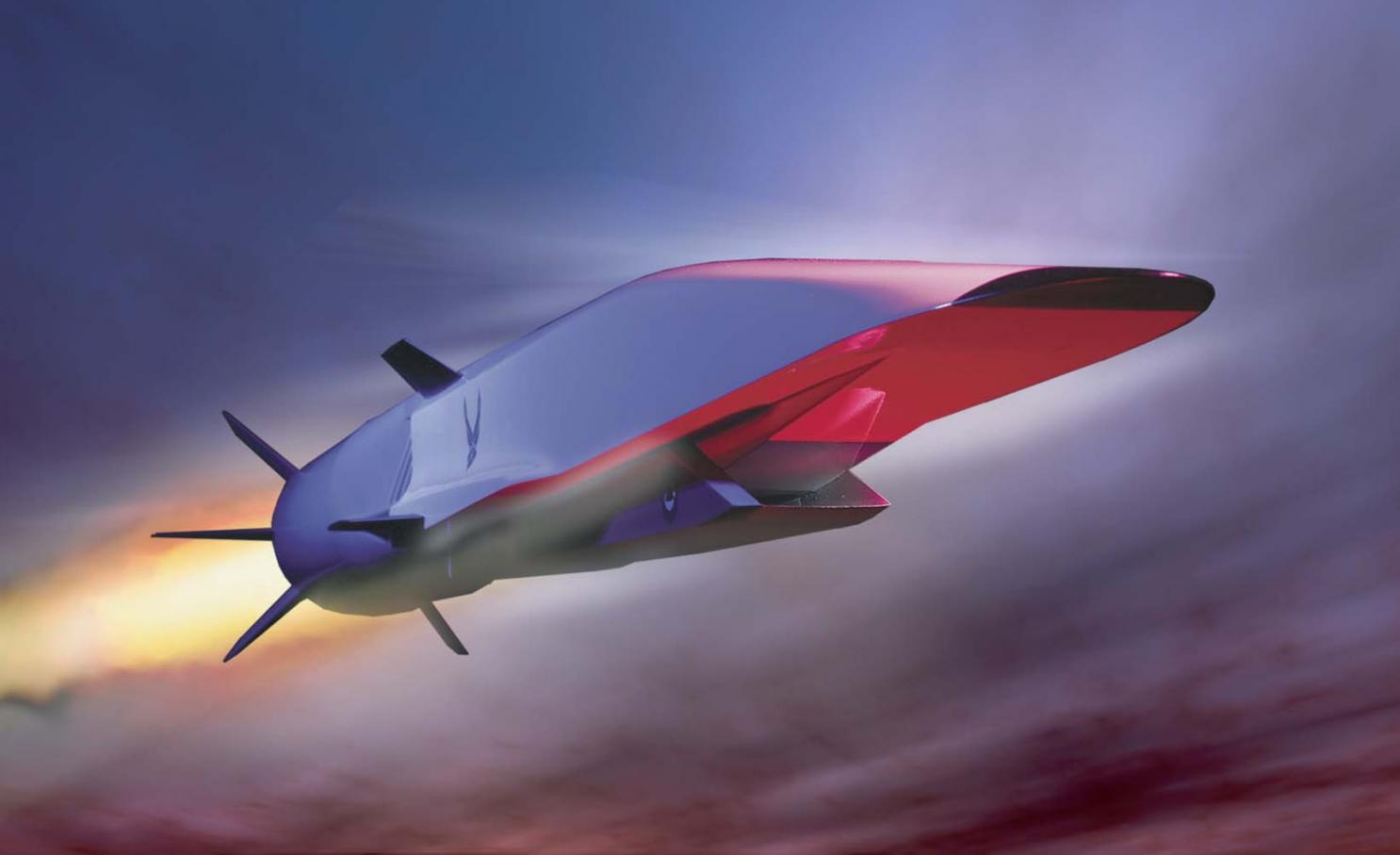
The Air Force Research Laboratory is interested in strengthening airplane design education by posing students and faculty with problems of interest to the Air Force that are in the public domain. It is expected that a few key ideas about strengthening aircraft design education by adding elements of realism, hands-on experience, and response to challenges that reflect real issues the technology struggles with. The focus will be on developing design and analysis methods and tools for a tailless supersonic flight vehicle with high maneuverability.

Many questions remain as to the viability of a completely tailless supersonic aircraft. What configurations enable elimination of the tail surfaces? What level of maneuvering is possible? What are the tradeoffs between maneuverability, max mach and range for tailless vehicles compared to their tailed counterparts? What technologies (innovative control effectors, control algorithms, etc) need to be developed and demonstrated to enable a completely tailless, supersonic aircraft design to be efficient and controllable? If not completely tailless, can the size of the tails be dramatically reduced? Can active aeroelastic control technology be employed to exploit the flexibility of long, slender bodies associated with supersonic vehicles?

The proposed work seeks to conduct applied research for the purpose of enabling activities that will explore the design and technology space for Efficient Supersonic Air Vehicles. It is anticipated that the results will produce innovative solutions to the design problem, and new design and analysis tools. We propose to investigate nonlinear approach & landing control laws for a tailless supersonic aircraft that accomplish global tracking of both fast and slow states, using recent results we developed using geometric singular perturbation methods [1]. The objective is to reduce the approach speed while accurately tracking flight path and velocity. The approach has been applied to simultaneously tracking both fast and slow variables for a desired reference trajectory that requires the aircraft to fly between linear and nonlinear flight regimes. These results will be achieved through a Design/Build/Fly approach.

TECHNICAL OBJECTIVES

  1. Identify key technical challenges
  2. Highlight shortcomings and limitations in public domain aerodynamic and aeroelasticity tools
  3. Propose solutions
  4. Synthesize a preliminary design of a supersonic tailless aircraft, based on general guidelines learned from past work
  5. Build and fly sub-scale low speed demonstrator
  6. Collect and analyze flight data

Working with me on this program is Graduate Research Assistant:

  • Frank Arthurs, Ph.D. student

Systems Engineering Design Course Curriculum Development

University of Texas
1 August 2013 – 15 December 2014
Co-P.I. Dr. Thomas W. Stragnac
Co-P.I. Dr. Raktim Bhattacharya
Total award $100,000

This project seeks to support the project Systems Engineering Design Initiative as a sub-contract effort to the University of Texas – Austin. The purpose is to investigate and develop educational tools and practical experience in the teaching of Systems Engineering (SE) principles and practices, which can be later transitioned into a broad range of aerospace engineering courses. The course AERO 440 Cockpit Systems & Displays at Texas A&M University (TAMU) already has significant SE content that will be enhanced and upgraded, and then integrated into the collective courses of instruction within the broad Systems Engineering Design Initiative effort. The AERO 440 course project for Spring 2014 will be purposely selected and directly tied-in with the Systems Engineering Design Initiative efforts at the University of Texas – Austin.

TECHNICAL OBJECTIVES

  1. Plan and test courses of instruction that integrate the fundamental principles of SE into existing design courses. The objective is to introduce students to the practical application of the fundamentals of SE without displacing other course content. The target TAMU courses are the AERO 401 for the fall 2013 semester and AERO 402 and AERO 440 for the 2014 spring semester.
  2. Critically review UT Austin Systems Engineering (SE) Student Handout and revise/enhance as appropriate for use by TAMU for the purpose of a design-focused undergraduate student introduction to and practical application of SE for aeronautical systems.
  3. Critically review UT Austin SE workshop presentation materials intended to introduce the fundamentals of SE to aerospace undergraduate aerospace students involved in extramural design projects, from the perspective of practical application of SE to extramural aerospace student projects but not limited to aeronautics. TAMU shall develop a plan for implementation and revise and/or develop materials for a TAMU version of a SE workshop. TAMU shall conduct the workshop a minimum of once per semester.

Working with me on this program is Graduate Research Assistant:

  • Frank Arthurs, Ph.D. student

AVSI AFE 61: Virtual Integration Process Landing Gear System Consistency Check Modeling

Aerospace Vehicle Systems Institute
1 July 2013 – 31 December 2013
Total award $35,000

SAVI is currently working toward a demonstration of the ability to pass information about solid models to and from a wheel braking system model (of the type described in SAE AIR 6110) done in a compliant solid modeling tool that is compatible with an architectural analysis model done in the Architectural Analysis and Design Language (AADL). This work supports this effort by generating a model of a representative landing gear system for a commercial air transport. This model is constructed in the SolidWorks solid modeling tool that allows SAVI users to manipulate it with their architectural model structure (AADL and SysML).

TECHNICAL OBJECTIVES

  1. Review literature and data to identify and obtain non-proprietary graphical models of landing gear and wheel braking systems representative of those found on commercial air transports.
  2. Generate models in SolidWorks, consisting of the size, location, and functionality of the main landing gear and the wiring harnesses. Check for consistency, accuracy, and interference effects. Report parameters that are checked and criteria for acceptance.
  3. Develop primary geometry of major components consisting of main strut, drag braces, wheel assembly, brake assembly, tires. Add geometry of initial wiring harness and location. Add needed details in all necessary components, with sizes, location, and connection ports for all electronic components shown in the functional diagrams. Indicate future modifications to model behavioral characteristics such as wheel brake dynamical modeling and control.

Working with me on this program are Undergraduate Research Assistants:

  • Bailey Huber, B.S. student
  • Riaz Husain, B.S. student

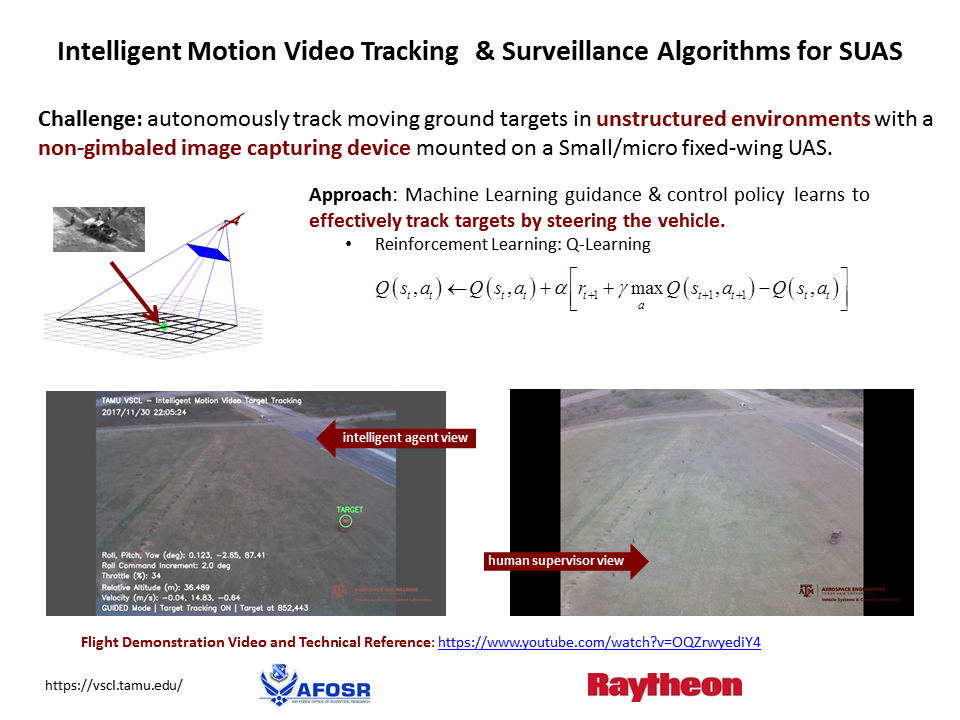
Intelligent Motion Video Algorithms for Unmanned Air Systems, Phase IV

Raytheon Company, Intelligence and Information Systems
1 January – 31 December 2013
Co-P.I. Dr. James D. Turner
Total award $250,000

This project consits of applied research that will enable a pathway for basic academic research at Texas A&M University to be transitioned into larger Raytheon Corporate Research and Development efforts for operational systems.

TECHNICAL OBJECTIVES

  1. Demonstrate the utility of motion based video algorithms developed with the Reinforcement Learning / Approximate Dynamic Programming methodology in Phases I-III.
  2. Develop and demonstrate a reinforcement Learning / Approximate Dynamic Programming methodology for UAS Autonomous Soaring.
  3. Conceive novel platform positioning algorithms in support of advanced UAS platforms.
  4. Refine and demonstrate video processing algorithms with the Land, Air, and Space Robotics Laboratory (LASR) at Texas A&M University.

Validation and verification flight testing will be conducted using the three Pegasus research UAS owned and operated by the Vehicle Systems & Control Laboratory.

Working with me on this program are Graduate Research Assistants:

  • Anshu Siddarth, Postdoctoral Research Associate
  • Kenton Kirkpatrick, Postdoctoral Research Associate
  • Dipanjan Saha, Ph.D. student
  • Jim Henrickson, M.S. student
  • Tim Woodbury, M.S. student
  • Josh Harris, B.S. student
  • Candace Hernandez, B.S. student
  • Alejandro Azocar, B.S. student


PEGASAS FAA General Aviation Research Center of Excellence

US DOT – Federal Aviation Administration
1 August 2013 – 15 December 2014
TAMU Site Director
Total initial award $10,000

The Partnership to Enhance General Aviation Safety, Accessibility and Sustainability (PEGASAS) Center of Excellence will focus research and testing efforts on safety, accessibility and sustainability to enhance the future of general aviation. Research and development efforts by PEGASAS will cover a broad spectrum of general aviation safety issues, including airport technology, propulsion and structures, airworthiness, flight safety, fire safety, human factors, system safety management and weather. PEGASAS is led by Purdue University, The Ohio State University, Georgia Institute of Technology, Florida Institute of Technology, Iowa State University and Texas A&M; University. Affiliate members include: Arizona State University, Florida A&M;, Hampton University, Kent State University, North Carolina A&T; State University, Oklahoma State University, Southern Illinois University (Carbondale), Tufts University, Western Michigan University and University of Minnesota, Duluth. “The FAA continues its goal of working to reduce general aviation fatalities by 10 percent over a 10-year period, from 2009 to 2018,” said Acting FAA Administrator Michael Huerta. “The Center of Excellence program is a valuable tool in providing the critical data we need to reduce those accidents.”

Unmanned Air System Departure Resistance Using Nonlinear Two-Time Scale Tracking Control

Northrop-Grumman Corporation
13 December 2011 – 31 January 2012
Total award $16,713

Unmanned Air Systems (UASs) are routinely restricted to fly in low angle-of-attack flight regimes where the vehicle dynamics are predominately linear. While this restriction helps ensure survivability of the vehicle by avoiding nonlinear flight regimes which can lead to departure from controlled flight, or nonlinear regimes where precise tracking of trajectories or aircraft states can be difficult if not impossible, it also restricts both routine operation and mission flexibility. A motivating example is the approach flight phase to precision landing, such as an arrested landing on an aircraft carrier. In this situation an aircraft must track both fast states (angular rates and sink rate) and slow states (flight path and heading) simultaneously, and accurately and reliably. Flying at higher approach speeds and therefore lower angles-of-attack can largely mitigate this two-time scale dynamics effect and prevent departure due to stall. But higher approach speeds have long been known to lead to higher occurrences of landing mishaps or accidents. Another motivating example is an aircraft tracking a prescribed fast moving target, while simultaneously regulating speed and/or one or more kinematic angles.

This work develops nonlinear approach & landing control laws for a UAS that accomplish global tracking of both fast and slow states, using our recent results in geometric singular perturbation methods. The objective is to reduce the approach speed while accurately tracking flight path and velocity. The approach has been applied to simultaneously tracking both fast and slow variables for a desired reference trajectory that requires the aircraft to fly between linear and nonlinear flight regimes. The control laws were designed and implemented without making any assumptions about the specific nonlinearity of the 6-DOF aircraft model. Nonlinear simulation results we generated for a combined longitudinal lateral/directional maneuver of an F/A-18A Hornet, consisted of an aggressive vertical climb with a pitch rate of 25 deg/sec, followed by a roll at a rate of 50 deg/sec, all the while maintaining zero sideslip angle. The controller accomplished global asymptotic tracking while keeping all closed-loop signals bounded and well behaved.

Extensions to the work in a subsequent phase will consist of verification flight testing of the controller, using the Pegasus research UAS owned and operated by the Vehicle Systems & Control Laboratory.

Working with me on this program is Graduate Research Assistant:

  • Anshu Siddarth, Ph.D. student

Intelligent Motion Video Algorithms for Unmanned Air Systems, Phase III

Raytheon Company, Intelligence and Information Systems
1 December 2011 – 31 December 2012
Total award $200,000

Advanced development and testing phase of algorithms developed during the Phase I & II efforts (described below).

TECHNICAL OBJECTIVES

  1. HARDWARE INTEGRATION: Sensor and experimental controller integration, flight controller off-board control modifications, validate integrated sensor and flight computer with Pegasus UAS via hardware-in-loop simulation. Validate experimental controller in flight test.
  2. ALGORITHM DEVELOPMENT: Perform additional learning for more complicated target paths, flight test reinforcement learning controller.
  3. GROUND STATION: Write extensions to ground station to transmit experimental controller commands back to vehicle. Ground test to ensure proper operation including failure scenarios in sensor, telemetry links, ground station PC, etc.
  4. FLIGHT VEHICLES: Build three additional Pegasus UAS vehicles.

Working with me on this program are Graduate Research Assistants:

  • Kenton Kirkpatrick, Ph.D. student
  • Jim May, M.S. student
  • Drew Beckett, M.S. student
  • Grant Atkinson, M.S. student
  • Jim Henrickson, M.S. student
  • Tim Woodbury, M.S. student
  • Nick Oliviero, B.S. student
  • Josh Harris, B.S. student

Novel Head Worn Displays and Interfaces for Pilots, Phase I

Boeing Research & Technology
1 September – 21 December 2011
Total award $52,092

Head Up Displays (HUD) are ubiquitous in high performance military aircraft because of the improved situational awareness that they provide to the pilot, which directly impacts mission effectiveness and flight safety. Transitioning of HUD technology to the Commercial Aircraft has been underway for more than a decade. While the situational awareness and flight safety improvements have clearly justified their use in this sector, the weight, volume, and power penalties they incur from a design and operations standpoint are not acceptable. Helmet Mounted Displays (HMD) used in current high performance military aircraft such as the F-22 and F-35 are advantageous from the weight, volume, and power standpoints, but they are not an acceptable solution for commercial flight operations since these pilots do not wear helmets. Head Worn Displays (HWD) that project HUD type data and information onto modified sunglasses or even a monocle offer a promising solution for the commercial aircraft sector. However, many human factors and systems level problems remain to be solved.

The Phase I effort encompasses a complete systems engineering effort that includes pre-concept design, trade studies, options, and layout.

TECHNICAL OBJECTIVES

  1. Determine a preferred system concept for a Head Worn Display (HWD) system to be used by pilots of FAR 23 and FAR 25 commercial air transports. The HWD would present a to be determined set of real-time situational awareness information consisting of weather (WX), traffic (TX), route, Traffic Collision Avoidance (TCAS), etc. A collision prediction and projection capability is also desired.
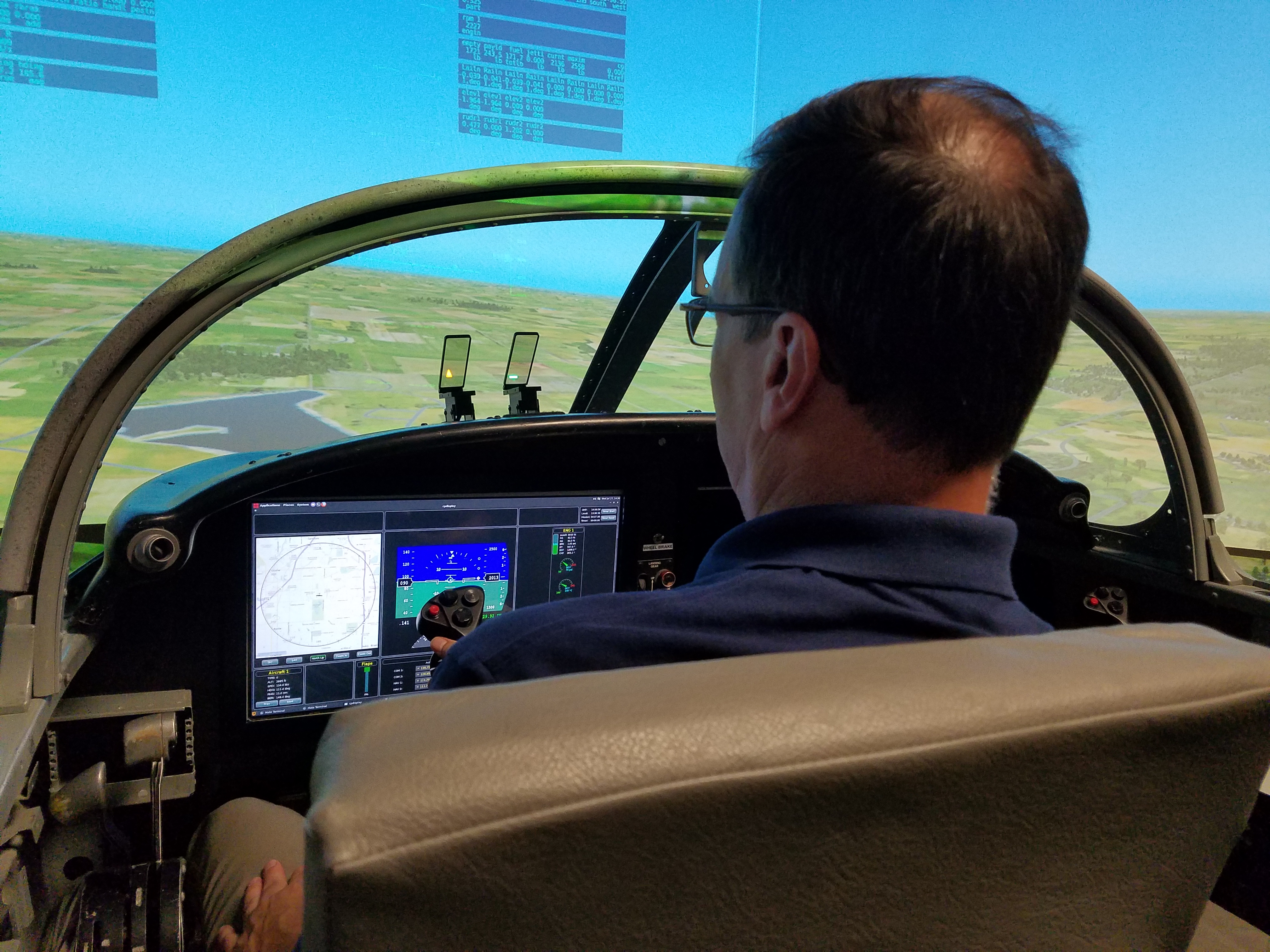
  2. Implement system into hardware and software prototype. Conduct human factors evaluation with test subject pilots via real-time simulation, using the Engineering Flight Simulator in the Vehicle Systems & Control Laboratory. Transition prototype system to Boeing, and assist Boeing engineers with development.

Working with me on this program are Graduate Research Assistants:

  • Kenton Kirkpatrick, Ph.D. student
  • Jim May, M.S. student
  • Nick Oliviero, B.S. student
  • Josh Harris, B.S. student

Machine Learning Control of Nonlinear, High Dimensional, Reconfigurable Systems

Air Force Office of Scientific Research
1 July 2011 – 30 June 2014
Co-P.I. Dr. Suman Chakravorty
Total award $420,000

Optimal Control is the most general framework for posing and solving sequential decision making problems. Much progress has been made in solving such problems for deterministic systems and very efficient transcription based techniques, where the original infinite dimensional optimization problem is approximated by a finite dimensional nonlinear programming problem. For instance, the pseudo-spectral methods have been devised to solve open loop optimal control problems, with and without constraints. Unfortunately, the same cannot be said about problems under uncertainty. If we assume a stochastic model of uncertainty in the system process model, the sequential optimization problem can be posed as a so-called Markov Decision Problem (MDP) whose solution is given by a stochastic Dynamic Programming (DP) equation.

However, it is also very well known that solutions to the DP problem are subject to Bellman’s famous Curse of dimensionality, i.e. the fact that solution complexity grows exponentially in the dimension of the state-space. This makes solutions to the stochastic DP problem for continuous state and control spaces in particular, tractable only in low dimensional state-spaces, even given the computational resources available today. Moreover, to the best of our knowledge, it is very difficult to consider constraints on such continuous state/control space MDPs. There is also a need to consider the extension of the MDP techniques to multi-agent sequential optimization problems where the control computations for the individual agents need to take place in a collaborative and decentralized fashion, given DoD’s increasing interest in such highly decentralized networked control systems. In addition, if there is sensing uncertainty in the system state, the sequential optimization problem transforms into the so-called “Partially Observed Markov Decion Problem (POMDP)”, whose solution is given by an infinite dimensional Information Space DP problem which is virtually intractable for continuous state-space problems.

Furthermore, we have previously developed a theory of Reinforcement Learning or Approximate Dynamic Programming (ADP) combined with Adaptive Control holds the promise to be effective for controlling various aerospace systems of interest, but has been developed to date for only a specialized class of dynamical systems. We are currently extending this approach to a much more realistic class of dynamical systems.

TECHNICAL OBJECTIVES

  1. Extend ADP techniques to control of nonlinear, multiple time scale, non-affine systems in an Adaptive Control framework
  2. Develop solution techniques for MDPs that scale to continuous state and control spaces with constraints
  3. Extend MDP techniques to solve multi-agent co-ordination and control problems in a decentralized fashion.
  4. Develop solution techniques that scale to continuous state-space POMDP and their multi-agent generalizations.

Working with me on this program are Graduate Research Assistants:

  • Anshu Siddarth, Ph.D. student
  • Kenton Kirkpatrick, Ph.D. student
  • Elizabeth Rollins, Ph.D. student
  • Caroline Dunn, B.S. student

Intelligent Motion Video Algorithms for Unmanned Air Systems, Phase II

Raytheon Company, Intelligence and Information Systems
1 June 2011 – 31 August 2011
Total award $45,000

This project will conduct a realistic outdoor flight test demonstration of the autonomous target tracking algorithm developed in the Phase I effort (described below).

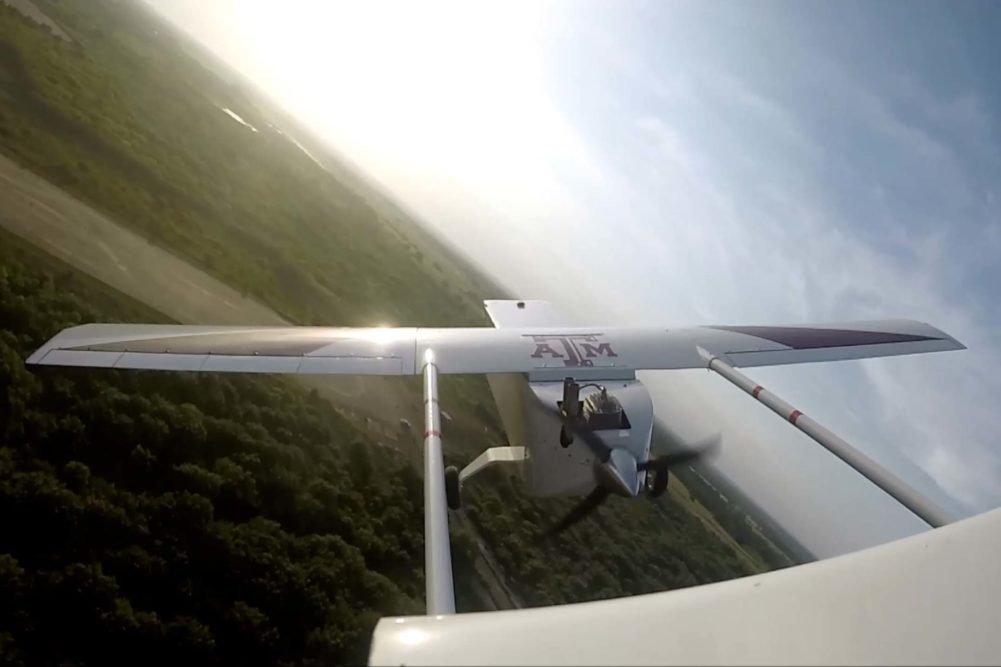
The flight vehicle will be the Pegasus fixed-wing Unmanned Air System (UAS) designed, built, and developed by the Vehicle Systems & Control Laboratory. Pegasus has a maximum takeoff weight of 60 lbs, a payload weight of 20 lbs, and one hour flight endurance.

All flights will be conducted at the runway complex at the Flight Mechanics Laboratory, Texas A&M; University Riverside Campus.

Working with me on this program are Graduate Research Assistants:

  • Kenton Kirkpatrick, Ph.D. student
  • Jim May, M.S. student
  • Drew Beckett, M.S. student

« Previous Page
Next Page »

© 2016–2026 Log in

Texas A&M Engineering Experiment Station Logo
  • State of Texas
  • Open Records
  • Risk, Fraud & Misconduct Hotline
  • Statewide Search
  • Site Links & Policies
  • Accommodations
  • Environmental Health, Safety & Security
  • Employment