In October Dr. John Valasek reached a career milestone by presenting at his 100th invited seminar/lecture/panelist.
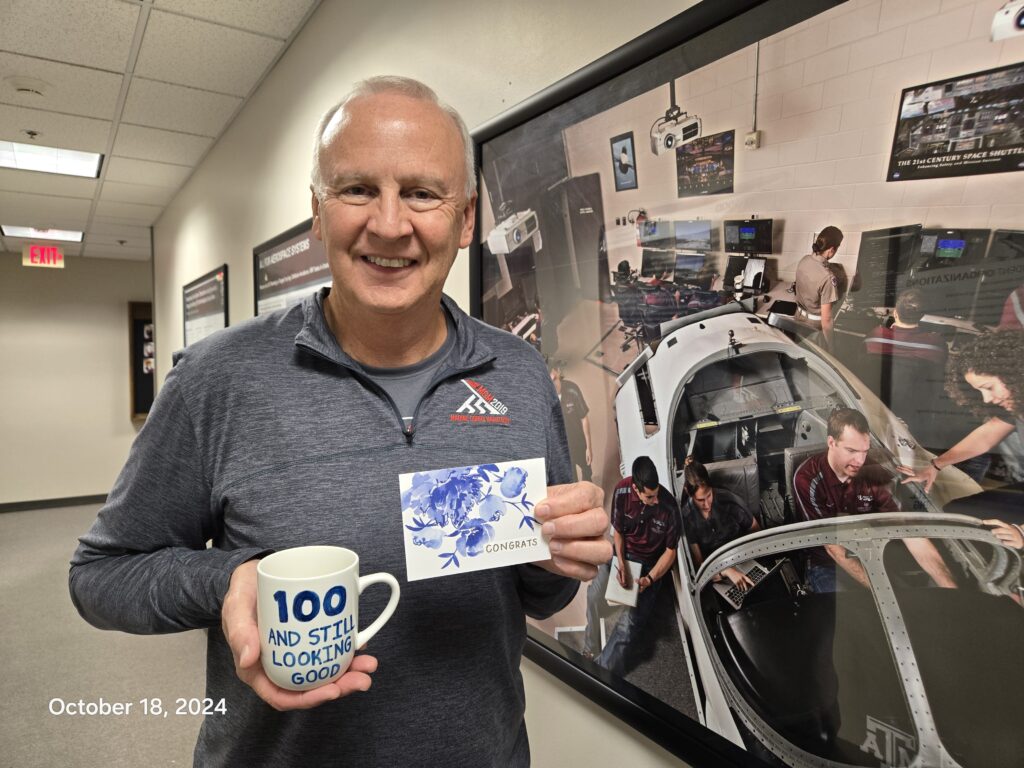
Chronologically:
#1 “Fighter Agility Metrics, Research, and Test,” Lockheed Advanced Development Projects Division (Skunk Works), Burbank, CA, 13 July 1990.
#100 “Multiple-Time-Scale Nonlinear Output Feedback Control of Systems With Model Uncertainties,” Department of Aerospace Engineering, University of Maryland, College Park, MD, 9 October 2024.
Congratulations Dr. Valasek!
 Dr. John Valasek and the Vehicle Systems & Control Laboratory has been awarded a multi-year (2023-2026) research grant by the Office of Naval Research (ONR) to investigate multiple time scale (MTS) adaptive control systems for naval applications such as unmanned air systems (UAS), high performance aircraft, and satellites. MTS systems are systems with some states that evolve quickly and some states that evolve slowly. These systems can have coupled fast and slow modes which occur simultaneously. MTS systems are particularly interesting from a controls perspective because the time scale separation in the plant can cause degraded performance or even instability under traditional control methods. Accounting for the time scales can remedy this problem. For example, a MTS control technique demonstrated significantly reduced rise times over traditional Nonlinear Dynamic Inversion (NDI). Similarly, traditional adaptive control has been demonstrated to have reduced performance on MTS systems. On the other hand, traditional control techniques that are specifically designed for MTS systems cannot account for systems with model uncertainties. Thus, a method of MTS control for uncertain systems is needed.
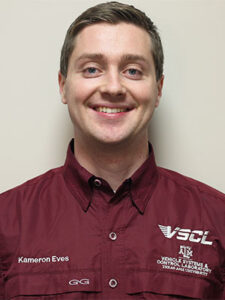
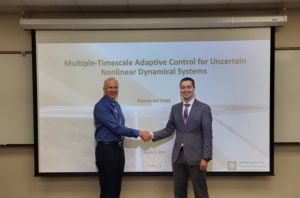 ) successfully defended his Ph.D. dissertation titled “Multiple-Timescale Adaptive Control for Uncertain Nonlinear Dynamical Systems”. Kameron’s dissertation investigated combining nonlinear multiple time-scale controllers that VSCL has been researching for the last 15 years, with adaptive controllers which VSCL has been researching for more than 20 years. Multiple-timescale control has been shown to have difficulty with uncertain systems and adaptive control has been shown to have difficulty with multiple-timescale systems. His dissertation describes a novel control methodology called [K]Control of Adaptive Multiple-timescale Systems (KAMS). KAMS seeks to address systems that simultaneously exhibit uncertain and multiple-timescale behaviors. Unlike traditional multiple-timescale control literature, KAMS uses adaptive control to stabilize the subsystems. The reference models and adapting parameters used in adaptive control significantly complicate the stability analysis. KAMS is a flexible theory and framework and the stability proofs apply to a wide array of adaptive algorithms and multiple-timescale fusion techniques. Additionally, formal and numerical validation of how KAMS can relax the minimum phase assumption for a multitude of common adaptive control methods. KAMS is demonstrated and evaluated on examples consisting of stabilization and attitude control of a quadrotor Unmanned Air System; fuel-efficient orbital transfer maneuvers; and preventing inlet unstart on hypersonic aircraft.