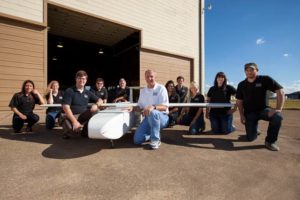
Dr. John Valasek and Co-Inventors Andrew Beckett, James F. May, and Cecil C. Rhodes with research team and Pegasus at RELLIS Campus hangar.
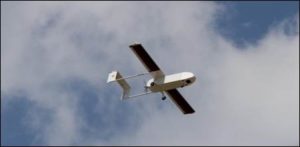
A team of inventors from the Vehicle Systems & Control Laboratory, in the Department of Aerospace Engineering A&M University, have been awarded U.S. Patent 9,957,035 for Un-Manned Aerial Vehicle Having Adjustable Wing Module, Tail, and Landing Gear. The Pegasus Unmanned Air System (UAS) was conceived, specified, designed, built, and flown by the team of Dr. John Valasek, Professor, Graduate Research Assistants Andrew Beckett and James F. May, and A&P Technician and Flight Mechanics Specialist Cecil C. Rhodes Jr. Pegasus was conceived as the Control Systems Integration Testbed (CONSINT) for researching and evaluating fault tolerant adaptive control laws, autoland control laws, and a variety airborne sensors for imaging and tracking missions.
Video of the Pegasus flight operations can be viewed here: https://youtu.be/NWg24afA5GU
The Pegasus patent can be viewed here: https://patents.google.com/patent/US9957035B2/en
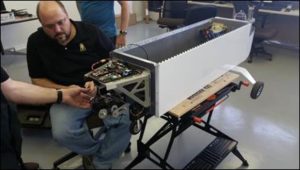 Pegasus has 80+ flights at the Texas A&M University RELLIS campus, out of its design life of 300 takeoff and landing cycles. The airframe has a wing span of 12 feet and is designed to 7g limit maneuvering load factor and has a maximum takeoff weight of 108 pounds. Pegasus can carry 30 pounds of payload in the nose and fuselage payload bay, which has a volume of 12U half-width rack chassis. Pegasus features variable static stability with a positionable wing location on the fuselage and multiple redundant control surfaces: 8 ailerons, 2 elevators, 2 rudders, and throttle. Pegasus has a stall speed at maximum takeoff weight of 26 knots and a maximum speed of 90 knots. The endurance is 1+ hour depending upon fuel system configuration.