
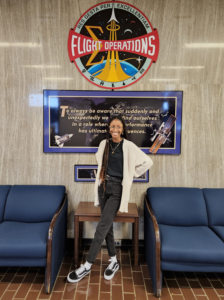
VSCL Alumnus Mia Brown ’20 has accepted a new position as a Flight Controller at NASA Johnson Space Center. Mia will be working as a flight controller in mission control for the Robotics Team (ROBO). The job of a flight controller in mission control is to plan and help execute missions to/from the International Space Station (ISS). As part of team ROBO, Mia will work with the Canadian Space Agency (CSA) to operate the robotic arm and primarily focus on fixing things on the outside of the ISS, capturing/releasing vehicles that come aboard the space station, and also assist with crew extravehicular activity (EVA) missions.
Mia is a graduate of the Department of Computer Science and Engineering with a major in Computer Engineering. She started working with VSCL in the Spring of 2017, with her major roles including working in the Texas A&M University Engineering Flight Simulator and helping to develop a means for evaluating human factors aspects for Head Mounted Displays (HMD) for Enhanced Vision System technologies. Previously, Mia worked for Dell Technologies as a Security Analyst where she helped to manage the security of Dell’s information.
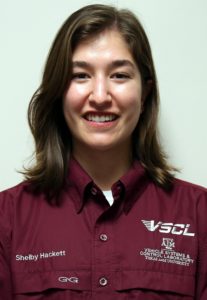

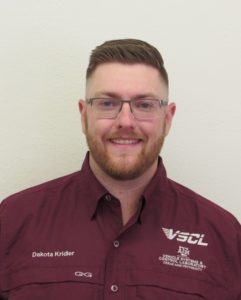
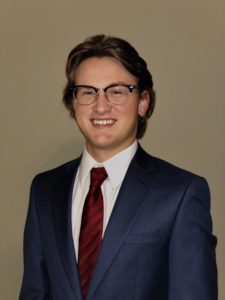

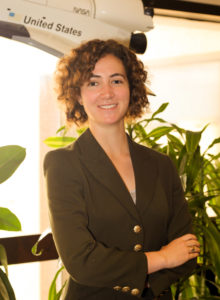
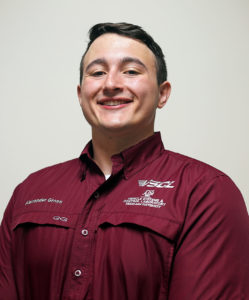 VSCL Undergraduate Research Assistant Alex Gross has been selected for a Summer 2022 internship at
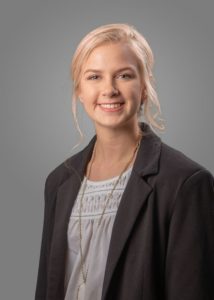
  VSCL Graduate Research Assistant and Ph.D Student Hannah Lehman has been selected for a Summer 2022 research internship at
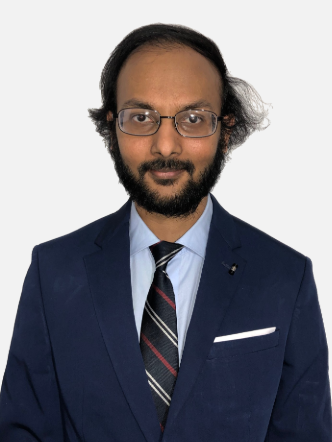
  VSCL Graduate Research Assistant and M.S. Student Cassie-Kay McQuinn has been selected for a Summer 2022 research internship at
  VSCL Graduate Research Assistant Md Nazmus Sunbeam has been selected for a Summer 2022 internship with the Army Research Laboratory in Aberdeen, MD. Sunbeam will be working as a Summer Student Researcher with the Human Research and Engineering Directorate developing algorithms and extensions for Cycle-of-Learning. Cycle-of-Learning is a framework for quick training of AI agents through human interaction. Sunbeam has been a member of VSCL: since August 2021. His research has focused on advancing the Cycle-of-Learning by investigating the use of similarity metrics.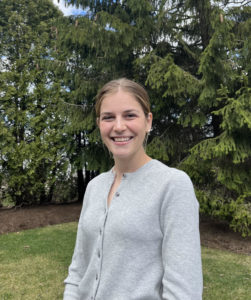
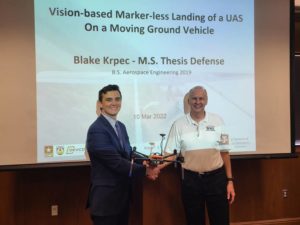 VSCL student Blake Krpec, who will graduate with his Master of Science degree in May 2022, has defended his thesis “Vision-Based Marker-Less Landing of a UAS On a Moving Ground Vehicle”. Blake’s defense had 34 people in attendance including many in attendance from the Army Research Lab. His committee is Drs. Reza Langari, Manoranjan Majji, Srikanth Saripalli, and Stephen Nogar (special committee member from Army Research Laboratory and the Technical Monitor). His research is supported as a Journeyman Fellow by the
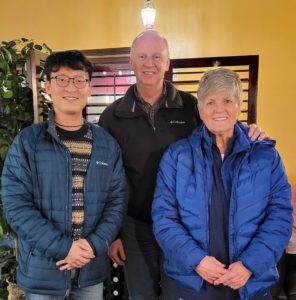 Dr. Sangwoo Moon, postdoctoral researcher in VSCL, has accepted a position as a Postdoctoral Fellow with NASA’s Jet Propulsion Laboratory. Dr. Moon will be working with the JPL Robotics Group, Robotic Aerial Mobility. His work at JPL will be mainly focused on communication-aware decision making and perception approaches for multi-robot systems. The work will include software development/integration for data fusion and multi-level planning/control, simulation verification/
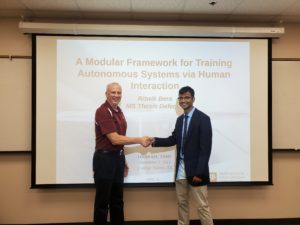 VSCL student
 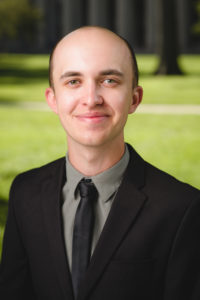 Maison Clouatre is an incoming Ph.D. student in the aerospace engineering department. He will graduate in May 2022 with a double major in electrical engineering and mathematics from Mercer University. As an undergraduate, Clouatre held visiting research positions in the Electronic Systems (ELSYS) Laboratory at the Georgia Tech Research Institute (GTRI), the Vehicle Systems & Control Laboratory (VSCL) at Texas A&M University, and the Laboratory for Information & Decision Systems (LIDS) at the Massachusetts Institute of Technology (MIT). His research interests lay at the intersection of control theory, optimization, and learning, and he focuses on applying his theory to the fields of quantum information science and aerospace engineering. Clouatre is both a Goldwater Scholar and Stamps Scholar. At VSCL, Clouatre will research quantum control and learning for quantum dynamics.